SAN FRANCISCO, June 27, (THEWILL) – Recent revelations regarding the funding of the campaigns for the election that brought Governor Ayodele Fayose of Ekiti State into office have brought to the fore the appropriateness or otherwise of organisations and companies sponsoring the electioneering activities of politicians and political parties.
The Economic and Financial Crimes Commission, EFCC, had declared that N4.7 billion allegedly used for Fayose’s campaigns in 2014 emanated from office of the embattled former National Security Adviser, Sambo Dasuki. The anti-graft agency also linked former Minister of State for Defence, Musliu Obanikoro to the disbursements.
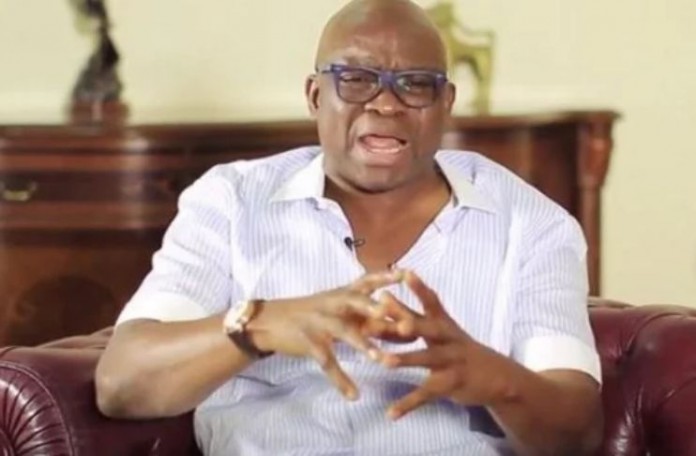
But the governor, in denying the allegation, disclosed that Zenith Bank funded his campaign. He challenged the EFCC to publish bank statements or evidence, either in cash, cheque or electronic transfer affirming its allegations against him. He said, in a press statement, that he had a pact with the bank to sponsor his campaign, in which he was asked to nominate a trusted ally for the funds’ disbursement.

According to the governor, it was under the circumstance that he nominated one Abiodun Agbele, through whose bank accounts in Zenith Bank, all the payments were made. He further claimed that fundraisers, donations and sale of campaign souvenirs, also boosted his campaigns.
However, the bank has denied sponsoring the campaign, with reports stating that it only donated N50 million to support it. Meanwhile, the governor’s three accounts with the bank, two personal and one company’s, have been frozen on the orders of the EFCC.
This development has opened a can of worms on the sources of parties and politicians’ campaign funds. It further fuels speculations that the entire transaction may have breached some fundamental banking rules, especially as Zenith Bank Plc failed to file reports of the unusual financial dealing to appropriate regulatory bodies like the Central Bank of Nigeria, CBN.
For instance, the monies were paid into the said Agbele’s accounts, which were hurriedly opened for the transaction. This begs the questions: why were the funds paid into these accounts, whereas Fayose has three accounts with the same bank? Why was the disbursement staggered through the bank’s branches at Ibadan, Akure and Lagos, in manners suggesting that there was something to hide? Why was the identity card used in opening the account in 2014, collected from Agbele less than two weeks ago?
The governor, who claims he is being unduly hunted because of his unrelenting criticism of the Federal Government, has maintained that the, “EFCC is only acting a movie scripted, produced and directed by the All Progressives Congress-led government of President Mohammadu Buhari.”
As investigations continue, insinuations are rife that there is more to the transactions than the banking public, whose monies the bank is keeping in trust, has been told.
THEWILL therefore demands that the bank clear the air in the raging controversy surrounding the funding of Fayose’s election in 2014. Last week, it was reported that two top Zenith Bank officials visited Fayose in his office, who he said came to “apologise” to him, blaming the anti-graft agency of arm-twisting the bank to indict him. The bank is yet to officially react to the governor’s recent claim.
Governor Fayose has however not helped his case with the lies and propaganda his aides and social media handlers have been peddling since the senior officials of the bank visited him.
Some have argued that the bank may truly not have funded the campaign, but merely acted as conduit to distribute the funds from office of the then NSA.
Notwithstanding the dramatic twists, the law criminalises donation or sponsorship of campaigns of politicians or political parties. According to Section 221 of the 1999 Constitution of the Federal Republic of Nigeria (as amended), “No association, other than a political party, shall canvass for votes for any candidate at any election or contribute to the funds of any political party or to the election expenses of any candidate at an election.”
Also, the Companies and Allied Matters Act, Cap. C20 L.F.N. 2004 (CAMA) prohibits any direct or indirect donations, in cash or kind, to political association, individual or party, for any political intention.
THEWILL condemns the alleged role played by Zenith Bank, especially as it failed to alert the relevant authorities if the monies were only routed through it. If indeed, the bank agreed it donated N50 million to the campaign funds, under what arrangement was that done, especially as it contravened both the Constitutional provisions and CAMA.
In reality, the probe of campaign funds as they relate to elections must be seen to be genuine concerns to sanitize the financial system in the spirit of the ongoing anti-corruption fight.
THEWILL is however opposed to selective probe of the funding of PDP campaigns at the elections. In the ensuing concerns that have arisen over the investigation of campaign funds, Nigerians and indeed the world deserves to know how the campaigns of President Muhammadu Buhari were funded.
This becomes necessary against the backdrop of allegations from Fayose and others, linking the president’s campaign funding to some companies and corporate organisations. THEWILL recalls that prior to the election, Buhari declared that his bank manager in Kaduna facilitated the N27 million used in procuring the form to vie for the APC ticket.
We therefore demand that the probe of campaign funds be made to cut across party lines. APC will be well advised to use this period to let Nigerians know those who funded its campaigns.
This is the least the ruling party can do to exonerate itself from the widely reported allegations that some corrupt APC bigwigs, some of whom are now holding juicy positions in the Federal Government, prosecuted the party’s presidential campaign with public funds.
This government must also take seriously calls to reform campaign finance so that corrupt monies do not end in the political system.