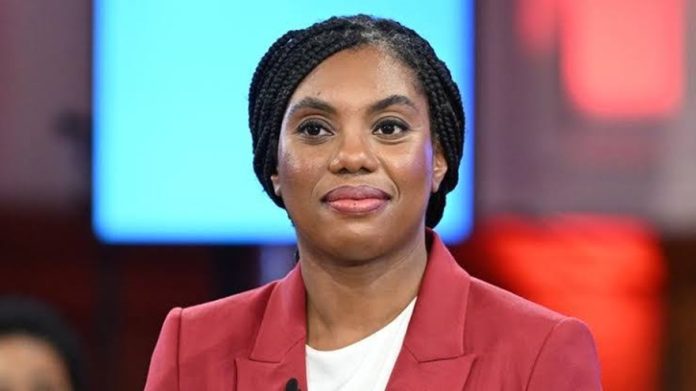
August 25, (THEWILL) — It is a shocking read in the UK Sunday Times that the Leader of the Conservative Party in the United Kingdom (UK), Kemi Badenoch, is griping about personal attacks she endures from British racists for becoming the first black woman to lead the party, describing the scale of the abuse as “hysterical”.
For a politician who climbed the ladder of British politics to the top as the leader of one of the two leading parties in the country, her disclosure comes as a surprise. The surprise stems from the fact that she appears to misunderstand the trends in the society she aspires to lead.
Coming on the heels of her previous praises of Britain as the best thing that has happened to her and the best place in the world for black people, her disclosure exposes a trait that is complicated and raises questions about her capacity.
According to her in the newspaper interview, the attacks she receives from “fellow MPs is minimal, compared to abuse hurled at her by racists on social media who target her because of her race and ethnicity.”
“There’s a certain cadre of people who clearly can’t cope with the fact that I won this and I’m doing it. The level of personal attacks from anonymous people, it’s hysterical. Not even just from MPs. I actually don’t think it’s that many MPs. I think it’s two to three people out of 120. That’s nothing. But online as well. People used to talk about Trump derangement syndrome. I think there’s a Kemi derangement syndrome: ‘How could she possibly have done this?’ ” She lamented.
Badenoch said the racists on social media believed she couldn’t have achieved the current status all by herself. “There’s a lot of ethno-nationalism creeping up, lots of stuff about my race and my ethnicity and the tropes around, ‘well, she couldn’t possibly have done this all by herself’. I always try to think of every possible explanation before I go to race and racism. I think that is a healthy way to run a society. I remember when I stood up a few years ago and said Britain is not a racist country – ethnic minorities do very well here, it is white working-class boys who are actually struggling on a lot of metrics and I got pilloried for that.
“My view is that there are people out there who will say whatever it is, they will throw whatever kind of mud at you and they will hope that it sticks,” She told the Sunday Times.
All these would sound like music in the ears of many Nigerians who rejoiced over the ascension of “their own,” to the leadership of the party but soon felt let down by her persistent attacks on the West African country, on which she seized every opportunity to make uncomplimentary statements.
Ordinarily, many would have thought that having being born in Wimbledon in the UK but grew up in Nigeria before moving back to her current country at the age of 16 should have broadened her horizon about life in two cities and give her a perspective on multiculturalism that would certainly be one of the support pillars for globalisation. We recall one of her parliamentary encounters with Prime Minister Keir Stammer when the latter blasted her “as a self-appointed saviour of Western Civilisation,” shortly after she had granted a television interview claiming that the slave trade and colonisation that stunted growth in Africa is unconnected to the wealth of the Britain, one of the chief sponsors and beneficiaries of that sad chapter in human history.
We sympathise with her and urge her to learn quickly from her mistakes before further embarrassing situations like the ones she has spoken about surface and dog her carrier. She must understand that not many women of her background and age can make the steady climb to the heights she currently occupies in British politics and the potential it holds for her to make the desired impact in the modern world in which inclusion, solidarity and mutual support are in great need. She needs to step back, do some introspection and rebrand; it is never too late in politics, as we expect her to know.