
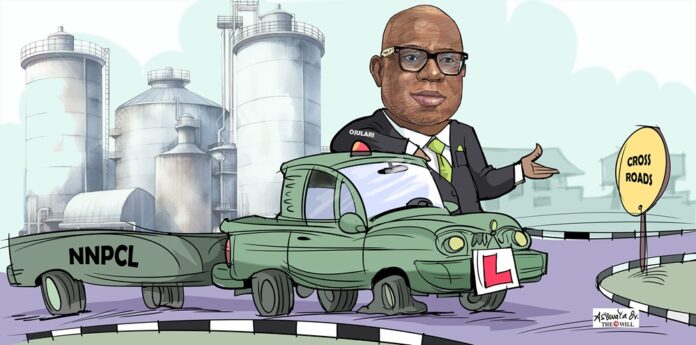
August 03, (THEWILL) — The recent statement by the Group Chief Executive Officer (GCEO) of the Nigerian National Petroleum Company Limited (NNPCL), Engr. Bashir Bayo Ojulari, that the state-owned refineries would not be sold, was most disappointing. This is because the NNPCL GCEO had earlier indicated that the facilities would be sold to terminate the unending repairs constituting a drain to the economy.
Parting with the refineries
In an interview with Bloomberg at the 9th OPEC International Seminar in Vienna, Austria, on July 11, 2025, Ojulari said that a strategic review of the NNPCL’s refinery operations was underway and expected to be concluded before the end of the year which could precede the sale or concessioning of the refineries.
“So, we’re reviewing all our refinery strategies now. We hope that before the end of the year we’ll be able to conclude the review. That review may lead to us doing things slightly differently,” he said.

When asked if that could include putting the refineries up for sale, Ojulari said, “But what we’re saying is that sale is not out of the question.
“All the options are on the table, to be frank, but that decision will be based on the outcome of the reviews we’re doing now.”
Policy somersault
However, at a company-wide town hall meeting held in Abuja, later in July, the NNPCL GCEO announced that the refineries would no longer be sold, reaffirming the company’s commitment to completing high-graded rehabilitation and retention of the plant.
Mr Ojulari explained that his new position was not a shift, but informed by ongoing detailed technical and financial reviews of the Port Harcourt, Kaduna and Warri refineries, noting that the ongoing review indicates that the earlier decision to operate the Port Harcourt refinery, prior to the full completion of its rehabilitation, was ill-informed and sub-commercial.
While progress is being made on all three facilities, he said the emerging outlook calls for more advanced technical partnerships to complete and high-grade the rehabilitation of the Port Harcourt refinery, thus selling them is highly unlikely as it would lead to further value erosion.
This revised edition of Ojulari’s position on the moribund refineries is being conceived as constituting a grave economic challenge, considering the enormous resources already committed in fixing the refineries.
The drain pipe
Among those who are skeptical about the possible revival of the refineries is Aliko Dangote, president of the Dangote Group, who expressed serious doubt about the Port Harcourt, Warri, and Kaduna refineries — owned by the NNPCL — working again.
Dangote, who spoke on Thursday July 17, 2025, while hosting members of Global CEO Africa from the Lagos Business School, after a tour of the Dangote Petroleum Refinery in Lekki, Lagos, was frontally skeptical about the moribund refineries ever reverting to active functionality.
The billionaire said more than 50 percent of the production of his refinery — a facility built after the Umaru Musa Yar’Adua Administration had blocked his bid to buy ailing NNPCL refineries — is now petrol, the commodity that had consumed the bulk of the nation’s foreign exchange earnings through importation.
“The refineries that we bought before, which were owned by Nigeria, were doing about 22 percent of PMS. We bought the refineries in January 2007. Then we had to return them to the government because there was a change of government.
“The managing director at that time convinced Yar’Adua that the refineries would work.
“They said they just gave them to us as a parting gift or something. As of today, they have spent about $18 billion on those refineries and they are still not working. I don’t think so and I doubt very much if they will work,” he said.
Dangote emphasised that the turnaround maintenance of the refineries is “like you trying to modernise a car that was built 40 years ago, when technology and everything have changed.
“Even if you change the engine, the body will not be able to take the shock of that new technology engine,” he said.
Dangote’s claim resonated about two years after Reuters had published a similar report on May 31, 2023, to the effect that Nigeria spent more than 11.35 trillion naira ($25 billion) on fixing the country’s three moribund refineries in the previous 10 years. It quoted the outgoing parliament in a report, calling for a forensic audit of the matter.
Reuters noted that despite the huge sums of money spent to rehabilitate the refineries, they were producing at less than 30 percent capacity, quoting the parliament – a situation that had kept the country reliant on fuel imports, which it subsidies to keep prices low.
Empty promises
The government had made empty promises through the NNPC that the refineries would resume production in no distant time. Into the era of empty promises to fix the refineries, the Senate on October 24, 2023, constituted an ad-hoc committee to investigate all contracts estimated at over N11.35 trillion awarded for the rehabilitation of the four moribund refineries in the country.
This followed a motion brought by Senator Sunday Karimu on the unending repairs of the nation’s refineries despite the huge resources invested in fixing them.
In graphic details, the lawmaker said, “Despite the moribund state of the four refineries, the operating costs of these refineries between 2010 and 2020 is estimated at N4.8 trillion naira. The refineries are estimated to make a cumulative loss of N1.64 trillion, within four years.”
He added, “We are concerned that the Federal Government of Nigeria has carried out rehabilitation projects in Port Harcourt Refinery Company (PHRC) over a period of seven years from 2013-2019 at an estimated cost of N12,161,237,811.61.
“In addition, on 18th March, 2021, a rehabilitation contract was executed between NNPC/PHRC and Tenenimont SPA at a Lump Sum of $1,397,000,000.00, about N75 billion naira amidst global public criticism, no result has been achieved.
“Phase 1 of the Project is expected to be completed in 28 Months after the contract, Phase 2 within 24 months and Phase 3 within 44 months of execution. Despite this, the Port Harcourt Refinery remains a money pit.
“Going by projections and representations from NNPCL the renovation works ought to be completed and operations of the Refinery commenced by June 2023.”
Senator Karimu expressed further concern that in a bid to revitalise the Warri Refinery, the Federal Government injected huge public funds into revamping the facility to the tune of over N28, 219, 110, 067.10 between 2014 and 2019.
The Senate, consequently, constituted a 7-member ad-hoc committee to investigate the matter and to submit their findings to the upper legislative chamber within four weeks – November 21, 2023. No report was submitted.
Dubious U-turn
However, in a dramatic turn of events, the NNPCL on August 30, 2024 announced that it was seeking private Operations and Maintenance (O&M) companies to bid for the Warri and Kaduna refineries (while repairs of the Port Harcourt refinery were in progress).
“NNPC Ltd is seeking to engage reputable and credible Operations & Maintenance (O&M) companies to operate and maintain two of its refineries, Warri Refining and Petrochemical Company (WRPC) and Kaduna Refining and Petrochemical Company (KRPC), to ensure reliability and sustainability to meet the nation’s fuel supply and energy security obligations,” the company said in a circular.
As expected, this was not achieved. Instead, the plants suddenly began production, according to NNPCL, following the commencement of petroleum products by the Dangote Refinery on September 3, 2024.
NNPC had been working to revamp the refineries, which were shut down entirely in 2021 and produced little or no fuel over the past decade.
In a dramatic coincidence, Nigeria’s four moribund refineries, which had laid comatose for well over two decades, returned to life. This happened at a time Dangote Petroleum Refinery has begun production and inching close to full capacity operations.
Dangote Petroleum Refinery, the largest single train refining plant in the world, took the globe by surprise when it commenced actual production of petrol on September, 3, 2024 — shocking sceptics and snubbing mortified government officials who saw the new facility as a threat.
Although Dangote achieved the feat through thick and thin underlying several unsuccessful attempts to start production, September 3, 2024 remained indelible in the annals of Nigeria’s economic history: the much-desired petrol rolled out from a Nigerian refinery, other than the NNPC plants, after 28 years.
Following the Dangote ‘magic’, the four state-owned refineries (Warri, Kaduna and two in Port Harcourt), which are run by the NNPCL, “commenced production”. The second Port Harcourt Refinery was said to be at the verge of commencing production “without prior announcement”.
The Port Harcourt Refinery which was announced to have commenced production on November 26, 2024, was shut down in May for a three-month maintenance, corroborating the fears of Alhaji Dangote that the refining facilities may have gone into perpetual closure.
With this strategic waste of taxpayers’ money on non-functional refineries where workers earn huge pay for producing nothing, there should be no hesitation in concessioning or selling the refineries.

Sam Diala is a Bloomberg Certified Financial Journalist with over a decade of experience in reporting Business and Economy. He is Business Editor at THEWILL Newspaper, and believes that work, not wishes, creates wealth.
