
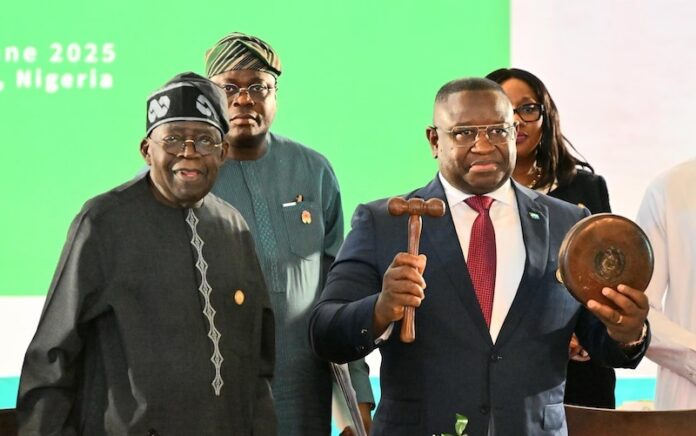
June 22, (THEWILL) – President Bola Ahmed Tinubu has officially handed over the leadership of the Economic Community of West African States (ECOWAS) to Sierra Leone’s President, Julius Maada Bio.
The transition took place during the 67th Ordinary Session of the ECOWAS Authority of Heads of State and Government, held at the Conference Centre, State House, Abuja.
In a symbolic gesture, Tinubu presented the ECOWAS chairmanship emblem to Bio, expressing optimism about the bloc’s future. He noted that the regional community had made progress under his leadership despite facing serious challenges.

“As I now hand over the mantle of leadership to my great friend and dear brother, His Excellency, President Julius Maada Bio of Sierra Leone, I do so with a deep sense of fulfillment and optimism for the future of West Africa,” Tinubu said in his closing address.
Reflecting on his tenure, Tinubu emphasized the importance of collaboration among member states in addressing insecurity, political instability, and economic challenges.
He reiterated that ECOWAS must continue to prioritize peace, security, and prosperity for all its people.
“Our organization must continue to strike a fine balance between its core regional mandate of economic integration and the complex political, security, and governance challenges facing our region,” he said.
He added, “Economic integration cannot thrive in an unstable political environment.”
He urged leaders to promote inclusive growth, particularly for women, youth, and vulnerable groups, and to remain vigilant in responding to evolving challenges.
In his acceptance speech, President Maada Bio said he was “humbled and grateful” to assume the leadership of ECOWAS at a time of immense regional challenges.
“I accept this responsibility with full awareness of the magnitude of the task ahead and the complexity of the moment,” he said.
Bio paid tribute to Tinubu’s leadership, describing his two-year tenure as marked by “unwavering commitment to regional dialogue, economic recovery, and peacebuilding.”
He outlined a four-point agenda for his chairmanship focused on restoring constitutional order, revitalizing regional security cooperation, boosting economic integration, and building institutional credibility.
“The democratic space is under strain in parts of our region,” he warned. “Yet across West Africa, citizens—especially our youth—are demanding not just elections, but accountability, transparency, and a fair stake in national life.”
Bio also cited rising insecurity, illicit arms flows, political instability, transnational crime, and climate change as pressing issues confronting the region.
Despite these challenges, he said West Africa’s youthful population, abundant resources, and entrepreneurial energy offer hope for transformation.
To confront security threats, he called for a comprehensive overhaul of the regional security architecture, improved intelligence sharing, and a rapid unified response to emergencies.
“We must confront new threats with unity and resolve,” he stressed.
Bio further emphasized the need to make ECOWAS more transparent, accountable, and responsive to the needs of citizens, saying reform is essential to rebuilding public trust in regional cooperation.
“West Africa’s future is not one of decline, but of possibility—if we act with courage, urgency, unity, and moral clarity,” he declared.
His remarks were met with resounding applause from regional leaders, diplomats, and delegates, signalling a collective desire to reposition ECOWAS for greater effectiveness.
President Tinubu was first elected as ECOWAS Chairperson on July 9, 2023, in Guinea-Bissau and re-elected on July 7, 2024, in Abuja.
His re-election was based on a consensus among West African leaders who sought continuity to address mounting regional crises, including military coups and violent extremism.
Tinubu’s leadership was characterized by strong rhetoric against unconstitutional changes of government and efforts to restore democratic governance in member states.
His tenure also witnessed growing calls for institutional reform and deeper economic integration.
As ECOWAS turns a new chapter under Bio’s leadership, the focus now shifts to implementation, regional unity, and restoring confidence in the bloc’s capacity to tackle challenges and deliver results for West Africans.
Felix Ifijeh is a journalist with years of professional reporting experience. Known for his keen news sense, compelling storytelling and commitment to accurate, impactful reporting, he has built a reputation for turning leads into clear, engaging, and well-structured reports that resonate with readers. His work reflects deep newsroom experience and a commitment to accurate, impactful journalism.
