
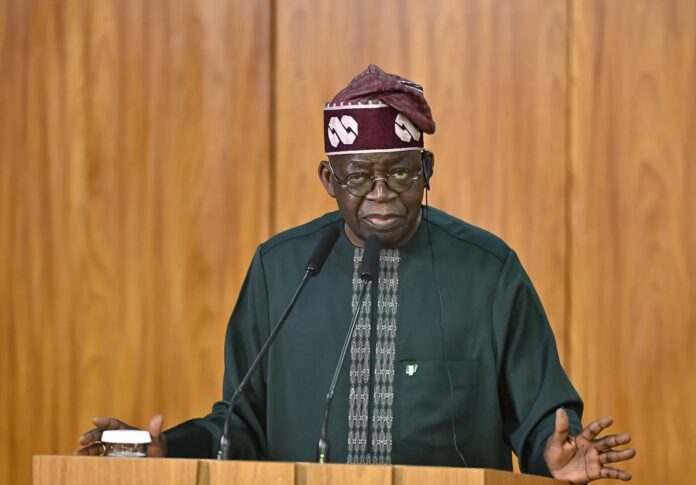
June 12 (THEWILL) — President Bola Tinubu on Friday paid glowing tribute to the heroes and heroines of Nigeria’s pro-democracy struggle, honouring scores of activists, journalists, politicians, and military officers who played pivotal roles in the historic June 12 struggle, while announcing national honours for dozens of Nigerians who suffered persecution in the fight to restore democratic governance.
Speaking during his nationwide broadcast to commemorate Nigeria’s 2026 Democracy Day celebration marking 27 uninterrupted years of democratic rule, Tinubu said the sacrifices of those who confronted military dictatorship and fought for democratic freedom laid the foundation for the liberties Nigerians enjoy today.
The President said June 12 remains one of the most sacred chapters in Nigeria’s political history, describing it as more than a date on the national calendar but a defining moment that demonstrated the possibility of national unity beyond ethnic and religious divisions.

According to Tinubu, the greatest tribute the current generation can offer the heroes of June 12 is to build a Nigeria where freedom remains protected, justice prevails, opportunity is expanded and government remains accountable to the people.
“Today, we honour the resilience of Nigerians who refused to surrender their faith in freedom and the courage of those who stood firm against intimidation. We pay tribute to patriots who endured persecution, imprisonment, exile, and even death so that future generations could enjoy democracy,” the President declared.
The President paid special tribute to the late Moshood Kashimawo Olawale Abiola, widely regarded as the symbol of the June 12 struggle after emerging victorious in the annulled June 12, 1993, presidential election, which remains one of the freest elections in Nigeria’s history.
Tinubu also honoured the late Kudirat Abiola, whose assassination during the military era turned her into one of the enduring symbols of resistance against authoritarian rule.
Among other democracy heroes recognised by the President were renowned human rights lawyer Gani Fawehinmi, former Attorney General of the Federation Bola Ige, businessman Chief Alfred Rewane, pro-democracy leader Pa Abraham Adesanya, nationalist Chief Anthony Enahoro, labour activist Frank Kokori, physician and rights campaigner Beko Ransome-Kuti, and political figure Shehu Musa Yar’Adua.
Others acknowledged included Arthur Nwankwo, Chima Ubani, Balarabe Musa, Commodore Dan Suleiman, and several unnamed activists whose sacrifices contributed to ending military rule in Nigeria.
As part of Democracy Day celebrations, Tinubu announced that the Federal Government would confer national honours on dozens of Nigerians who suffered detention, persecution, exile, and intimidation under successive military governments during Nigeria’s democratic struggle.
Prominent among those listed for national recognition are veteran columnist and newspaper publisher Sam Omatseye, activist Dr Joe Okei-Odumakin, veteran broadcaster and media executive Babajide Kolade-Otitoju, respected journalist Tunde Fagbenle, columnist Bola Bolawole, media executive Gbemiga Ogunleye, veteran editor Muyiwa Adekeye, journalist Louis Odion, activist Debo Adeniran, lawyer Ayoka Lawani, and public affairs analyst Richard Akinnola.
Also listed for recognition were former political activists Chief Ayo Opadokun, Chief Ralph Obiora, Femi Aborisade, Jenkins Alumona, Ose Osayande, Prof Sylvester Odion-Akhaine, Dr Osagie Obayuwana, Joe Igbokwe, Sir Ademola Osinubi, Lade Bonuola, Femi Kusa, and several others.
The President noted that the official honours list would be released formally by the Federal Government in the coming days.
Tinubu also announced recognition for military officers who opposed military dictatorship and aligned themselves with democratic forces during the June 12 crisis.
Those recognised include Major General MA Garba, Brigadier General Lawal Jaafaru Isa, Colonel Umar Farouk Ahmed, Colonel Sambo Dasuki, Colonel Lawan Gwadabe, Brigadier Jonathan Ndam Temlong, Colonel Musa Shehu, Major General Chris Eze, Major General Harris Dzarma, Colonel Isa Jibrin, Major General Joseph Oshanupin, and Lieutenant Colonel Happy Kefas Bulus.
The President also recognised Brigadier Yahaya Abubakar, the current Etsu Nupe and holder of the national honour of CFR.
As part of efforts to immortalise contributors to Nigeria’s democratic evolution, Tinubu announced that the Federal Government had approved the renaming of the completed Institute of Petroleum Studies in Kaduna after the late General Shehu Musa Yar’Adua.
According to the President, the institution will now be known as the General Shehu Musa Yar’Adua University of Geological Sciences and Engineering Technology.
Tinubu described the late Yar’Adua as one of the architects of modern democratic Nigeria whose vision helped shape national political partnerships that ultimately strengthened democratic governance.
The President reminded Nigerians that despite doubts in some quarters nearly three decades ago, democracy has survived and remained resilient because Nigerians continued believing in the nation’s diversity as a source of strength rather than division.
He said while Nigeria’s founding fathers secured independence and the June 12 generation fought for democracy, the responsibility of the present generation is to secure economic prosperity for future Nigerians.
“June 12 reminds us that Nigerians do not break. We bend, we bleed, but we do not break. Let us renew our covenant that the labours of our heroes past shall never be in vain and that government of the people, by the people, and for the people shall not perish from this land,” Tinubu said.
Tinubu urged Nigerians to reject division, cynicism, and despair while embracing national unity, hope, and collective responsibility in building a prosperous future.
“May God bless the heroes of our democracy. May God bless the Federal Republic of Nigeria.”
The June 12 Democracy Day celebration commemorates the annulled 1993 presidential election, won by the late MKO Abiola, widely regarded as Nigeria’s most credible election and a defining symbol of the country’s struggle against military dictatorship.
Felix Ifijeh is a journalist with years of professional reporting experience. Known for his keen news sense, compelling storytelling and commitment to accurate, impactful reporting, he has built a reputation for turning leads into clear, engaging, and well-structured reports that resonate with readers. His work reflects deep newsroom experience and a commitment to accurate, impactful journalism.
