
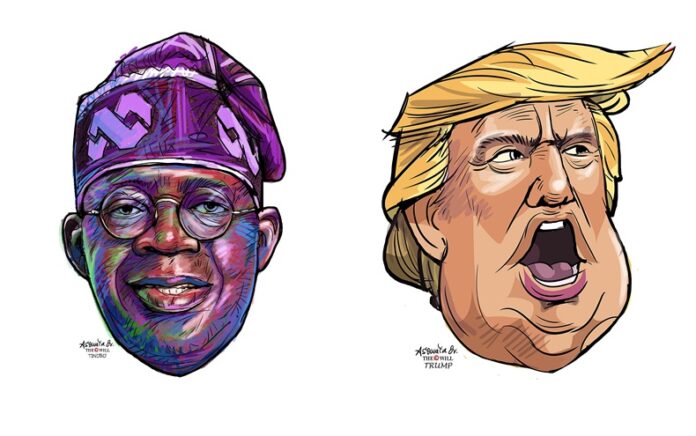
November 09, (THEWILL) — Tempers appear to have cooled on the American and Nigerian fronts after a heated debate over the initial challenge posed by President Donald Trump’s designation of Nigeria as a “Country of Particular Concern,” with a threat to attack terrorists’ enclaves in Nigeria to stop an alleged Christian genocide.
In the United States of America, a different reality has set in soon after the ‘Department of War’ set about operationalising Trump’s weekend post on social media directing it to prepare for possible action and the Defence Secretary, Pete Hegseth, had responded immediately by directing AFRICOM to submit operational options. AFRICOM is a United States Africa Command, responsible for US military operations and security cooperation in Africa. It is headquartered in Stuttgart, Germany and its mission is to promote regional stability, counter terrorism and build partnerships with African nations to address security challenges and protect US interests.
At the weekend, the United States military has reportedly drawn up contingency plans to actualise President Donald Trump’s order to “prepare for military intervention” to protect Christians from attacks by Islamic militants.
The influential New York Times reported that defence and security officials have ruled out the possibility of direct attack because it may worsen the prolonged terrorism in Nigeria and further complicate the prolonged terrorism that has polarised the country and continue to lead to the death of innocent citizens in their thousands.
According to the newspaper, Senior military officials say the US operation against terrorists in Nigeria would be a replay of an Iraq- or Afghanistan-style campaign, which President Trump has since washed his hands off.
“The American military cannot do much to quell the violence unless it is willing to start an Iraq- or Afghanistan-style campaign,” one defence official said. “No one is seriously considering that.”
According to officials, “the US Africa Command (AFRICOM), based in Stuttgart, Germany, has prepared three military options—light, medium, and heavy to forward to the Pentagon’s Joint Staff.
“Under the light option, Washington would support Nigerian security forces with intelligence, logistics and limited joint raids against Boko Haram and the Islamic State West Africa Province (ISWAP). The medium option involves drone strikes on militant camps, bases and vehicles in northern Nigeria, while the heavy option would entail moving an aircraft carrier group into the Gulf of Guinea to conduct deep strikes—an unlikely prospect, officials said.

“Maj. Gen. Paul D. Eaton, a retired Army officer who oversaw US training in Iraq, warned that such intervention could backfire.
“It would be a fiasco,” he said. “Airstrikes might create shock and awe, but not much more. It’s like pounding a pillow.”
According to the newspaper, officials familiar with the matter said the plans would spiral with complications.
They said the violence in northern Nigeria is driven not only by religious extremism but also by long-running disputes between farmers and herders over land, corruption and ethnic tensions that militants have exploited.
“The reality is that this is not a simple fight between Christians and Muslims,” one U.S. national security official said. “It’s a complex mix of insurgency, poverty, and governance issues. Even the drone strike option faces logistical hurdles. The U.S. military vacated its drone bases in Agadez and Niamey, Niger, in August, both now occupied by Russian forces.
The nearest alternative launch points are in southern Europe or Djibouti, significantly reducing operational reach.
It quoted analysts as saying that deploying “an aircraft carrier to the Gulf of Guinea would also stretch US naval resources already committed to operations in the Pacific and Middle East.
“Despite the tough talk from Washington, military and national security officials remain skeptical about the likelihood, or effectiveness, of any large-scale U.S. intervention.”
From Nigeria, President Bola Tinubu had at the weekend risen to the occasion. After his initial “we are ready to defeat terrorism” response to Trump’s threat the previous day during a Federal Executive Council meeting, President Tinubu on Friday took to his X handle to reach the global audience and urged Nigeria’s international partners to deepen their cooperation with the country as it intensifies efforts to eliminate terrorism and criminal networks undermining national security.
According to President Tinubu, Nigeria remains resolute in restoring peace and protecting its citizens, adding that the fight against terrorism is central to his administration’s agenda.
“We will spare no effort in eradicating terrorism and reclaiming the safety and dignity of our people,” Tinubu wrote. He reaffirmed that the Federal Government is sustaining military operations, improving intelligence coordination and strengthening diplomatic engagements to consolidate recent gains.
“We face challenges head-on and remain steadfast in our commitment to engage partners and champion Nigeria’s interests on the diplomatic front. We are confidently asserting our presence on the global stage with calm, clarity and purpose,” he stated.
Tinubu noted that although Nigeria had battled terrorism for nearly two decades, she would not retreat.
“We will decisively defeat terrorism. Security is non-negotiable and we will never compromise on this principle. With unwavering courage and a commitment to the rule of law, we will prevail,” he added.
The President maintained that Nigeria would continue to function as a reliable partner in the international community, while advancing domestic reforms aimed at economic inclusion and stability.
“Nigeria is one united family. We rise together and reject despair. Our future is stronger than any fear. Nigeria will remain a dependable ally to its friends and a steady voice for stability,” he said.
He also paid tribute to members of the armed forces and intelligence services for their sacrifices in the fight against terrorism, saying their commitment strengthens the nation’s resolve.
In practice, however, the position of President Trump is literally unquestioned. He does not require the approval of the Congress to designate any country as a “Country of Particular Concern”, CPC,
According to the principle, the President wields that power to so designate any country through the Secretary of State, under the International Religious Freedom Act (IRFA). This designation triggers various sanctions and restrictions. Nonetheless, the Senate play a symbolic role in that presidential action. It does so through its Committee on Foreign Relations, which transfers the “Nigeria Religious Freedom Accountability Act of 2025” bill, which directs the Secretary of State to designate Nigeria as a CPC.
Felix Ifijeh is a journalist with years of professional reporting experience. Known for his keen news sense, compelling storytelling and commitment to accurate, impactful reporting, he has built a reputation for turning leads into clear, engaging, and well-structured reports that resonate with readers. His work reflects deep newsroom experience and a commitment to accurate, impactful journalism.
