
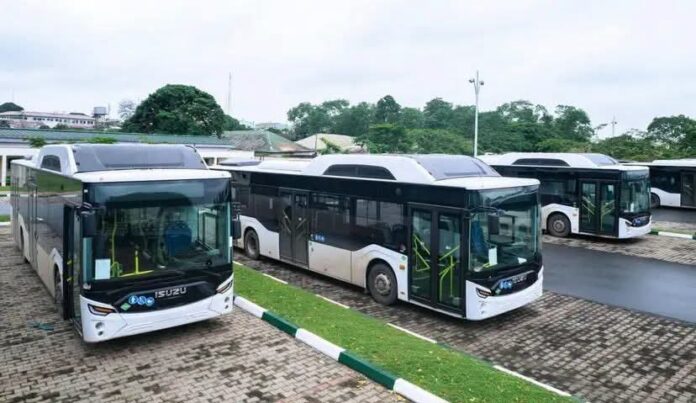
July 2 (THEWILL) — For thousands of Akwa Ibom residents burdened by rising transport costs, Governor Umo Eno’s investment in a 50-bus Compressed Natural Gas (CNG) mass transit scheme is emerging as one of the administration’s most impactful people-centred initiatives, offering renewed hope that the cost of daily commuting may soon become more affordable.
Since the removal of fuel subsidy, commercial transport fares have risen steadily, forcing civil servants, students, traders, artisans and low-income earners to devote a significant portion of their income to transportation. For many households, the daily journey to work, school or the market has become an increasing financial burden.
Against this backdrop, the unveiling of the first batch of 20 brand-new factory-built CNG buses has been welcomed by commuters, development stakeholders and community leaders, who see the initiative as a practical response to one of the state’s most pressing economic challenges.

The project, implemented under Governor Eno’s ARISE Agenda, extends beyond the procurement of buses. It includes the construction of a modern transport ecosystem comprising a central terminal in Uyo, bus terminals in all 31 local government areas, maintenance workshops, bus sheds, driver training schools, car wash facilities and CNG refuelling stations. The integrated network is expected to reposition Akwa Ibom as a leader in sustainable public transportation in Nigeria.
For many residents, the intervention could not have come at a better time.
“I spend almost half of what I earn every day on transportation”, lamented a civil servant in Uyo. “Sometimes I have to choose between feeding my family properly and paying transport fare.”
That frustration resonates with countless commuters across the state. Many have resorted to walking longer distances, postponing non-essential trips or enduring overcrowded commercial buses in an effort to reduce transport expenses.
It is this reality that the state government hopes to change through its CNG-powered mass transit system.
During a media inspection of the buses at Government House, Uyo, the Commissioner for Information, Dr Aniekan Umanah, accompanied by the Commissioner for Transportation, Dr Anthony Luke, and the Chief Press Secretary to the Governor, Ekerete Udoh, described the initiative as the beginning of a modern, affordable and environmentally friendly transport system.
Governor Umo Eno approved the acquisition of 50 Isuzu CNG buses, with the first 20 already delivered, while the remaining 30 are expected between July and August.
Unlike conventional petrol or diesel-powered vehicles, the buses run on compressed natural gas, which is considerably cheaper. Government officials believe the reduced operating costs will translate into lower transport fares, providing much-needed relief for residents grappling with the high cost of living.
The announcement has already generated optimism among commuters.
Many residents who spoke after the unveiling described the project as one of the administration’s most practical interventions, expressing confidence that affordable transportation would ease the financial pressure on families.
“If the government can truly regulate the fares, this will be one of the best things that has happened to ordinary people”, said a trader at Akpan Andem Market. “Transport has become too expensive. Anything that reduces the cost is a welcome development.”
A university student shared a similar view: “Our biggest challenge isn’t finding buses; it’s paying the fare. Sometimes, transport costs are almost as much as feeding for the day. If these buses bring down fares, students and parents will benefit greatly.”
While commuters welcomed the initiative, it has also generated anxiety among commercial transport operators, particularly those operating inter-local government routes.
Several drivers plying the Uyo-Oron, Uyo-Ikot Ekpene and Uyo-Eket routes expressed concern that government-backed buses offering lower fares could significantly reduce their passenger traffic.
“If passengers can travel for less on government buses, who will board our vehicles?” one driver asked. “We are not against development, but many of us bought our buses with loans. If we lose passengers, our businesses may crumble.”
Another operator appealed to the government to work with existing transport unions to ensure that the new system complements, rather than displaces, private operators.
Transport analysts, however, believe the concerns are understandable but argue that an efficient mass transit system could stimulate economic activities, improve mobility and create employment opportunities for drivers, mechanics, engineers, terminal operators and other support personnel.
Beyond lowering transport costs, the buses are expected to provide safer and more comfortable journeys through modern seating, improved safety features and scheduled operations that promise greater reliability.
When completed, the transport network will connect major commercial centres, including Uyo, Abak and Oron, while providing dedicated links to the Victor Attah International Airport.
Addressing speculation on social media, Commissioner for Information, Dr Aniekan Umanah, dismissed claims that the buses were refurbished vehicles.
“We have complete documentation of the manufacturing process, production line and factory inspections. The buses are brand-new, factory-built vehicles. We invited members of the media to inspect them firsthand so that the public can be properly informed”, he stated.
Commissioner for Transportation, Dr Anthony Luke, who witnessed the production process at the Isuzu manufacturing plant in Turkey, also affirmed the authenticity of the buses.
“I speak as an eyewitness because I was there. I witnessed the production process and the quality inspections. What Akwa Ibom people are seeing today is genuine. These are brand-new buses manufactured specifically for our state,” he said.
The Chief Executive Officer of Alpha Dias Project Limited, Alexandro Selefteriadis, explained that the buses were purpose-built to operate on compressed natural gas using Cummins gas engines and were not diesel-powered vehicles converted to CNG.
According to him, the investment places Akwa Ibom among the few sub-national governments in Africa deploying factory-built CNG buses for public transportation.
The initiative has continued to attract commendation from stakeholders.
Chairman of the Nigeria Union of Journalists (NUJ), Akwa Ibom State Council, Nsibiet John, applauded Governor Eno for opening the project to public scrutiny through the media, describing the exercise as a demonstration of transparency and accountability.
Several community leaders and civil society groups also praised the governor for investing in infrastructure that directly addresses the economic realities facing ordinary citizens, noting that affordable transportation is essential to inclusive development and economic growth.Following the inspection, journalists boarded the buses for a demonstration ride, assessing their comfort, safety features and overall performance.
Ultimately, the true success of the initiative will be measured not by the number of buses on the road, but by its ability to deliver consistently affordable, reliable and efficient transportation for residents.
For commuters, it represents hope for lower fares and easier mobility. For commercial operators, it presents a challenge to adapt to a changing transport landscape. For the Akwa Ibom State Government, it is a bold investment aimed at easing the cost of living while laying the foundation for a modern public transport system.
Stakeholders reason that if effectively managed and sustained, Governor Umo Eno’s CNG mass transit programme could become one of the defining achievements of his administration, transforming the way people move across Akwa Ibom while improving the quality of life for thousands of residents.

