
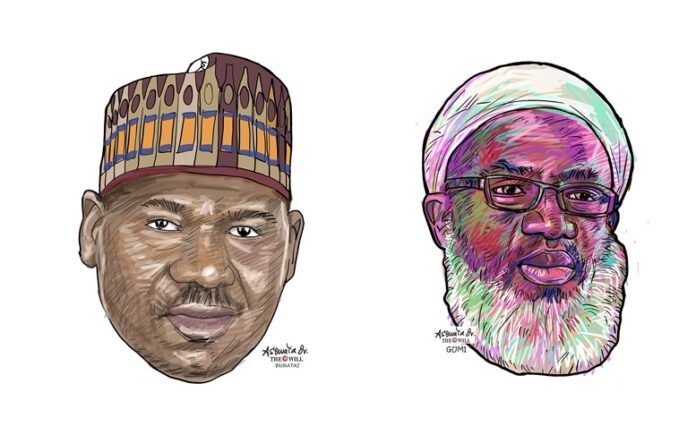
March 23, (THEWILL) — For the second time in 10 days, the issue of location, identity and financiers of terrorism in Nigeria has come up with pundits wondering whether the lack of political will is becoming a major hindrance in the fight against the worsening insecurity in the country. First, it was the controversial Kaduna-based Muslim cleric, Sheikh Abubakar Gumi, who made some allegations ten days ago and then on Friday, March 20, 2025, a former Chief of Army Staff, Lt-General Tukur Buratai (Retd.).
According to both of them, the sponsors and financiers of terrorists operating in the country are known to the public and still walking about.
According to Gen. Buratai, who appeared in Channels Television programme, Politics Today, at the weekend, the Nigeria Army operates professionally and should neither be held responsible for the non-release of names of individuals allegedly financing terrorism in the country nor for the policy initiative on repentant Boko Haram, which he said was a government policy the army only helped to implement.

“The decision to rehabilitate repentant members of Boko Haram was taken by the government, not the military. The initial concept that we had was that we gave them a timeline to surrender in 2016 and if they did, we gave them a free passage and handed them over to the appropriate agencies to rehabilitate them,” he said.
On the financiers of terrorism whom the retired general and former ambassador said are known and they are within the society, he added, “You cannot say I should be responsible for naming the financiers of terror. It’s not just about mentioning names; those agencies know why the names are not released. Action should be taken; these individuals are still within society today and they are known. I take responsibility for certain things that are strictly the Nigerian Army’s responsibility.”
Under the Operation Safe Corridor, multi-agency, a federal initiative started in 2015 by the Muhammadu Buhari administration and designed to offer a path back to civilised society and normal living for individuals who were coerced into joining terrorists and insurgents, ex-combatants were rehabilitated after undergoing deradicalisation, religious instruction and vocational skill acquisition to become productive citizens prepares ex-combatants for re-entry into society. Following training, participants are to be returned to their communities. A separate, state-led “Borno Model” has also been used for community-level reconciliation and reintegration.
The programme soon faced severe backlash from local communities, who often opposed accepting the so- called repentant terrorists back into communities that aggression had disorganised and residents driven away to Internally Displaced Persons camps. Currently there are 1.8 million displaced persons in Borno State, considered to be hosting 80 per cent of IDPs across the BAY states, namely Borno, Yobe and Adamawa, troubled states in the Northeast.
Earlier, Islamic scholar Gumi had alleged that the Nigerian Government was aware of the identities and locations of terrorists operating across the country. The cleric made the claim during a recent interview with DRTV, on Tuesday, March 10, 2025. He was reacting to accusations that he personally knows and regularly interacts with terrorists and bandits responsible for insecurity in parts of Nigeria and that he often speaks on their behalf.
In his response to the claims, Gumi who has previously taken part in controversial dialogue initiatives with armed groups in northern Nigeria in his belief that maintaining negotiation could help reduce violence and persuade fighters to lay down their arms, said his meetings with the armed groups were not conducted alone, insisting that security agencies were also involved in the process.
He said, “The government knows every terrorist by name and by location. I don’t go alone to negotiate — I go with the police and other security agencies,” he said. Gumi further said that some of the engagements have involved visits to traditional rulers as well as trips into forests believed to be hideouts for bandits.
“I would go to the Emirs. In fact, when we went to one forest, I even went with women into the bush,” he added. The disclosure by the cleric and the retired Chief of Army Staff, analysts believe, would persuade the Federal Government to act on its previous assurances that those found to be backing terrorists in any way would be exposed and prosecuted.
Rather than abate, given the renewed onslaught by the military against terrorists in Borno, insurgents and bandits in Kaduna, Zamfara and Kwara States, the March 16, 2026 multiple suicide bomb attacks that hit crowded locations in Maiduguri and Borno States, including a teaching hospital and markets, killing at least 23 people and injuring over 100, the recent deadliest attacks by a Boko Haram offshoot which massacred nearly 200 people in Woro, Kwara State on February 3, 2026 and the killing of at least 50 people in an overnight attack on Tungan Dutse Village in Zamfara State, with reports of widespread abductions of women and children by gunmen on motorcycles, have raised the question of hesitation or seeming foot dragging by the government.
Since 2021, when the immediate past administration announced that it had identified several individuals and entities allegedly funding terrorist groups, thereby raising public expectations that their names would be made public, no significant step has been taken in that direction.
The Nigerian Financial Intelligence Unit had also reportedly indicated that it tracked suspicious financial flows linked to terrorism, while security agencies intensified investigations into funding networks supporting insurgent activities.”
Despite these disclosures, the identities of the alleged financiers, terrorists and their locations have yet to be disclosed officially, drawing sustained disapproval from civil society groups and security analysts who continue to point out the harm that the lack of due process and absence of the political will was doing to the successful prosecution of the war against terror-related attacks in many parts of the country.
According to them, this official stand has contributed to the insecurity from the Northeast through the Northwest to the Northcentral with a high possibility of further spread to the remaining part of the country as the politicking for the upcoming 2027 general election gains momentum, leading to avoidable deaths, displacements of the citizens from homes, communities and farms and the spread of fear.
Felix Ifijeh is a journalist with years of professional reporting experience. Known for his keen news sense, compelling storytelling and commitment to accurate, impactful reporting, he has built a reputation for turning leads into clear, engaging, and well-structured reports that resonate with readers. His work reflects deep newsroom experience and a commitment to accurate, impactful journalism.
