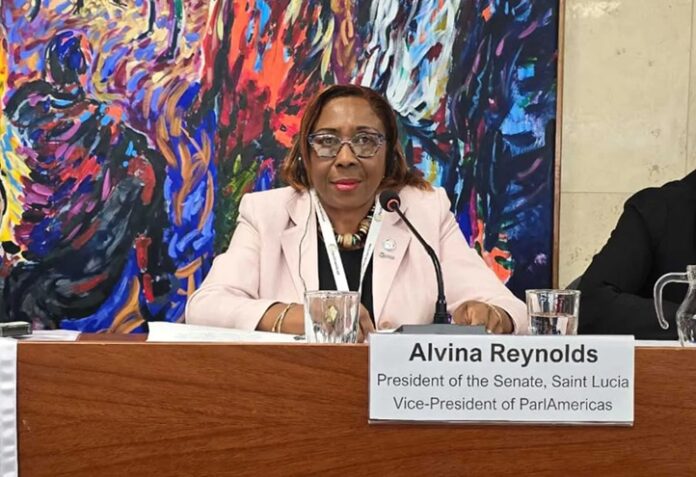
June 30, (THEWILL) — President of the Senate in Saint Lucia, Alvina Reynolds, has reaffirmed the deep ancestral and cultural ties between Nigeria and Saint Lucia, stating that most Saint Lucians have Nigerian roots.
Speaking on Monday during a joint session of Saint Lucia’s bicameral Parliament to formally welcome President Bola Tinubu on a state visit, Senator Reynolds cited a British census conducted on the island in 1815, which revealed that of the 16,282 enslaved individuals in Saint Lucia at the time, 34% were from Nigeria, 11% from the Nigeria-Cameroon region, and 22% from the Congo.
The rest were born in Saint Lucia, with ancestral origins traceable to Senegambia and Nigeria.

She described President Tinubu’s visit as a historic step in rekindling the connection between the Caribbean and Africa, especially West Africa.
“This visit rekindles a mission to reunite us with our ancestral homeland and for our people to work together. The ties are strong and undeniable,” Reynolds said.
The Senate President also paid tribute to the late Sir Darnley Alexander, a Saint Lucian who migrated to Nigeria in 1957 and later became Chief Justice of Nigeria from 1975 to 1979 — the only non-Nigerian to ever hold that office in post-independence Nigeria.
Reynolds noted the ongoing presence of Nigerian Catholic priests serving in Saint Lucia, including Father Festus, who was present during the session.
She further highlighted the symbolic timing of the President’s address, coinciding with World Parliament Day — a moment to reflect on the vital role of parliaments in governance.
Recognising President Tinubu’s legacy in defending democracy and advocating for good governance, Reynolds said: “Given your courageous past in the fight for democratic rule in Nigeria, it is an honour to have you with us today.”
In his remarks, Saint Lucian Prime Minister Philip J. Pierre described Tinubu’s visit as a moment of reflection, freedom, and celebration, underscoring the spiritual and cultural bond shared between Africa and the Caribbean.
Pierre stated: “We are African people who have made homes for ourselves on this side of the Atlantic, but our hearts, spirits, and aspirations remain connected to West Africa,” Pierre said.
“Saint Lucia is a small fragment of Africa, where the Nigerian connection—genetically and culturally—cannot be erased.”
In a symbolic gesture, Pierre recalled that Tinubu’s visit comes exactly 27 years after the late Nelson Mandela visited the island—mirroring the number of years Mandela spent in prison.
The Prime Minister acknowledged the contributions of Nigerian professionals to Saint Lucian society, particularly in healthcare, religion, cuisine, tourism, and education.
“Your Excellency, we warmly embrace the Nigerian presence in our society. Their influence enriches our culture and drives development,” he added.
Pierre highlighted literary and cultural connections between the two nations, referencing Nobel laureates Wole Soyinka and Derek Walcott, as well as the global popularity of Nigerian Afrobeats, Nollywood, and authors like Chimamanda Ngozi Adichie among Saint Lucian youth.
“Today, our young people reconnect with Africa through music and film. Nigerian creativity has become a bridge to our shared heritage,” he said.
He proposed greater cooperation in areas such as creative industries, sports, tourism, fintech, and healthcare.
He also called for the establishment of direct air links between West Africa and the Caribbean to boost trade and people-to-people exchanges.
Pierre confirmed that an Agreement on Technical Manpower Assistance would soon be signed between Nigeria and Saint Lucia, particularly in the health sector.
“I look forward to its implementation and to visiting Nigeria in the near future as we deepen ties ahead of the Africa-CARICOM Summit in Addis Ababa,” the Prime Minister said.
The joint session was attended by high-level dignitaries, including leaders from the Organisation of Eastern Caribbean States (OECS): Prime Ministers Roosevelt Skerrit (Dominica), Dickon Mitchell (Grenada), Terrance Drew (Saint Kitts and Nevis), and representatives from Antigua and Barbuda, Montserrat, and Saint Martin.
Felix Ifijeh is a journalist with years of professional reporting experience. Known for his keen news sense, compelling storytelling and commitment to accurate, impactful reporting, he has built a reputation for turning leads into clear, engaging, and well-structured reports that resonate with readers. His work reflects deep newsroom experience and a commitment to accurate, impactful journalism.