
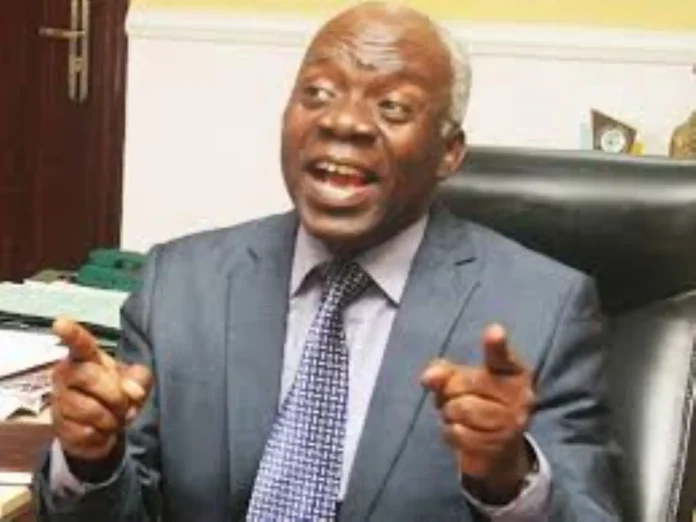
January 04, (THEWILL) – The Alliance on Surviving COVID-19 and Beyond, chaired by human rights lawyer Femi Falana, SAN, has disputed former President Olusegun Obasanjo’s explanation for the reversal of the sale of the Port Harcourt Refinery under his successor, the late President Umaru Musa Yar’Adua.
Former President Obasanjo, in an exclusive interview with Channels TV on Thursday, claimed that the Nigeria National Petroleum Company influenced Yar’Adua to reject a $750 million deal offered by a consortium led by Aliko Dangote for a public-private partnership (PPP) to manage the refinery.
Obasanjo had said, “Aliko got a team together and they paid $750m to take part in PPP in running the refineries. My successor refunded their money. I went to him, and he said NNPC wanted the refinery and could run it. I told him, ‘But you know they cannot run it.’”

However, Falana, in a statement on Friday, countered the claim, asserting that Yar’Adua’s decision to cancel the sale stemmed from concerns over its legality and alignment with national interest.
He described the transaction as a breach of the Privatisation Act, emphasizing that then Vice President Atiku Abubakar, the statutory chairman of the National Council on Privatisation was excluded from the process.
Falana stated, “Under the Privatisation and Commercialisation Act, the Vice President is the chairman of the NCP, which oversees the privatisation of public enterprises. In breach of the Act, President Obasanjo sidelined Vice President Atiku and directly managed the privatisation of several public assets.”
The senior lawyer detailed that on May 17, 2007, Obasanjo sold a 51% stake in the Port Harcourt Refinery for $561 million to Bluestar Oil, a consortium including Dangote Oil, Zenon Oil, and Transcorp.
Ten days later, on May 28, 2007, Obasanjo sold 51% of the Kaduna Refinery for $160 million to the same group.
Falana alleged that before these deals, Obasanjo had acquired substantial shares in Transcorp through a “blind trust,” raising questions about the moral and legal propriety of the sales, which occurred in the final days of his administration.
“The two major oil unions, NUPENG and PENGASSAN, opposed the deals, citing conflicts of interest and procedural breaches. They argued that the nation was shortchanged, as the $561 million paid for the Port Harcourt Refinery was a fraction of its estimated $5 billion value,” Falana added.
The unions’ opposition culminated in a four-day nationwide strike in June 2007, which nearly crippled the economy.
The strike ended after the federal government assured a thorough investigation into the transactions.
Following the investigation, Yar’Adua annulled the privatisation, a decision that went unchallenged in court.
“The cancellation was in line with the letter and spirit of the Privatisation Act,” Falana stated.
Falana further urged NUPENG and PENGASSAN to remain vigilant against any attempts to privatise Nigeria’s refineries in ways that undermine national interest. “Those advocating privatisation should establish their refineries, as the Dangote Group has done,” he said.
Felix Ifijeh is a journalist with years of professional reporting experience. Known for his keen news sense, compelling storytelling and commitment to accurate, impactful reporting, he has built a reputation for turning leads into clear, engaging, and well-structured reports that resonate with readers. His work reflects deep newsroom experience and a commitment to accurate, impactful journalism.
