
-
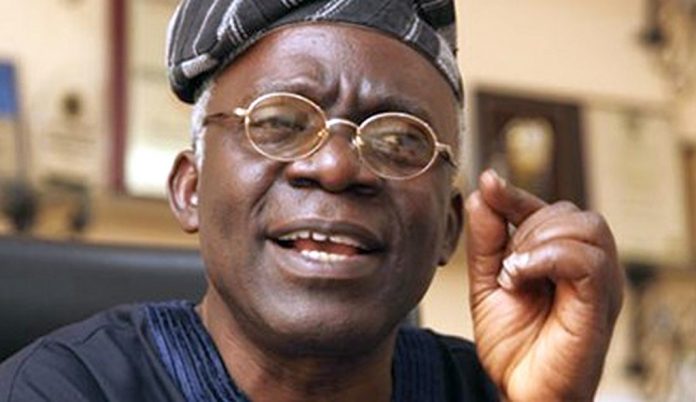
Falana urges the Federal Government to abandon reliance on diplomatic protests and impose economic sanctions on South African companies operating in Nigeria over recurring xenophobic attacks targeting Nigerians.
-
The senior advocate says Nigeria must invoke the principle of reciprocity, insisting Pretoria will only act decisively when attacks on Nigerians begin to carry tangible economic consequences.
-
He encourages Nigerians to patronise alternative service providers where available, arguing that consumer action against South African businesses would send a stronger message than diplomatic complaints alone
-
Falana also challenges the Federal Government to grant Nigerians direct access to the African Court on Human and Peoples’ Rights, saying victims of xenophobic violence deserve a continental legal pathway to seek justice.
Aug 03, (THEWILL) — Human rights lawyer and Senior Advocate of Nigeria (SAN), Femi Falana, has called on the Federal Government to abandon what he described as ineffective diplomatic protests and adopt tougher economic measures against South African businesses operating in Nigeria, insisting that only firm retaliatory actions would compel Pretoria to halt the recurring xenophobic attacks on Nigerians and the destruction of their businesses.
Falana said while diplomatic engagement remained an essential tool of international relations, repeated attacks on Nigerians in South Africa had shown that protests and official condemnations alone were no longer sufficient to protect Nigerian lives and investments.
The senior advocate made the remarks on Saturday while speaking with journalists in Ilawe-Ekiti, Ekiti State, after a reception organised in honour of the late Alawe of Ilawe-Ekiti, Oba Adebanji Alabi.

He argued that the Federal Government’s decision to escalate the matter to the African Union, though appropriate, was unlikely to produce meaningful results because resolutions adopted by the continental body are often not backed by effective enforcement mechanisms.
Calling for a shift in strategy, Falana urged the Federal Government to deploy economic leverage against South African interests in Nigeria, saying reciprocity is a fundamental principle of international diplomacy.
“The Federal Government will have to employ diplomatic action, but beyond that, it should also adopt economic measures against South African companies operating in Nigeria. International diplomacy is about reciprocity.
“ If they chase out Nigerians and destroy their businesses, Nigeria has a duty to act. South African companies here should be sanctioned where there are alternatives,” he said.
Falana also called on Nigerians to support alternative telecommunications providers instead of MTN wherever viable options exist, describing consumer patronage as a peaceful but effective means of applying economic pressure.
“Where there are alternatives, Nigerians should be encouraged to migrate from MTN because there are alternatives. That is one way South Africa will know that Nigeria is serious,” Falana said.
The senior lawyer further recalled Nigeria’s historic role in the global campaign against apartheid, noting that the country had not hesitated to deploy economic measures in defence of justice.
“In the 1970s, because of apartheid in South Africa, Nigeria nationalised British Petroleum. It should also be possible today to nationalise some South African investments in Nigeria if necessary,” he stated.
Push for Access to African Human Rights Court
Falana also criticised the Federal Government for failing to grant Nigerians direct access to the African Court on Human and Peoples’ Rights, located in Arusha, Tanzania.
He explained that although the court was established by the African Union to hear cases involving human rights violations across member states, Nigeria has yet to deposit the declaration required under the court’s protocol to enable individuals and non-governmental organisations to institute cases directly before it.
According to him, if Nigeria had taken that step, victims of xenophobic attacks in South Africa could already have sought judicial redress at the continental level.
“There is the African Court on Human and Peoples’ Rights in Arusha, Tanzania, established by the African Union to address human rights abuses in member states. Nigeria has refused to allow its nationals access to that court by failing to deposit the necessary instruments,” he said.
Falana challenged the Federal Government to immediately file the necessary declaration, arguing that Nigerians should enjoy the same opportunity to seek justice before the African Court as they currently do before the ECOWAS Court of Justice.
“I challenge the government of Nigeria to allow citizens access to the African Court without any further delay. Victims of gross human rights violations in African countries should have the opportunity to seek justice before the continental court, just as they can at the ECOWAS Court,” he said.
Nigeria and South Africa enjoy one of Africa’s largest bilateral economic relations, with South African companies maintaining significant investments in Nigeria’s telecommunications, banking, retail, entertainment and hospitality sectors. Conversely, thousands of Nigerians live, work and own businesses in South Africa, contributing to its economy.
Relations between both countries have, however, been periodically strained by recurring xenophobic attacks targeting Nigerians and other African migrants. Several episodes of violence over the past two decades have claimed lives, destroyed businesses and sparked diplomatic tensions between Abuja and Pretoria.

Felix Ifijeh is a journalist with years of professional reporting experience. Known for his keen news sense, compelling storytelling and commitment to accurate, impactful reporting, he has built a reputation for turning leads into clear, engaging, and well-structured reports that resonate with readers. His work reflects deep newsroom experience and a commitment to accurate, impactful journalism.
