
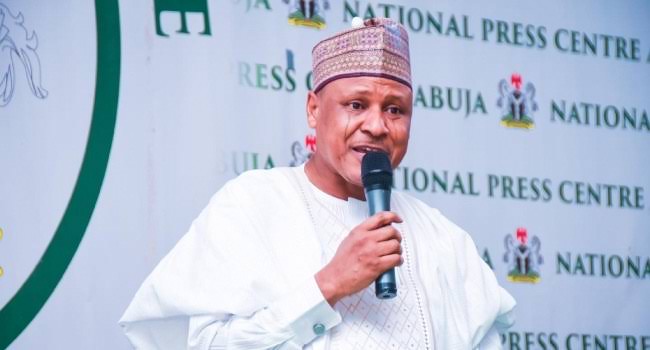
January 16, (THEWILL) – The Federal Government says the approval of the 16th Emir of Kano, Alhaji Muhammad Sanusi II, is needless for its laudable policies, urging the former Central Bank Governor to rise above personal interests and partisan undertones and prioritise the greater good of Nigerians.
Minister of Information and National Orientation, Mohammed Idris, made this known on Thursday, in response to Sanusi’s earlier remarks.
Speaking on Wednesday in Lagos as the chairman of the 21st Anniversary of Gani Fawehinmi’s Annual Lecture 2025, Sanusi had said he would not help the President Bola Tinubu-led federal government on how to tackle the economic challenges facing the country because “they don’t behave like friends”.

“I can give a few points here about what we are going through and how it was predictable and avoidable. But I am not going to do that. I have chosen not to speak on the economy, or reforms or to explain anything because if I explain it, it will help this government. But I don’t want to help this government. They are my friends, but if they don’t behave like friends, I won’t behave like a friend. They don’t even have people with pedigree that can come and explain to the people what they are doing. I am not going to help. I started by helping, but I am not going to help. Let them come and explain to Nigerians why they are pursuing the policies that they are pursuing”, he reportedly said.
While the Federal government expressed disappointment that reforms widely recognised as essential by global experts, including the Emir, are now being subtly condemned “because of a shift in loyalty”, in its response on Thursday, noting Sanusi’s background in economics, Idris said he has a unique responsibility to contribute constructively rather than undermine reforms aimed at collective progress because he feels estranged from his “friends” in government.
The statement reads, “The Federal Government notes the recent remarks by His Highness, Emir Muhammadu Sanusi II, regarding the economic reforms introduced under President Bola Ahmed Tinubu’s administration, at a public event in Lagos. We note the Emir’s acknowledgment of the noble initiatives which, he said, he could explain away but for his decision “not to help the government”.
“First, we acknowledge that Sanusi, and indeed any Nigerian, has the inalienable right to express an opinion either in the form of commendation or criticism on how the government is being run. However, we find it amusing that a leader, more so one from an institution that ennobles forthrightness, fairness, and justice would publicly admit to shuffling off saying the truth because of personal interest hinged on imaginary antagonism.
“It is pertinent to state that Nigeria is at a pivotal juncture where bold and decisive actions are necessary to tackle entrenched economic challenges. This administration has implemented transformative reforms not because they are easy, but because they are essential for securing Nigeria’s long-term stability and growth, as Emir Sanusi had consistently advocated.
“The temporary pains currently experienced from these inevitable decisions, as Sanusi himself acknowledged, are a “necessary consequence of decades of irresponsible economic management” more than anything else.
“These reforms are already delivering measurable progress. The unification of exchange rates has bolstered investor confidence, which has contributed to increased foreign reserves and strengthened Nigeria’s ability to shield itself from external economic shocks. The removal of the fuel subsidy has freed up significant resources, allowing for greater investment in critical sectors such as infrastructure, education, and healthcare. Projections from respected institutions, including the World Bank, show an upward trajectory in Nigeria’s GDP, signaling that our economy is firmly on the path to recovery. Additionally, by addressing inefficiencies, the country has reduced its debt service-to-revenue ratio, creating a more sustainable fiscal framework for future generations.
“It is deeply disappointing that reforms widely recognised as essential by global experts—including by Emir Sanusi II himself—are now being subtly condemned by him because of a shift in loyalty. His Highness, given his background in economics, has a unique responsibility to contribute constructively rather than undermine reforms aimed at collective progress because he feels estranged from his “friends” in government.
“We urge the Emir to rise above personal interests and partisan undertones and prioritise the greater good of Nigerians.
“Rebuilding Nigeria requires unity, focus, and sacrifice from all stakeholders. As a government, we urge esteemed leaders to refrain from rhetorics that undermine public trust. Instead, they owe it a duty to champion the collective goal of a prosperous Nigeria. This is a critical time for our country, what is needed is collaboration, not unnecessary distractions.
“President Bola Ahmed Tinubu’s administration’s mission is to lead Nigeria towards economic inclusivity, sustainability, and shared prosperity. The challenges we face demand courage and collective effort, not divisive narratives. This administration is open to constructive dialogue with all well-meaning stakeholders while remaining steadfast in putting the interests of Nigerians above all else.
“Let history record this moment as a turning point—when leaders and citizens alike, choose to prioritise the nation’s destiny over personal gain. Together, we will deliver on the promise of renewed hope and a better Nigeria for all.”

Felix Ifijeh is a journalist with years of professional reporting experience. Known for his keen news sense, compelling storytelling and commitment to accurate, impactful reporting, he has built a reputation for turning leads into clear, engaging, and well-structured reports that resonate with readers. His work reflects deep newsroom experience and a commitment to accurate, impactful journalism.
