
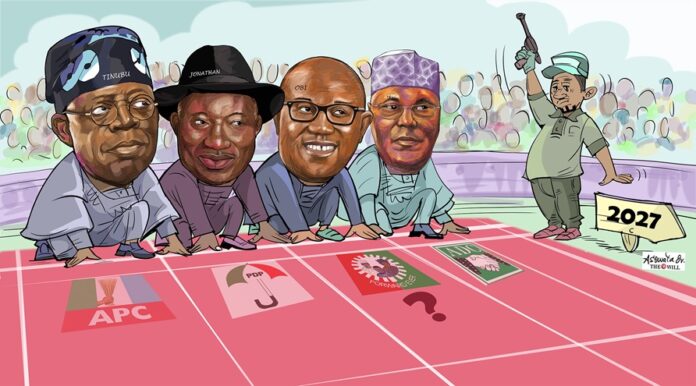
August 10, (THEWILL) — Unfolding political events in the polity show that four powerful presidential candidates may square up in the 2027 presidential election. They are President Bola Tinubu for the governing All Progressives Congress, APC; former President Goodluck Jonathan for the major opposition Peoples Democratic Party, PDP, presidential candidate of the Labour Party in the 2023 election, Peter Obi and his former PDP counterpart, Atiku Abubakar.
For Jonathan, a second journey to the presidency, which stalled in 2022 when some APC big-wigs tried to draft him in as their party’s candidate unconditionally, has started again, this time through the Peoples Democratic Party.
Believed to have been staged by late President Muhammadu Buhari’s nephew and influential adviser, Mamman Daura, as part of a clique’ s power control strategy, that move failed because Jonathan demanded for coronation rather than participating in an elective convention he considered too demeaning for his stature as former President.

Fast forward to 2025. That scenario is being re-enacted by the PDP, the former Presidents’ party, which is desirous of reclaiming the power which it lost, incidentally in 2015 under Jonathan.
Jonathan, like he did with the APC, has reportedly agreed in principle to the idea of running on the party’s platform in 2027 as long as his usual preconditions are met, thus handing him the ticket on a silver platter.
Confirming Jonathan’s consent to persuasions to contest the forthcoming election, the PDP’s Deputy National Publicity Secretary, Ibrahim Abdullahi last week said, “Some of the conditions he gave us were: to be given automatic ticket if he accepts to run. He also said he would have to make a consultation before getting back to us.”
While politically discerning Nigerians await the verdict of his consultations, analysts say the ex-President has a possible barrier to the consummation of his ambition. That is the Constitutional requirement that may check his eligibility.
For a man who was sworn into office to complete the tenure of late President Umaru Yar’Adua and then voted into office again, Section 137 subsection section 3 of the Constitution as amended, prevents him from running again for the same office of President.
The Constitutional amendment came into effect in 2018 after late President Muhammadu Buhari signed it into law. It states that, “A person who was sworn into office to complete the term for which another person was elected as President, shall not be elected to such office for more than a single term.”
Experts however argue that the Constitutional provision has been tested and supports Jonathan’s stand. The argument of those in support of Jonathan’s eligibility is based on the judgement by Justice Isa Dashem of Federal High Court in Yenagoa in a pre-APC convention suit filed by two members of the party in 2022, Andy Solomon and Idibiye Abraham seeking Jonathan’s disqualification from contesting the presidency again.
Justice Dashem had ruled that barring Jonathan would mean applying the new law retroactively. According to the judge, the oath Jonathan took in 2010, following Yar’Ardua’s death, was in compliance with the provision of the Constitution and not because he contested and won an election.
FOUR- HORSES’ RACE
In the event that Jonathan surmounts this Constitutional hurdle, the 2027 presidential contest will present an astonishing wild card of presidential heavyweights.
On the one hand is Jonathan who would probably get a PDP coronation. On the other is Labour Party 2023 presidential candidate, Peter Obi, currently a coalition member of the African Democratic Congress, ADC, but still formally a member of the crisis ridden Labour Party with two factions, led by Julius Abure and Senator Nenadi Usman, respectively.
Awaiting him in the wings, however, is either the Obidient Peoples Party or the Progressive Obidient Party, both of which are eagerly waiting for registration by the Independent National Electoral Commission, INEC. This may happen in a fortnight.
According to the Commission’s National Commissioner and Chairman of the Information and Voter Education Committee, Sam Olumekun, the shortlist of successful associations, which has hit 151, will be made public immediately after the August 16 by-elections.
Should either the OPP or POP, even both, become political parties, Obi may reconsider using them as a platform if his mission in ADC fails, THEWILL has gathered. That mission is to get the ADC’s candidacy for the presidency on the premise of his promise to do a single tenure as President.
Ahead of INEC’s plan to unveil the new parties, the Obidient Movement, which claims to have registered members at ward and units level in 23 states, is already planning a heavy media campaign to sensitise the public to its mission. According to Dependable sources who confided in THEWILL that should the OPP or POP become political parties, Obi’s endorsement as its candidate will be a foregone conclusion.
Already, the governing APC has endorsed President Tinubu as its sole candidate for the 2027 poll. In all likelihood, Abubakar may pick the candidacy of the ADC at its convention, which the party leadership has repeatedly said would be the only mechanism through which its candidate would emerge. His allies have positioned themselves in the party for the great task ahead.
STRATEGIC CALCULATIONS
With this unfolding scenario, political strategists and tacticians would have their hands full with all kinds of permutations for the 2027 presidential election.
The four candidates likely to come from four geo-political zones in the country, where they are expected to perform better than their rivals, given the nature of identity politics in Nigeria, are President Tinubu who comes from the southwest, Jonathan from the South south, Obi from the Southeast and Abubakar from the Northeast. The Northwest and Northcentral will become battleground zones.
Still, the power of incumbency, in spite of the growing hardship and insecurity in the country as selling points for the opposition, is still a big factor to contend with in Nigeria’s dysfunctional politics.
THE NUMBERS AT THE GEO-POLITICAL ZONES
President Tinubu won the 2023 election with 8.79 million votes, followed by Atiku Abubakar of the PDP, who scored 6.98 million votes. Peter Obi of the LP got 6.1 million votes and Dr. Rabiu Kwankwaso of the NNPP got 1,496,687 votes.
Kwankwaso is currently out of consideration in the unfolding presidential picture. His party, the New Nigeria Peoples Party, NNPP, is factionalised. In addition, his performance in the 2023 election was a home -based affair in Kano where he won the majority votes.
Considering the voting pattern in the 2023 presidential election, President Tinubu and the APC led with 53.59 per cent in the Southwest, followed by the PDP with 22.14 per cent and the LP with 19.97 per cent.
Tinubu and APC also won in the North Central Zone with 38.58 per cent, Obi and LP with 31.01 per cent, Abubakar and PDP with 25.46 per cent.
Tinubu and APC led in the Northwest zone with 39.54 per cent, followed by Abubakar and PDP with 34.87 per cent and LP with 4.08 per cent.
In the Southeast, Obi and the LP led with 87.79 per cent, with Tinubu and APC having 5.71per cent, while Abubakar and PDP scored 4.08 per cent.
Similarly, Obi and LP led in the South-South with 42.37 per cent, followed by Tinubu and APC with 27.99 per cent and Abubakar and PDP with 26.12 per cent.
In the North-East, Abubakar and the PDP won 50.67 per cent of the presidential vote, followed by the APC with 29.16 per cent and LP with 6.09 per cent.
While this result reflected the country’s diversity as the candidates and their parties got representations at the legislative and executive branches of government, the entry of Jonathan in the race will further add to the variety, pundits say.
Following the 2023 results, the two critical zones in contention would be the Northcentral and Northwest geopolitical zones.
NORTH CENTRAL, NORTHWEST ZONES
The results of the 2023 presidential election, showed that President Tinubu led the pack in the North-Central and North-West geopolitical zones. But two years down the line, things are no longer the same. While there appears to be no serious challenge in the Northcentral as the ADC under Senator David Mark is still reorganising, the Northwest, which delivered the winning votes for President Tinubu in 2023, is under siege.
The largest concentration of late President Muhammad Buhari’s Congress for Progressive Change, CPC, membership comes from this zone and many are aggrieved over the alleged dominance of the Action Congress of Nigeria within the APC, leading to their perceived marginalisation. Majority of them have threatened to dump the governing party and defect to ADC. This crisis has created a headache for the APC in the zone.
During the 2023 presidential election, for example, the North-West had a total of 6,468, 492 votes. Atiku won in four of the seven north-western states, namely Kaduna, Katsina, Kebbi and Sokoto. Tinubu picked two, Jigawa and Zamfara. But the half a million votes the President got in Kano tipped the scale in his favour. Thus, Tinubu beat Abubakar in the zone, scoring 2,652,824 votes, compared to the latter’s 2,197,824 votes.
Interestingly, the North-West zone gave President Tinubu the highest number of votes in the 2023 election.
Tinubu got 30 per cent of the total number of 8,794,726 votes he scored in the 2023 election from the North-West.
The religious sentiment that worked in Obi’s favour in the North-Central zone, leading to his resounding victory in two states in the zone, namely Plateau and Nasarawa states, may dwindle with the entry of Jonathan, a fellow Christian. Obi trailed President Tinubu in the zone, scoring 1,415,557 votes as against 1,760, 993, for the President. The trio of President Tinubu, Jonathan and Obi would slug it out in the zone, ending up sharing the votes.
THE NORTH
Recall that President Tinubu got a whooping 5,346,404 votes of his total 8.79 million votes from the North, followed by Abubakar with 4, 834, 767 votes; Obi of LP with 2,080,247 votes and Kwankwaso of the NNPP with 1, 545, 649 votes.
For incoming Jonathan, analysts say northern politicians who are feeling nostalgic about his arguably better administration, in comparison to APC’s 10 years and have become vocal critics of the government may want to piggy back into power through him.
It is believed that the choice of a core establishment politician like second term PDP governor of Bauchi State, Bala Mohammed or Senator Aminu Tambuwal or even Dr. Rabiu Kwanwaso as running mate would give Jonathan a competitive edge in the North and redraw the electoral map for 2027. Tambuwal, Mohammed and Kwankwaso have strong electoral strengths that worked for their respective parties in 2023.
Kwankwaso defeated the three other candidates in his Kano home base, scoring 997,279 votes as against 517, 341 votes for President Tinubu, his closest rival, while Abubakar gor 131,716 and Obi of the Labour Party 28,513. Tambuwal and Governor Mohammed helped Abubakar secure victory in the North-West states of Sokoto, Kebbi, Kaduna and Katsina and in the North-East states.
On top of this emerging scenario in the Northwest is another threat. If President Tinubu were to drop Vice President Kashim Shettima in 2027, as has been speculated, the move would solidify the perception that he uses and dumps deputies at will, a tolerable move at the state level which becomes magnified into insensitivity at the national level because of the issues involved.
The constituency and stakeholders involved are considerable. For example, a deputy governor who represents a senatorial zone or a federal constituency in a state, would loom large as a Vice President at the centre because his constituency would translate into a geo-political zone with many governors as potential allies.
Thus, an APC without VP Shettima would imply delivering Northeast geo-political zone to Abubakar, a likely ADC candidate, effortlessly. The VP’s removal would also become campaign material for anti-Tinubu politicians in the North generally. The fallout of the APC Gombe summit where delegates insisted the party must endorse President Tinubu for 2027 alongside Shettima is still festering.
In the 2023 polls, President Tinubu trailed Abubakar substantially in the North-East. He scored 933,176 votes as against Abubakar’s 1,741,846 votes. Shettima, however, delivered the votes of his home state, Borno, which Tinubu won with 252,282 votes, compared to Abubakar’s 190, 921 votes. As a possible candidate of the ADC, Abubakar is expected to perform better than other candidates in this geo-political zone than he did during the 2023 poll. His loyalists have since joined the ADC bandwagon and they are planting the party in the zone.
Another challenge facing the APC in the North-East is that the party and its main rival, the PDP are head -to- head in the control of the six states there: The PDP governs in Bauchi, Adamawa and Taraba, while APC governs in Borno, Yobe and Gombe. The coming of ADC through Abubakar into this zone will upset previous calculations, even though he is expected to improve on his performance because of the undercurrents over VP Shettima’s ‘treatment’, in addition to the growing hardship.
SOUTH-SOUTH, SOUTH-EAST
Obi won the Southern votes in 2023, scoring 4,020, 687 votes, followed by Tinubu with 3,026,969 votes, Abubakar with 1,751,047 votes and Kwankwaso with 42, 038 votes. Jonathan will share a significant proportion of the vote by reducing it to the Southeast zone where Obi comes from and the LP candidate in 2023 scored an overwhelming 87.79 per cent of the total votes cast in the region.
The South-South votes that Obi got in 2023 may shrink considerably in 2027. Jonathan is from South-South as against Obi, a core southeasterner. Each of the four candidates will explore the electoral weakness in enemy territory to advantage.
With the defection of governors from two critical states in the South-South from the PDP to APC- Sheriff Oborevwori of Delta State and his Akwa Ibom counterpart, Umo Eno, President Tinubu is expected to upgrade his poor performance in the zone in 2023. Contesting against two heavyweights like Jonathan and Obi would certainly challenge the electioneering skills of the president’s men in the South-South, where Tinubu scored 27.5 per cent in 2023.
Making a fair assessment of the current political climate at the weekend, a founding member of the PDP and former governor of Jigawa State, Sule Lamido, who welcomed the possible coming of Johathan into the 2027 race because of “ his pedigree, cool headedness and partnership,” noted that it is too early to say who will emerge president in 2027 because two years is a long time for things to change and present calculations to crash.

Amos Esele is the Editor of THEWILL Newspaper. He has over two decades of experience on the job.
