
June 29, (THEWILL) — For the second time in two weeks, the ruling All Progressives Congress, APC, is going through a political upheaval of seismic proportions. Just when the leaders, stakeholders and members of the party were still recovering from the disruption caused by the unexpected fiasco at the North-East Zonal Party Delegates Summit, following disagreements over the non-endorsement of Vice President Kashim Shettima alongside President Bola Tinubu for the 2027 general election, one of the dramatis personae in that event and the National Chairman of the party, Dr. Abdullahi Ganduje was suddenly booted out of office on Friday.
The party immediately appointed Hon. Ali Bukar Dalori, Deputy National Chairman, North, as the acting National Chairman.
A dependable party source told THEWILL that the “Man on whose desk the buck stops had to take a decision because the National Chairman had become a stumbling block to progress.”

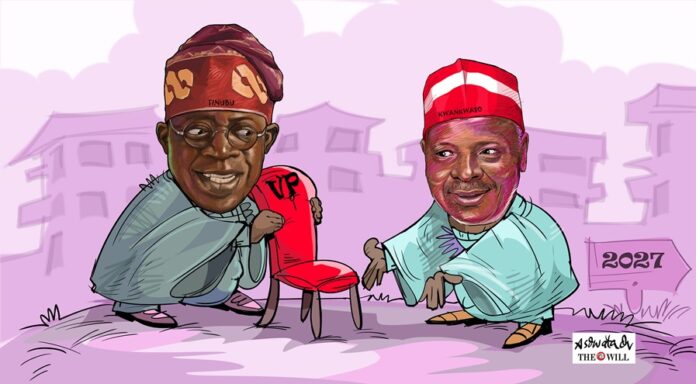
The major reason for this presidential fiat, it turned out, was to let Ganduje go in order to admit Dr Rabiu Kwankwaso into the party. Kwankwaso, who was the presidential candidate of the New Nigeria Political Party, NNPP, in the 2023 general poll, holds the key to the political permutations of the president’s camp ahead of 2027.
As reported exclusively by this newspaper in its last Sunday cover story titled, ‘2027: Shettima Going…, Going…, Going…‘ the President’s camp had perfected a plan to woo Dr. Rabiu Kwankwaso into the APC as the most viable replacement of VP Shettima, ahead of the 2026 presidential primaries of the party.
Current political realities in the country, which are likely to pose a serious challenge to Tinubu’s re-election, are said to have caused the President to change his mind about getting involved in 2027 politics now.
One of the present realities facing the President, sources say, is the fact that controlling the federal structure is a huge advantage against his rivals but using it to get to the finishing line is quite another thing.
The plan, therefore, is to woo Kwankwaso into the party and let the President see his impact before taking a crucial decision on the 2027 general election.
The former Kano State governor, who is Ganduje’s predecessor in office and his arch-rival carries more political punch in the North-West geopolitical zone, which was critical to the President’s victory in 2023 but is now threatened by coalition politicians riding on the wave of threats from insecurity and hunger in the land.
Apart from the Northeast fiasco, the other factor that quickened Ganduje’s exit is what a source called, “the Senator Ali Ndume Factor”.
THE NDUME FACTOR
In what is now referred to as the ‘Senator Ali Ndume’s factor,’ the President’s camp is said to have got further confirmation of the unsuitability of VP Shettima in their calculations for the President who has been endorsed by stakeholders as the party’s sole candidate for the 2027 election.
The Senator representing Borno South on the platform of the APC disclosed in a national television interview last week that he has been attending meetings of the opposition coalition politicians and would defect to join them if the Bola Tinubu Administration failed to improve on its policies that are impoverishing Nigerians.
Considering that Senator Ndume comes from, “not just the Northeast zone but also the VP’s state”, as a source puts it, is enough confirmation that “Shettima has lost control of his backyard.”
Senator Ndume said in the interview that “I’m aware of the opposition coalition. I have attended some of their meetings. I still believe this president can fix these things, but failure might cause me to move. The overloaded ship will sink.”
In addition, Governor Babagana Zulum, whom the VP handpicked as his successor once raised eyebrows in the presidency when he harshly criticised the government’s tax policy during the town hall meetings held across the country to sensitize Nigerians to the components and implications of tax laws. President Tinubu signed the four tax reform bills, aimed to modernise and streamline Nigeria’s tax system, into law on Thursday, June 26, 2025. The new tax laws take effect from January 1, 2026.
The ‘Senator Ndume’, factor brought the governor’s critique into fore again, said the source and further complicates matters for the VP.
THE BUHARI FACTOR
Another factor that, in retrospect, has featured in the calculations of the President’s camp is the expression of political neutrality by former President Muhammadu Buhari. The former President who still has a significant cult following in the North, particularly in the critical North-West which his Katsina State belongs to, has repeatedly said that he would continue to support President Tinubu, but allow the people to exercise their political choices. The President’s men see this as a red flag. In fact, recent rumblings in Buhari’s former party, Congress for Progressives Change, CPC, is a clear indication of the impact of Buhari’s neutrality which has unsettled the President’s men.
THE CRITICAL NORTH-WEST GEO-POLITICAL ZONE
Kwankwaso is believed to still have a cult following within the Kwankwasiyya Movement in the North-West, though on a comparatively lower scale than Buhari. This makes him suitable to be lured into the ruling party to enable it maintain its grip on the geopolitical zone. Nigerian political parties are not ideological.
The North-West is made up of some of the highest voting states in the country, notably Kaduna, Katsina and Kano, beside Sokoto, Zamfara, Kebbi and Jigawa which make the zone one with the highest number of states, totalling seven, in the country. Moreover, this zone gave President Tinubu the highest number of votes in the 2023 general election.
A state-by-state analysis of votes cast in the zone shows that the presidential candidate of the PDP and opposition coalition leader, Atiku Abubakar won in four out of the seven North-West states, namely Kaduna, Katsina, Kebbi and Sokoto. President Tinubu won in only two, namely Jigawa and Zamfara. Dr. Rabiu Musa Kwankwaso, candidate of the New Nigeria Peoples Party (NNPP) took his home state, Kano. In Kano, Tinubu polled 517, 341 votes; Dr Kwankwaso scored 997,279 votes; Atiku Abubakar came third after polling 131,716, while Peter Obi, the Labour Party, LP, candidate, came fourth with 28,513 votes. But when it comes to the total number of votes cast for each of these three candidates in the North-West, Tinubu led the pack.
Tinubu led with 2,652,824 votes, compared to Atiku’s 2,197,824 votes. Kano, where Tinubu got almost half a million votes, did the magic. Overall, Tinubu got 30 per cent of the total number of 8,794,726 votes he scored in the 2023 election from the North-West. This is almost one-third of the total votes he scored in the entire poll. In comparison, the South-West, where he hails from, gave him 2,542,979 votes.
DWINDLING VP SHETTIMA’S NORTHEAST ZONE
Compared to the North-West, the North-East where VP Shettima hails from returned a total of 933,176 votes for President Tinubu, trailing Atiku who polled 1,741,846 votes. Shettima, however, delivered the votes of his home state, Borno State, which Tinubu won with 252,282 votes, compared to Atiku’s 190, 921 votes. Another challenge facing the APC in the North-East is that the party and its main rival, the PDP are head -to- head in the control of the six states there: The PDP governs in Bauchi, Adamawa and Taraba while APC governs in Borno, Yobe and Gombe.
Regionally, however, Tinubu had a better showing in the North than in the South. Of the total number of 13, 716,667 votes cast in the Northern region, Tinubu got 5,346, 404 votes, followed by Atiku who scored 4,834, 767 votes, Obi who polled 2,080,847 votes and Kwankwaso who polled 1, 454,649 votes.
This impressive showing by the President in 2023 in the North is being threatened by the ongoing political coalition, whose leaders are capitalising on the hardship and worsening insecurity in the country to drive their agenda, especially in the North.
These leaders include Atiku, Peter Obi, former Kaduna governor, Nasir el-Rufai, ex- National Vice Chairman of the APC, Salihu Lukman, former Transportation Minister, Chibuike Amaechi, former Cross River State governor, Liyel Imoke, former senate president David Mark and former presidential aide, Prof Umar Ardo, as well as many other political bigwigs across political parties in the country.
KWANKWASO AND KANO FACTORS
Apart from having arguably the highest voter population in the country, Kano is a key state in the all-important North-West geo-political zone. Among the six other states, Kano is king when it comes to voting strength. In addition, it has a unique quality: It is free from insecurity that plagues and reduces the political integrity of all the other states in the zone, courtesy of the state- of -the art security infrastructure built by ex-Governor Abdullahi Ganduje. Picking a VP from the North-West, the President’s camp reckons, is the best way to secure it and prevent the coalition from taking it.
Multiple sources told THEWILL that Kwankwaso will accept the offer which could be the surest and safest path to his bid to rule the country. Currently his party, the NNPP is factionalised. The party’s National Chairman, Dr Agbo Major said recently that the former Kano governor remained expelled from the party, just as one of its Senators from Kano, Abdulrahman Kawu, recently defected from the party alongside some other party representatives from Kano State.
Amos Esele is the Editor of THEWILL Newspaper. He has over two decades of experience on the job.
