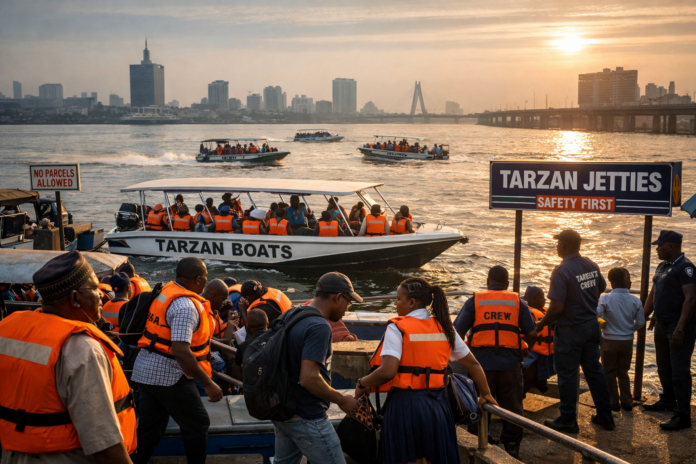
February 10, (THEWILL) — Before the city wakes to traffic jams and horn blasts, the Lagos Lagoon already hums with life.
Boats glide across the water, engines whispering over the ripples, carrying thousands of commuters, who rely on the lagoon as much as the roads.
For them, the journey is not leisure; it is survival. On these waters, every crossing matters, and every life jacket counts.

Away from the mainland’s congestion, the lagoon offers what roads often cannot: speed, certainty, and a predictable rhythm.
But familiarity carries its own dangers. Over time, the daily crossing becomes ordinary, almost forgettable, and risk fades into the background.
At Tarzan Jetties, Engr. Ganiyu Shekoni Balogun has seen this complacency play out countless times.
As Managing Director of Tarzan Jetties and President of the Association of Tourist Boat Operators and Water Transporters of Nigeria, he notes that many travellers still treat water transport as a casual movement rather than a regulated journey, demanding discipline and cooperation. The life jacket, offered freely, is often dismissed.

The resistance is predictable. The water looks calm, the distance short, the risk exaggerated.
But accidents do not announce themselves, and on water, survival hinges on preparation.
For Tarzan Boats, the life jacket is no longer optional; it is a condition of travel. Boarding now begins with compliance, setting the tone for the journey ahead.
This insistence has altered the atmosphere at jetties. Rules are clearer, enforcement firmer, and disputes occasional.
Yet in a city where convenience often overrides regulation, this firmness signals a shift: water transport must evolve beyond informal practices if it is to earn sustained public confidence.
Trust, however, extends beyond safety gear. In recent years, allegations of illicit activities on waterways have unsettled commuters and operators alike. The Lagos Lagoon, with its vast reach, has become a focal point of scrutiny.
Balogun has been deliberate in drawing clear boundaries. Tarzan Marine Enterprises will not carry drugs or unmonitored parcels.
Long-standing informal habits of parcel delivery are now curtailed, and passengers are required to transport their own belongings.
While some commuters see this as inconvenient, the policy strengthens the integrity of water travel, reducing the risks of anonymous parcel movement. Accountability replaces assumption, and confidence in the journey itself is restored.
Tarzan Boats has also introduced a softer, socially conscious dimension to water travel.
On routes where schoolchildren rely on boats to reach classrooms, students in uniform travel free during peak hours. For them, the boat becomes more than a vessel—it is a bridge to opportunity.
In riverine communities, where transport costs can determine school attendance, this gesture has practical weight, subtly positioning water transport as part of the education ecosystem.
Night travel, another critical concern, is deliberately restricted. While demand exists among traders and late commuters, poor visibility, limited rescue capacity, and security risks make after-dark journeys hazardous.
Fixed closing times, though occasionally unpopular, prioritise predictability over peril. On the water, knowing when not to move is as vital as knowing when to go.
As THEWILL observes, the evolving practices at Tarzan Jetties offer a window into the future of water transport in Lagos.
Safety, trust, and social responsibility intersect, redefining expectations for a network long treated as a shortcut. Structured, accountable travel is replacing improvisation, and passengers are learning that compliance benefits everyone.
Travel, ultimately, is an agreement between provider and passenger. On Lagos waters, that agreement is being rewritten—one life jacket, one rule, one journey at a time.
The quality of a journey is measured not by speed alone, but by how safely and responsibly it carries those who trust it.

Janefrances Ebere Chibuzor is a Tourism Writer at THEWILL