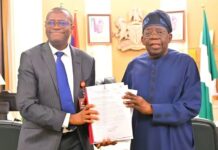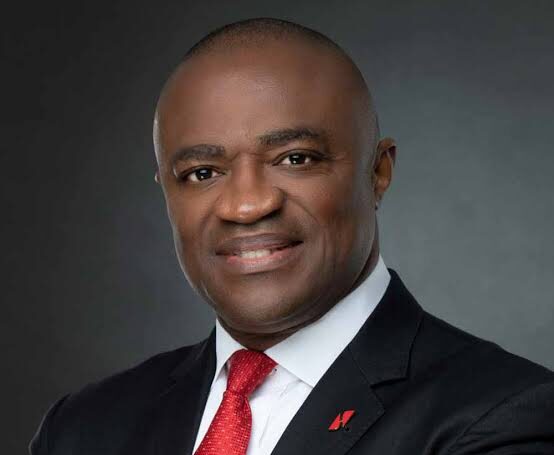
November 11, (THEWILL) — The Group Managing Director (GMD) of United Bank for Africa (UBA), Dr Oliver Alawuba, has said that achieving the much-desired infrastructure transformation for Africa entails partnership, leveraging on the inclusiveness and competitiveness of the stakeholders.
Alawuba made this assertion in his keynote speech at the UAE-Chad Trade & Investment Forum in Abu Dhabi, UAE, on Monday, November 10, 2025, with the theme ‘Financing African Competitiveness – Building Bridges, Powering Progress’.
According to him, Africa has long been referred to as a continent of great potential without practical evidence on critical infrastructure such as electricity, water, roads and the environment, noting that the era of rhetoric was over.

“We are here to discuss a subject that is both an imperative and an opportunity: Financing African Competitiveness.
“For too long, the narrative around Africa has been one of potential. But I stand before you today to declare that the era of potential is over. We are now in the era of execution. And what we are witnessing in Chad is a masterclass in how to make that shift.”
He emphasised that the model for success is clear. Africa’s infrastructure transformation requires partnership, and that partnership has a structure:
“International expertise and capital, particularly from partners like the UAE, bring world-class technical prowess and strategic long-term investment.
“African institutional banking and local knowledge – providing the on-the-ground intelligence, deal structuring, and capital mobilisation that makes global capital work effectively in local contexts.
“Development Finance Institutions (DFIs) like the World Bank and the AfDB – offering de-risking instruments and concessional finance that make projects viable.
Commending the visionary leadership of the Government of Chad and the strategic partnership of the United Arab Emirates for convening the participants around a blueprint of such transformative potential: Tchad Connexion 2030.
“The $30 billion Chad Connection 2030 plan is not just a document; it is a declaration of intent. It is a detailed roadmap to move a nation from the periphery to the very heart of global economic competitiveness. With its 268 projects targeting infrastructure, industrialisation, and human development, it understands a fundamental truth: competitiveness is not born in boardrooms; it is built on the ground.”
Articulating the strategy for execution, Alawuba said, “A plan of this magnitude poses one critical question: How do we finance this future?
“It means understanding that a reliable power grid is the foundation of industrial growth. Chad’s target of 60% electrification by 2030 will enable factories to operate, cold chains for agriculture to function, and the digital economy to flourish.
“It means recognising that water access for 11 million additional people drives economic transformation. Safe water reduces healthcare burdens, enables food processing industries, and unlocks agricultural productivity across the value chain.
“It means seeing the strategic value in infrastructure. When we finance a road, we finance market access. When we structure a PPP for renewable energy, we finance both climate resilience and energy independence. When we support digital payment systems, we create the foundation for inclusive economic growth.
“And it is built with governance that assures an investor that their capital is safe, and their project will be seen through.”
He said, “At UBA, we have always believed that the capital to transform Africa exists, both within and outside our continent. The challenge has never been a lack of capital, but a lack of bankable structures and credible partnerships, including huge domestic capital misalignment.
“According to the Africa Finance Corporation (AFC), Africa’s domestic financial assets are estimated to total approximately $4 trillion ($2.5 trillion in Commercial Bank Assets, $725 billion in Foreign Reserves and others, $455 billion in Pension Assets and $320 billion in Insurance Assets), but less than 15% of these assets are currently channeled into productive infrastructure essential for growth. This is the gap we bridge.
“Across our network in 20 African countries and global financial centres (New York, London, Paris) – including right here in the UAE (Dubai) – we have been structuring deals that de-risk investment and unlock capital at scale”, he stated.
Citing examples, the GMD announced the scorecard of the success achieved by UBA in tackling infrastructure challenges in three foremost African countries.
He said, “In Tanzania, we committed over $400 million to the Julius Nyerere Hydropower Project, a testament to our capacity for large-scale energy infrastructure.
“In Nigeria, we have invested over $700 million in the power sector post-privatisation and participated in the landmark $10 billion syndication for the Dangote Refinery.
“In Ghana, we financed $315 million in road infrastructure, understanding that connectivity is the lifeblood of trade.
“So, when we look at Chad’s targets – 60% electrification, water for 11 million people, the doubling of agricultural production – we do not see insurmountable challenges. We see a portfolio of bankable projects.”
He said the bank is committed to a two-fold strategy which focuses on national infrastructure and grassroots financial inclusion.
“At UBA, our commitment is two-fold: we are both architects of national infrastructure and champions of grassroots financial inclusion. Here in Chad, this is not a promise; it is a proven track record.
“We have already committed over $102 million in direct investments in the State of Chad’s securities and have been the lead financier on critical national projects – from a $49 million domestic gas project to bring clean energy to households, to a $6.7 million wind farm in Amdjarass and essential funding for road maintenance and telecom modernisation. This demonstrates a deep, vested partnership with Chad’s development agenda.
“But true competitiveness requires an inclusive economy. This is why our presence extends far beyond capital cities into the very fabric of Africa. In Mozambique, we serve clients in Beira, a 16-hour drive from the capital. In Guinea-Conakry, our branch in Nzerekore is 788 kilometres away, and in Uganda, we are in Gulu, 335 km from Kampala.
“By planting our flag in these regions, we are ensuring that the SMEs, the farmers, and the entrepreneurs who form the backbone of the economy are not left behind. “We are financing competitiveness from the ground up, ensuring that every link in the value chain, from a remote farmer to a national utility, has the capital to grow.”
He emphasised that “Our recent whitepaper, ‘Banking on Africa’s Future,’ launched at the World Bank-IMF Annual Meetings, demonstrates that strategic African anchor investment can attract international capital at a ratio of 10-to-1 or even 20-to-1. For Chad’s $30 billion plan, this multiplier effect is the key that unlocks the vault.”
“Specifically, for the panel on Attractiveness, Industrialisation, Water and Electricity, UBA is ready to partner in:
“Structuring PPPs for solar plants and water treatment facilities, learning from the UAE’s own success with projects like the Hassyan Power Plant.
“Providing syndicated loans and project finance to connect Chad to regional energy grids, ensuring stable, affordable power for industrial zones.
“Deploying digital payment platforms to support Chad’s E-Tax and e-registry initiatives, making the business climate more transparent and efficient for every investor in this room.
“Chad Connection 2030 is a bold invitation to the world. It says: ‘Come, build with us’”.
Sam Diala is a Bloomberg Certified Financial Journalist with over a decade of experience in reporting Business and Economy. He is Business Editor at THEWILL Newspaper, and believes that work, not wishes, creates wealth.