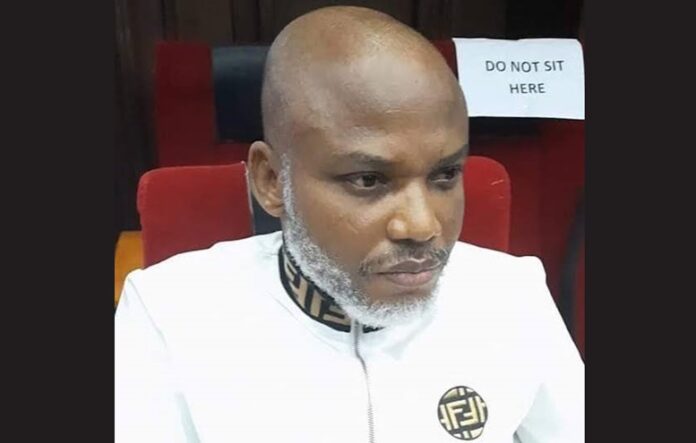
November 11, (THEWILL) — The detained leader of the proscribed Indigenous People of Biafra (IPOB), Nnamdi Kanu, has filed a fresh motion before the Federal High Court in Abuja, seeking to halt his ongoing prosecution on terrorism-related charges.
Since his re-arrest and repatriation from Kenya in June 2021, Kanu has remained in the custody of the Department of State Services (DSS), facing a seven-count amended charge bordering on treason and terrorism.
In the motion filed through his legal team, Kanu contended that the Federal Government’s continued reliance on the Terrorism (Prevention) (Amendment) Act, 2013, to prosecute him was unconstitutional, as the legislation had been repealed and replaced by the Terrorism (Prevention and Prohibition) Act, 2022.

Marked FHC/ABJ/CR/383/2015, Kanu insisted that his trial and detention violated both Nigeria’s Constitution and international human rights instruments.
In the application, the IPOB leader said his prosecution contravenes Sections 1(3), 36(1)–(12), and 42 of the 1999 Constitution, as well as Articles 7 and 26 of the African Charter on Human and Peoples’ Rights.
“The continued prosecution of the Defendant under a repealed statute, and upon a proscription order obtained ex parte and without fair hearing, violates the Constitution and the African Charter”, the motion reads in part, adding that the ex parte order proscribing IPOB in 2017 was unconstitutional, given that a prior court ruling had held that IPOB was not an unlawful society.
Kanu further prayed the court to strike out or permanently stay the amended count charges against him. Holding that they are barred by double jeopardy and rely on the same facts as charges previously struck out by the court on April 8, 2022, he insisted that proceeding with those counts would amount to a violation of his fundamental rights.
The IPOB leader equally prayed the court for an order declaring his extraordinary rendition from Kenya to Nigeria in June 2021, unlawful.
“The Defendant’s forcible abduction without extradition proceedings violated the Extradition Act and the African Charter”, the motion stated.
Kanu also alleged multiple breaches of his right to a fair hearing during detention by the Department of State Services (DSS), including restricted communication with his lawyers, seizure of legal documents, and eavesdropping during confidential discussions. He urged the court to nullify all proceedings conducted under such conditions.
The motion, supported by an affidavit personally deposed to by the Kanu, provides a detailed account of his arrest, detention, and alleged torture.
“I was abducted, blindfolded, and chained to the floor for eight days in Kenya before being forcibly flown to Abuja”, he swore, adding that he was never presented before a Kenyan court nor shown any extradition warrant.
Kanu recalled that his ordeal began in 2015 when the DSS arrested him in Lagos and detained him despite several court orders for his release. He detailed a pattern of disregard for judicial orders, including a December 2015 directive by Justice Adeniyi Ademola ordering his unconditional release — a ruling that was allegedly ignored.
He narrated that after being granted bail by Justice Binta Nyako in 2017, his family home in Afaraukwu, Abia State, was invaded by security forces, leading to deaths and injuries that forced him to flee the country.
“My parents later died from injuries sustained during the military raid”, Kanu stated.
In his affidavit, Kanu cited multiple judgments from Nigerian courts and international bodies supporting his claims. These include rulings from the High Courts of Abia and Enugu States, which declared the 2017 military invasion and the proscription of IPOB unconstitutional, awarding him N1 billion and N8 billion, respectively.
He also referenced findings from the African Union, the United Nations Human Rights Council, and the UN Special Rapporteur on Torture, all of which condemned his arrest, rendition, and continued detention as violations of international law.
“The UN and AU both called for my unconditional release”, he reminded the court.
Kanu maintains that his continued prosecution amounts to “flagrant contempt” of the Court of Appeal judgment of October 13, 2022, which discharged him of all charges and condemned his extraordinary rendition. Though the Supreme Court later set aside that discharge on procedural grounds, it affirmed that the rendition was illegal and criminal.
The IPOB leader insists that the government’s reliance on the repealed Terrorism Prevention Amendment Act, 2013, nullifies the current proceedings, since the law under which he was charged ceased to exist in 2022.
“A court cannot enforce a dead law”, he argued.
As of Tuesday evening, Justice James Omotosho had not fixed a date for ruling on the preliminary objection.
THEWILL had reported that Justice Omotosho, last Friday, fixed November 20, 2025, for judgement in the terrorism trial of Nnamdi Kanu.

Felix Ifijeh is a journalist with years of professional reporting experience. Known for his keen news sense, compelling storytelling and commitment to accurate, impactful reporting, he has built a reputation for turning leads into clear, engaging, and well-structured reports that resonate with readers. His work reflects deep newsroom experience and a commitment to accurate, impactful journalism.