
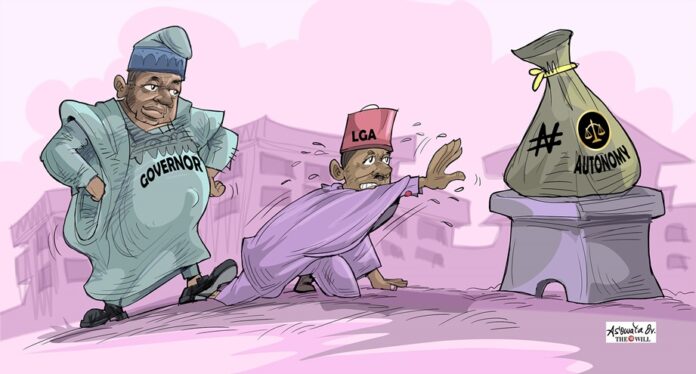
April 13, (THEWILL) – Two months shy of a year since the Supreme Court of Nigeria delivered a historic judgment that upheld the financial autonomy of the 774 local government areas of the federation as the third tier of government, nothing concrete has happened.
The apex court also ordered the Accountant–General of the Federation to pay federal allocations directly to the LGA accounts. It declared that failure by the 36 states to remit funds to the LGAs was unconstitutional.
However, an indication of the states’ readiness to implement the apex court’s ruling became evident in January when the Central Bank of Nigeria reportedly directed the Chairmen of local government councils to open accounts with it for the purpose of disbursement of federal allocations. But the local government authorities are uncertain.

“Have you seen the letter released by CBN directing local government councils to come forward to open the account?” President-General of the Nigerian Union of Local Government Employees, NULGE, Comrade Aliu Haruna Kankara, asked THEWILL in answer to a related question during an interview on Friday. “The truth is that we have not seen any circular yet. As we speak, I only read about the CBN thing in the newspapers. As NULGE, we are appealing to the CBN to issue a circular to that effect. But that has not been done up to this moment as I am talking to you,” he said.
That quoted report happened in January, almost four months ago. Then, on February 10, 2025, the CBN publicly claimed it had begun the process of opening accounts for the LGA Chairpersons.
According to the Director of Legal Services at the CBN, Kofo Salam-Alada, who was a keynote speaker at a meeting on strengthening local government autonomy in Nigeria, organised by the Nigerian Bar Association, in Abuja, the bank was processing LGA Chairpersons bank details in collaboration with the office of the Attorney- General of the Federation and Minister of Justice and the local government councils which, he disclosed, the CBN had written letters to that effect.
“This is all about standard procedure in the form of KYC (Know Your Customer). Anyone who will be a signatory to the account must be profiled. The process is ongoing, and we are collaborating with the AGF’s office. We have also written to the LGAs,” he said.
Surprisingly, the Association of Local Governments of Nigeria, ALGON disputed the CBN’s claim as related by Salam- Alada.
Mr Sam Akala, who represented ALGON at the event, stated that the association was not aware of any such letter as revealed by Salam-Aada of the CBN.
“I cannot confirm that such communication has not been received officially,” Sam Alaka said.
Relating this event, Kankara said, “This is happening because we do not respect the rule of law in Nigeria. If we respect court orders, we should not be in this situation. Since the Supreme Court delivered the judgement in July 2024, we are still fighting hard to ensure that it is implemented. They (the government) are foot-dragging.”
He added that neither the Ministry of Finance nor the Accountant General of the Federation has done anything concrete since the court ruling. “That is our worry.”
THE POLITICAL MANOEUVRES
THEWILL investigation shows that several state governors are opposed to financial autonomy for local government areas, and they have been working assiduously to ensure its non-workability. Although the Governors Forum alongside the Ministry of Finance, Accountant-General of the federation formed the Tripartite Committee working to implement the apex court ruling, most of the governors are said to be opposed to the Committees’ proposal that the LGA must open and maintain an account with the CBN.
The reason is because the LGA account with the CBN will disrupt the current State Joint Local Government, which empowers state governors to maintain control over the LGAs financially and politically. The Ministry of Finance and the Federal Government appeared to have outsmarted the governors with this proposal on the CBN account. But the majority of the governors are battling the idea to the ground.
When asked about this development, Alhaji Kankara admitted, “We have received the information, though we are yet to verify it that in some states the governors are stopping the LGA Chairmen from opening accounts with CBN.”
The second aspect of the slow implementation of autonomy for LGAs, according to investigation, is that the authorities are to identify an effective way to monitor expenditure at the local government level.
A senior staff of NULGE in Alimosho Local Government Area of Lagos State, who craved anonymity, recounted how governors resisted a similar development under the Muhammadu Buhari Administration, which briefly disbursed “between N300 million and N500 million to local government councils in 2019,” under the Nigeria Financial Intelligence Unit Act, NFIU, and the accounting reporting system for LGAs. Eventually, the Buhari administration, despite support from the then Senate and failed attempts by governors to get a court judgement against the move, yielded to pressure from the governors.
The Buhari administration started the NFIU Act in 2018, which established the NFIU as the central body for financial intelligence in Nigeria. “The Act provided the NFIU with greater autonomy and independence to combat money laundering and terrorist financing. Additionally, the NFIU started implementing a new system for local government funds in 2019, mandating direct bank transfers for allocations and capping cash withdrawals.”
“Of course, we have challenges with the governors because they are the ones blocking local government autonomy all along and we believe they have a hand in the delay in non-implementation of the apex court ruling. Every Nigerian knows that they want to spend the money on behalf of the local government councils. They do not want direct allocation to the local government councils. They want the money to go into the State Joint Account where they will be the one deciding who gets what,” Kankara told this newspaper.
Kankara accused the government at the centre and the states of playing politics with local government autonomy. Like the Buhari government that needed the support of the governors for its second term bid in 2019 and as soon as it had secured it, it became morally weak to implement the policy in 2019. The current administration appears to be less forceful on the implementation of autonomy for local government because of the prospects of successful politicking, which has begun and will expectedly peak in the last quarter of 2025 ahead of the electioneering years 2026 and 2027.
“We are appealing to the Federal Government to stop playing politics with local government autonomy. This thing has become a law. That is why all those concerned should do the needful.”
Now, the political terrain is becoming loaded against the government with the ongoing coalition talks among opposition parties, fear of defections of big wigs from the governing All Progressives Congress, APC, following growing criticism against unfair representation in appointments, worsening insecurity and untamed hardship in the country. This bleak picture has been compounded by the unstable global tariffs war unleashed by President Donald Trump of the United States, which imposed 14 per cent on Nigeria, in addition to the crashing of Brent Crude to a four-year low of below $70 per barrel at the international spot market as USA-China tariff war escalates.
Considering these political and economic developments, there are fears among LG workers and authorities that the governors may have their way because of political calculations ahead of the 2027 election.
THE SUPREME COURT RULING
A seven-member panel of the apex court, led by Justice Mohammed Lawal Garba, on July 11, 2024, declared unconstitutional the act of holding funds meant for local government administrations by state governors. It declared the act a clear violation of Section 162 of the 1999 Constitution, as amended.
According to Justice Emmanuel Agim, who read the lead judgement, 36 governors of the federation are barred from further retaining or utilising funds that are meant for the 774 Local Government Areas (LGAs) in the country.
Justice Agim held that no House of Assembly of any state has the power to make laws that could, in any manner, interfere with monies meant for the LGAs.
He declared, “Demands of justice require a progressive interpretation of the law. It is the position of this court that the federation can pay LGA allocations to the LGAs directly or pay them through the states. In this case, since paying them through states has not worked, justice of this case demands that LGA allocations from the federation account should henceforth be paid directly to the LGAs.”
The court further declared unconstitutional the appointment of caretaker committees by governors to run the affairs of the LGAs. It held that the 36 states are under obligation to ensure democratic governance at the third tier of government.
It dismissed the preliminary objection by the state governors contesting the right of the Attorney-General of the Federation (AGF) and Minister of Justice, Lateef Fagbemi, to file the suit.
The court invoked sections 1, 4, 5, 7 and 14 of the Constitution to declare that the State Governors and State Houses of Assembly are under obligation to ensure a democratic system at the third tier of government in Nigeria and to also invoke the same sections to hold that the governors cannot lawfully dissolve democratically elected local government councils.
They argued that “Nigeria, as a federation, was a creation of the 1999 Constitution, as amended, with the President, as Head of the Federal Executive Arm, swearing on oath to uphold and give effect to provisions of the Constitution.
Furthermore, they declared that the Constitution of Nigeria recognises federal, state and local government councils as three tiers of government and that the three recognised tiers of government are democratically elected and so can draw funds for their operation and functioning from the Federation Account created by the Constitution.
Restating that to put in place a non- existing democratically elected local government is to undermine the sanctity of the 1999 Constitution, they submitted that in the face of the violations of the 1999 Constitution, the Federal Government is not obligated under section 162 of the Constitution to pay any state funds standing to the credit of local government councils where no democratically elected local government is in place.
However, in separate preliminary objections filed before the apex court, the 36 states sought the dismissal of the suit with substantial costs.
They contended that the AGF, who initiated the action on behalf of the Federal Government, lacked the locus standi (legal right) to do so and further alleged that the AGF breached their right to a fair hearing when he failed to serve them with a copy of a further affidavit he filed in support of the suit.
WAY FORWARD
Kankara who is barely a month’s old in office said he was going to work with relevant stakeholders to see to the end of the matter.
“First, I am trying to see how we can meet with the AGF, who is the chief law officer of the land, the Minister of Finance, the CBN and discuss how to enforce the Supreme Court ruling. We will try as much as we can to put pressure on the government too.”
He said that though some of the local government chairpersons are reluctant to come forward for understandable reasons of having been supported into office by their governors, “we are getting cooperation we can from them, even though we know how limited they are because many of them are in office with the support of their governors.”
Reacting to Kankara’s claim that the government is playing politics with LGA autonomy, a media aide to President Bola Tinubu, Tope Ajayi disagrees.
He said the matter is entirely the work of a Tripartite Committee and they are working on it independently.
“They are working out the implementation. Government is working on it. There is a tripartite committee composed of the Nigeria Governors Forum, Association of Local Government Chairmen and the Federal Government. They are working out the details of the implementation of the Supreme Court judgement, that is all I can say,” he told THEWILL in a brief interview on Friday.
For the Attorney-General of the Federation and Minister of Justice, Lateef Fagbemi, a Senior Advocate of Nigeria, the LG autonomy implementation committee has been working on a structure that would enable the government to carry out the apex court ruling on the direct payment of allocations from the Federation Account to LGAs.
“The committee is expected to complete its mandate any time from now and present its recommendations to Nigerians,” the AGF stated, adding that the President Bola Tinubu Administration remained committed to granting LGAs full autonomy, he said at a recent event in Abuja, adding, “Local government structures had almost become extinct in Nigeria, necessitating the intervention of the Bola Tinubu administration. As a staunch advocate of democracy and the rule of law, the President took decisive action by filing a suit at the Supreme Court in May 2024. On behalf of the federation, I brought the Attorneys-General of the 36 states before the Supreme Court to secure declarations ensuring the full emancipation of local government areas in Nigeria.”
According to him the act is tantamount to treason and must be treated as such. “While it is true that section 308 of the Constitution grants governors’ immunity from prosecution, I wish to be clear that this flagrant disobedience to the Supreme Court judgment will have unpleasant consequences for the state as a whole, should it persist,” he warned.
On Thursday last week, he advised Nigerians to eschew political partisanship and stick to the law in their interpretation of court judgements. “You’ll see that I’ve avoided taking sides on any issue, though I’m part of the government.
“The CBN is currently awaiting directives from the Federal Government to open local government accounts for the respective states, which can be done between 24 and 48 hours for each.’
“I am a member of the sub-committee that was set up to trash out contentious grey areas and we have already met relevant stakeholders, including labour unions, local government chairmen, NULGE and so on.
“There was a general agreement that the commencement of direct federal revenue allocations to LGAs will be this January.
“Hopefully, we are just rounding off meetings and making submissions to the Federal Government for implementation and there’s no set timeline.’’

Amos Esele is the Editor of THEWILL Newspaper. He has over two decades of experience on the job.
