May 5, (THEWILL)- The stage for heightened expectations was cleverly set in such a way that even the discerning leaders of organised labour fell for it. Maybe they could not help it because the date chosen for the deal was May 1, an occasion of significant importance to workers all over the world.
So, on March 23, 2024, a month and a half before the Workers’ Day celebration, an unidentified government source who was quoted in media reports titled, “Tinubu May Announce New Minimum Wage on Workers’ Day,” said the National Minimum Wage Committee would meet to collate and consider reports from the zonal town hall public hearings and give President Bola Tinubu an idea of what to announce on Workers’ Day.
“Our target is to ensure that Mr President announces the minimum wage by May 1, which is Workers’ Day, for it to take effect from April. So, we are working to meet the timeline,” the source was quoted as saying in many of the reports on radio, TV and newspapers as well as online publications.

In another instance, another government official was quoted as saying, “I don’t think the government will be able to wait until May 1 before announcing the minimum wage. The law says it should be concluded by early April.
“If the parties agree, why do they have to wait to make the announcement? Because they are negotiating and the law says negotiations should be completed by April.”
Everything appeared set. The 37-member Tripartite Committee comprising representatives of federal and state governments, the private sector and labour which was inaugurated by the Vice President in January 2024 had gone about their work. Zonal public hearings were held in Lagos Kano, Enugu, Akwa Ibom, Adamawa and Abuja, where workers in the North-West requested N485,000; North-East, N560,000; North-Central, N709,000 by the Nigeria Labour Congress, NLC, and N447,000 by the Trade Union Congress, TUC; South-West, N794,000; South-South, N850,000; and South-East, N540,000 by the NLC and N447,000 by the TUC.
So confident was the NLC that it warned that governors who failed to implement the new minimum wage when it becomes a law would be committing an offence.
Alas, it was not to be. The picture of things that came out on the eve of the Worker’s Day, was a sad reflection of reality: The new story was that the Federal Government had approved 25 per cent and 35 per cent salary increases for civil servants across various consolidated salary structures. At the current wage of N30,000, this new salary increase raises the new wage to N47.250.
To make it legal and official, the National Salaries, Incomes, and Wages Commission, made the announcement through its Head of Press, Mr Emmanuel Njoku. He said the increments had taken effect from January 1, 2024.
According to him, the new increase applies to the six remaining consolidated salary structures, namely the Consolidated Public Service Salary Structure, Consolidated Research and Allied Institutions Salary Structure, Consolidated Police Salary Structure, Consolidated Paramilitary Salary Structure, Consolidated Intelligence Community Salary Structure and Consolidated Armed Forces Salary Structure.
Also, approved for augmentation is the pension of retirees enrolled in the Defined Benefits Scheme within the aforementioned consolidated salary structures from 20 per cent to 28 per cent, effective from the same date.
THEWILL recalls that the Federal Government had increased the salary for sectors such as tertiary education and health, encompassing structures like the Consolidated University Academic Salary Structure, Consolidated Tertiary Institutions Salary Structure, Consolidated Polytechnics and Colleges of Education Academic Staff Salary Structure, Consolidated Tertiary Educational Institutions Salary Structure, Consolidated Medical Salary Structure and Consolidated Health Sector Salary Structure.
A government source who spoke to THEWILL in confidence said that it would be unfair to blame the government aide and source quoted by the reports for either misinformation or for acting politically correct because they were acting from their view of the subject rather than the larger picture which was available to their superiors.
WORKERS’ DAY PICTURE
Whatever be the case, the picture of things became clearer on the May Day celebration in Abuja; the wool appeared to have fallen from the eyes of labour leaders. While the Federal Government never uttered a word about the 25 per cent and 35 per cent wage increases but rather expressed regret that the new minimum wage was not ready before this year’s Workers’ Day, Labour described the new increase as “mischievous.” Mr Joe Ajaero, President of the NLC accused the government of failing to reconvene the meeting that was adjourned.
According to the Minister of State for Labour and Employment, Nkiruka Onyejeocha, the Tripartite Committee on the National Minimum Wage was yet to finalise negotiations. There was nothing to fear, she promised workers, adding that the enforcement day of the new minimum wage remained May as the minimum wage had expired legally in April 2024.
Announcing the rejection of the new wage increase, Ajaero said the living wages the President promised to pay workers could be put at N615,000, following the post-subsidy removal realities in the country. This comprises housing and accommodation at N40,000; electricity of N20,000; utility that is about N10,000; kerosene and gas that is about N25,000 to N35,000; food for a family of six, at about N9,000 in a day and 30 days, that is about N270,000; medical at N50,000; clothing at N20,000; education, N50,000; sanitation of N10,000, and transportation at N110,000 because of the cost of petrol.
NIGERIA GOVERNORS’ FORUM REACT
Reacting to the new wage increase, the 36 governors under the umbrella of the Nigeria Governors’ Forum, NGF, parted ways with the Federal Government. It held a meeting after the government announced wage increase and issued a statement signed by its Chairman, Governor Abdulrahman AbdulRazaq of Kwara State.
While the NGF celebrated with workers “for their dedication to service and patience,” it reminded all parties to the wage dispute: “While we acknowledge the various initiatives adopted of recent by way of wage awards and partial wage adjustments, the 37-member Tripartite Committee inaugurated on the National Minimum wage is still in consultation and yet to conclude its work.”
Interestingly, the Forum disclosed that individual fiscal policies and their impact would determine “an improved minimum wage that we can pay substantially.”
This obviously knee-jerk response looks overtaken by events because some state governors had announced a new wage on Workers’ Day. For example, Governor Godwin Obaseki of Edo State, whose government had been paying the highest minimum wage in the country at N40,000 since 2021, N10,000 more than the national minimum of N30,000 announced an increase to N70,000 on May 1, 2024. Obaseki’s Ebonyi counterpart, Francis Nwifuru added N10,000 salary increase for civil servants in the state. And during the zonal hearings Adamawa governor, Umaru Fintiri and his Bauchi counterpart, Bala Mohammed had suggested a new minimum wage of N45,000.
BATTLE AHEAD
With the various competing interests and reactions from major stakeholders, it is hard to see a satisfactory end to the ongoing dispute. Sources say the wage increase announced by the National Wages and Salaries Commission, NWSC, on the eve of Workers’ Day is a pointer to the Federal Government’s attitude to the matter.
They say that in July 2023, the same NWSC, had argued in favour of N200,000 as minimum wage at a Federal Executive Council meeting, where it made a presentation. The basis for NWSC’s argument was that the new forex regime policy of the government and savings from the subsidy removal would make cash available for sharing between the tiers of government. Governors who were also eyeing a bigger revenue from the earnings under the monthly revenue distribution kicked against it on the grounds of sustainability.
Subsequently, a committee was appointed and placed under the leadership of Governor Charles Soludo of Anambra State to look into the matter. Nothing substantial came out of the committee until the NWSC released a new wage increase last week.
NLC GIVES MAY 30 DEADLINE
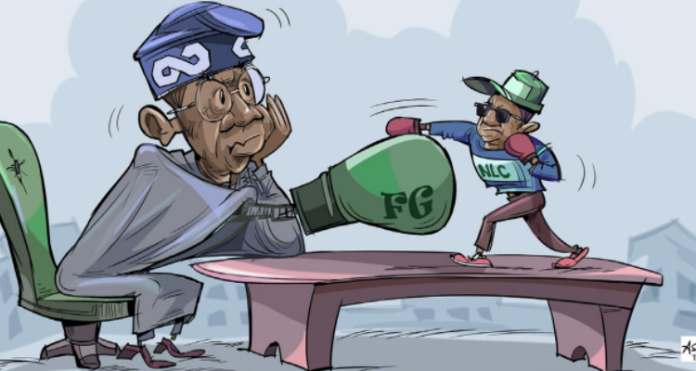
Pointing to government policies as the cause of inflation at 34.5 per cent, food inflation at 49.1 percent and worsened poverty rate at 38.8 per cent, the NLC and Trade Union Congress, TUC, have drawn the battle line with the Federal Government. They have set a May 31, 2024, deadline to embark on an indefinite strike should the government fail to bring a reasonable end to the wage issue.
The duo argued that the last minimum wage of N30,000 expired on April 18, 2024, and by May 1, discussions ought to have been concluded and a new national minimum wage announced.
According to them, the Federal Government through the National Assembly legislated on it, saying the discussion was inconclusive because the Federal Government refused to reconvene the meeting that was adjourned.
“We think the announcement appeared mischievous because there was no agreed minimum wage. We at the NLC and TUC are worried about this,” they said.
At a pre-Worker’s Day webinar hosted by Labour friendly stakeholders and attended by THEWILL, participants called for a more united front between NLC and the TUC to avoid the divisions of the past and provide leadership in the mobilisation of workers across the states “for solidarity action to prevent a situation, like the one in Imo State, where the NLC president was attacked, because the demand for a living wage of N615,000 cannot be won without a fight.”

Amos Esele is the Editor of THEWILL Newspaper. He has over two decades of experience on the job.