
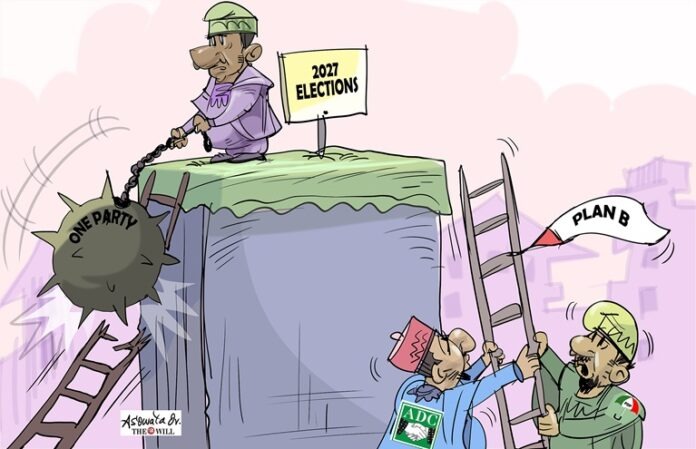
April 19, (THEWILL) — The African Democratic Congress, ADC, plans to inaugurate its newly elected executives and Chairmen at the national and state levels across the country on May 12, 2026, 20 days after the Supreme Court’s scheduled ruling on its appeal coming up on April 22, 2026.
When asked if the party intends to disregard the pending apex court ruling, a top party source told THEWILL that an earlier judgement of the court on party supremacy in administrative and leadership matters is informing their decision, although what is currently before the final court in the land is not the substantive issue in dispute, which is leadership of the party.
The source said, “People are mixing things up about this case and projecting their interpretation of the law on our activity to make us look lawless. We have not entered the substantive matter at the level of the Supreme Court. The real case is at the Federal High Court in Abuja, where Nafiu Bala Gombe filed a leadership suit and the ADC lawyers argued that the court has no jurisdiction and a follow-up appeal led to the parties in dispute being asked to maintained status quo ante bellum, which our lawyers say was wrongly interpreted by the Independent Electoral Commission, INEC, to delist the David Mark led National Working Committee, NWC.”

Sources within the party agree that since the substantive suit before the lower court is yet to be heard, there is a likelihood could be without a National Chairman at the end because of the position earlier taken by INEC to delist the David Mark led NWC. Given the April 23 to May 30, 2026 electoral timeline for the conduct of party primaries, the ADC may be faced with only two options: beginning afresh by adopting another party or losing its leaders to pursue their ambitions on other platforms. Both choices look frightening and unthinkable, say sources.
“That situation better not be imagined,” a visibly upset party source said in response to a question on the fall -back plan in the event of unresolved litigation and the INEC maintaining its earlier position to derecognise the Mark led-NWC.
Sources say the reported meeting with parties like the Peoples Redemption Party, PRP, for the purpose of adoption was untrue and unfounded, adding that the only plan within the party is to fight it out “with the powers that is bent on foisting a one-party, one candidate on the electorate.”
For the Turaki-led PDP, the judgement on its leadership, which it is seeking from the final court will lead to a straightforward plan already in the works. Coalition with the opposition or defection to the governing All Progressives Congress, APC, for the 2027 general election. Towards that joint but separate choices, the two governors left on the PDP platform, Seyi Makinde of Oyo State and Bala Mohammed of Bauchi, had already initiated talks with the ADC and APC, respectively.
Party sources say the conclusion of the convention held by the faction led by Minister of the Federal Capital Territory, Nyesom Wike following the breakdown in reconciliation talks between the factions in obedience to the advice by Justice Bioblele Georgewill of the Court of Appeal in Ibadan, irreconcilably widened the gulf between them.
During an April 8, 2026 meeting held at David Mark’s Apo, Abuja residence Makinde, who led PDP visit and the ADC group agreed to form a strategic alliance aimed at working together during the 2027 general election. Present at the meeting were former Vice President Atiku Abubakar, factional PDP National Chairman Tanimu Turaki, SAN, former Minister of Justice, Abubakar Malami, former Minister of Transportation, Rotimi Amaechi, former governor of Kano state, Dr. Rabiu Musa Kwankwaso, Senator Aminu Tambuwal, former Anambra State governor, Peter Obi; ex-Niger State governor, Babangida Aliyu; former Minister of Information, Prof. Jerry Gana and PDP National Secretary, Taofeeq Arapaja.
THEWILL gathered that Makinde has deepened the alliance talks with action back home. He is said to be backing the ADC in Oyo State with many of his loyalists planning to contest various positions in the 2027 general election on the party’s platform.
In Bauchi, Governor Mohammed is leaning towards the APC. Following the recent visit of the National Chairman, Yilwatda Nentawe and some governors to Bauchi, promising to admit him into the governing party on his own terms, coupled with the social pressure regarding the recent N4.2 billion corruption scandal unveiled by the Economic and Financial Crimes Commission, EFCC, the governor, who had accused the anti-graft agency of colluding with the Federal Government to armtwist him, appears to be at the end of his opposition. The apex court ruling against the Mark-led ADC could serve as a perfect alibi.
As at Saturday April 18, 2026 talks between APC and the governor showed signs of breakdown in negotiations over control of party structure in the state. Under the arrangement, Governor Mohammed’s camp had sought majority control of the APC structure from ward to state level as part of the condition for joining the ruling party. However, disagreement over this condition ultimately stalled the entire process.
Chairman of the Turaki-led PDP faction in Bauchi State, Sama’ila Burga, confirmed on Saturday that the negotiations had been formally discontinued after both sides failed to reach an agreement.
INEC RESPONSE TO ADC
INEC’s Commissioner and Chairman of its Information and Voter Education Committee, Mohammed Haruna, stated that the electoral body’s decision followed a review of relevant court rulings, including a directive to maintain the status quo in the leadership dispute within the ADC.
Haruna noted that the Commission’s action complied with the judgement of the Court of Appeal in Appeal No. CA/ABJ/145/2026: Senator Mark v. Nafiu Bala Gombe & Ors., as well as the pending case before the Federal High Court, disclosing that INEC had received separate correspondence dated March 16, 2026 from two law firms representing different interests within the party, highlighting the complexity of the ongoing leadership tussle.
THE ISSUES BEFORE THE SUPREME COURT
Two high-stakes appeals arising from leadership disputes within the ADC and the PDP are before the Supreme Court which has granted accelerated hearing in both matters due to their political urgency and electoral implications.
The twin appeals, which border on the legitimacy of party leadership structures and the validity of disputed conventions and internal processes, are expected to test the extent of judicial intervention in internal party governance ahead of key electoral timelines.
In the ADC matter, the appeal was filed by the party’s National Chairman, David Mark, who is challenging previous decisions of lower courts that have intensified competing claims to the party’s leadership and deepened internal divisions.
A five-member panel of the apex court, led by Justice Mohammed Garba, fixed April 22 after granting an accelerated hearing in the appeal SC/CV/180/2026.
The case stems from the March 12, 2026, judgement of the Court of Appeal, which dismissed Mark’s appeal against a September 4, 2025, ruling of the Federal High Court in Abuja.
The Federal High Court, presided over by Justice Emeka Nwite, had earlier refused to grant injunctive relief sought in an ex parte application filed by ADC chieftain, Nafiu Bala Gombe, a decision that later became central to the broader leadership contest within the party.
On Tuesday, April 14, 2026 proceedings, the apex court issued strict timelines for the filing of processes, directing Mark’s counsel, Jibril Okutepa, to file and serve the appellant’s brief within a shortened period consistent with the accelerated hearing order.
The court further ordered the respondents to file their briefs within three days of service, while granting the appellant one day to file a reply, if necessary.
The ADC leadership dispute has generated multiple suits across various courts, with rival factions laying claim to the position of National Chairman and control of the party’s national structure. The Supreme Court’s intervention is widely viewed as a decisive step toward bringing clarity and stability to the party’s internal governance.
For the PDP, the Supreme Court also fixed April 22 for an accelerated hearing of an appeal arising from the leadership crisis in the party, further intensifying judicial scrutiny of internal party disputes ahead of the next electoral cycle.
The appeal, SC/CV/166/2026, was filed by the Taminu Turaki-led leadership that emerged from the disputed national convention held in Ibadan on November 15–16, 2025.
A five-member panel of the court, led by Justice Mohammed Lawal, granted an abridgement of time, citing the urgency of resolving the dispute in the light of upcoming electoral deadlines set by the INEC.
Counsel to the appellants, Chris Uche, SAN, urged the court to expedite the matter, noting that the INEC had fixed April 23 for the commencement of candidate submissions by political parties, making the timely resolution of the dispute critical to the party’s electoral preparedness.
He supported the application with a 23-paragraph affidavit of extreme urgency, stressing the potential consequences of delay on the PDP’s participation in forthcoming elections.
Although the application was not opposed by the faction loyal to the Minister of the Federal Capital Territory, Nyesom Wike, their counsel, Emmanuel Ukala, SAN, requested 15 days to respond, while the INEC and other respondents sought 10 days to file their processes.
In its ruling, the Supreme Court ordered all respondents to file their briefs within five days and directed that all processes be completed and exchanged on or before April 21, ahead of the scheduled hearings.
The dispute stems from the PDP national convention held in Ibadan, which produced a leadership structure led by Taminu Turaki, SAN, but has since remained subject to competing judicial interpretations and factional claims.
The Court of Appeal of Nigeria had earlier upheld a Federal High Court judgement delivered by Justice James Omotosho, which nullified the convention on grounds of procedural irregularities, including alleged breaches of court orders, defective notices, and failure to comply with statutory requirements. Despite the appellate ruling, the PDP remains divided into rival factions, each asserting legitimacy over the party’s national structure.
However, following a recent Court of Appeal ruling, the Wike-led group organised a convention in Abuja and elected its officials, while the INEC, following a court injunction, de-recognised the David Mark-led ADC on April 1, 2026.
With both matters now on an accelerated track before the apex court, the outcomes are expected to have far-reaching implications for internal party governance, political stability, and preparations for the 2027 General elections.
ADC LEADERS JOSTLE
Meanwhile, the top contenders for the presidential ticket of the ADC have begun to jostle for the attention of members ahead of the expected primary within the INEC time frame, April 23 to May 30, 2026. In separate interviews during and after its just concluded convention, Abubakar, Peter Obi and Rotimi Amaechi have positioned themselves at the best candidate to prevent President Bola Tinubu’s re-election.
For Peter Obi, who said he stands a better chance of clinching the candidacy if the election process was transparent, his continued membership of the party hangs in the balance.
“If the presidential primary was transactional. I cannot be part of transactional primaries. I cannot be paying people to go and serve them,” he said, adding that, “I don’t have a long time in politics. But if I have a long time, if I have to do it 20 times, I will do it exactly – leave the ADC. I will not be part of (compromise), I cannot be talking about a change while being in the process of the same thing.”
Abubakar, who hinted that the 2027 poll may be his last shot at the presidency and announced his readiness to support any candidate that emerges from either the consensus or direct primary modes of election at the primary, said, “I represent both the past and the future. We have seen various levels of leadership in the country, both young and old, and we’re experiencing them,” he said.
For Amaechi, knowledge of Nigeria’s challenges and the capacity to solve them were within his full grasp, “I don’t care who else is running. I’m running because I’m a Nigerian candidate. Because I know the Nigerian problem. And I can solve the Nigerian problem.”

Amos Esele is the Editor of THEWILL Newspaper. He has over two decades of experience on the job.
