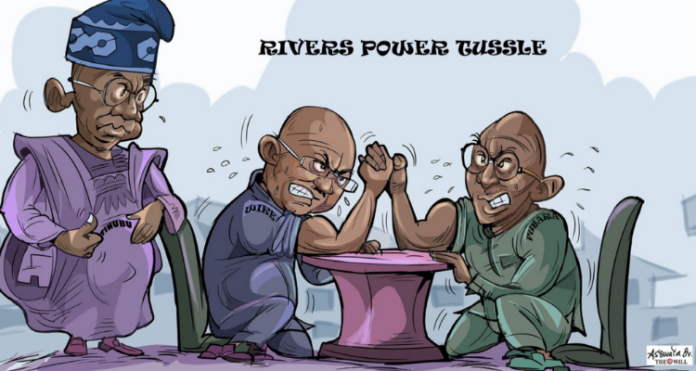
May 12, (THEWILL)- The Rivers State High Court ruling of Friday that restrained Hon. Martin Amaewhule and 24 other Pro-Wike lawmakers from acting as members of the Rivers State House of Assembly provided some respite from the tension that had gripped the riverine state at the onset of the current political crisis ignited by a battle for supremacy between Governor Siminalayi Fubara and his predecessor, Nyesom Wike, currently Minister of the Federal Capital Territory, Abuja.
According to Justice Charles N. Wali who issued the restraining order, following an ex parte motion in a suit filed by Hon. Victor Oko-Jumbo and two others, Amaewhule was also prohibited from convening plenary in the premises of the House of Assembly.
The case was adjourned till May 29 for hearing of the motion on notice. May 29, just for the record, is when Governor Siminalayi Fubara, like others across the country, will celebrate his first year in office, now partly spent in waging a battle with probably no end in sight as both pro- Fubara and pro-Wike camps refuse to give in to appeals to cease fire.

Indeed, THEWILL checks reveal that when the governor on Thursday made a detour from an official trip to visit the legislative quarters shortly after Hon. Oko-Jumbo of the Peoples Democratic Party had proclaimed himself speaker with the support of five members of the Assembly who shared the position of Deputy Speaker and Majority Leader among themselves, some members of the Amaewhule- led group present fled the premises. They thought the governor was coming for a fight, a source told this newspaper. Amaewhule at a news briefing accused the governor of planning to demolish the quarters; the government however dismissed the accusation as untrue and unfounded.
Addressing this stalemate on Friday night after Justice Charles N. Wali issued the restraining order, Professor of Law at Gregory University in Abia State, Anthony Agbazuare, reportedly submitted that the 27 lawmakers stand no chance in the ongoing crisis, saying legally, they are in limbo.
According to him, the law is very clear in Section 109 (1) (g) of the Constitution, which states that a member of a House shall vacate his seat in the House…if (g) being a person whose election to the House of Assembly was sponsored by a political party, he becomes a member of another political party before the expiration of the period for which the House was elected.
“I do not know Governor Fubara or Wike, but that is what the Constitution says,” he said, adding, “There is a caveat in Section 2, 109, which says that once the Speaker gets evidence that elected lawmakers have defected, they lose their seat.”
He supported the decision of the 5-man House with its Speaker, Deputy and Majority Leader: “The 27 lawmakers that left cannot now be a judge in their own case, according to the rule of natural justice. Section 95, I (g) of the same Constitution says that when the Speaker and Deputy Speaker are absent, those left or present choose one among themselves to fill the vacancy. Whoever is saying anything less is ignorant of the law. It is now left for the court to say whether the procedure was followed.”
The All Progressives Congress, APC, however disagrees. In its reaction to Governor Fubara’s declaration last week Wednesday that the House of Assembly did not exist by virtue of the defection of 27 members in clear violation of sections of the constitution, the governing party’s National Publicity Secretary, Felix Morka, on Friday, said the 27 Assembly members did not lose their membership of the Assembly by virtue of their defection.
Morka, who is a lawyer, said there is nothing “homeostatic about Section 109(1)(g) of the Constitution. It is not self-perpetuating. The Proviso to the said Section 109(1) (g) established exceptional grounds to the applicability of Section 109(1)(g) Section 109(1) states: A member of a House of Assembly shall vacate his seat in the House if – (S.109(1)(g) – being a person whose election to the House of Assembly was sponsored by a political party, he becomes a member of another political party before expiration of the period for which that House was elected.
“Provided that his membership of the latter political party is not as a result of a division in the political party of which he was previously a member or of a merger of two or more political parties or factions by one of which he was previously sponsored.”
SHOW OF POWER
Surprisingly, a day to the election of the new Speaker Oko-Jombo and two days to the restraining order by the High Court, Governor Fubara and his Commissioner for Information and Communication, Joseph Johnson, had declared publicly that the 27 lawmakers who defected to the rival APC were not known to law.
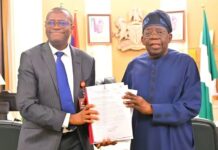
Investigation shows that both parties to the dispute, namely the Rivers State Government and the 27 pro-Wike lawmakers embarked on another round of conflict after each party breached the peace deal brokered by President Bola Tinubu between Wike and Fubara on December 18, 2023.
Highlights of the deal stated that commissioners who had resigned should be called back; the 2024 budget should be represented to the House of Assembly; all cases in court were to be withdrawn; impeachment proceedings against the governor to be withdrawn and the withheld allowances of the lawmakers should be paid.
Investigation shows that the governor fulfilled all except one of the signed agreements: That is re-presentation of the budget. The 27 lawmakers on their own failed to withdraw one of their cases in court in Abuja. In fact, they went ahead to get judgement in their favour.
The lawmakers had filed a case at the Federal High Court, Abuja shortly before President Tinubu’s intervention. It had the National Assembly, Senate President, Deputy Senate President, Senate Majority Leader, and Senate Minority Leader as the first to the fifth defendants, respectively. The sixth to I0th defendants were the Speaker of the House of Representatives, the Deputy Speaker of the House, House Majority Leader, House Minority Leader, and Clerk to the National Assembly. Governor Fubara, Attorney-General of Rivers, Commissioner of Finance, Accountant-General of Rivers, Rivers State Civil Service Commission, the Inspector-General of Police and Edison Ehie were the 11th to the 17th defendants.
The reliefs sought by the plaintiffs was an order of injunction restraining the first to the 10th defendants from entertaining any request from Fubara to take over the performance of the functions of Rivers State Assembly, including its role to make laws for the peace, order and good governance of Rivers State in respect of matters that are within its constitutional and legislative competence. Then on January 22, 2024, the Federal High Court in Abuja declared Rivers N800 billion Budget, passed by pro- Fubara four lawmakers, illegal.
Efforts to get the reaction of the Commissioner for Information and Communication, Johnson failed as he did not pick repeated calls to his phone. But a top government source confided in THEWILL that the state government decided to move against the pro-Wike 27 lawmakers for three major reasons, after deep consideration.
The first is political. “The assembly members defected from the PDP to the APC when there was no crisis in the party, either at the state or at the national level. On this, the Constitution is very clear and the Appeal Court and Supreme Courts have ruled that you cannot transfer the mandate of your party to another,” the source said.
The second reason the source gave is legal: “The 27 lawmakers said they dropped impeachment proceedings against Governor Fubara after the President’s intervention. While the governor withdrew his case against the lawmakers, they refused to withdraw the case they instituted against him before the peace deal. So, they were the first to violate the presidential agreement. They should stop crying as if they are the victims.”
Finally, the source said the 27 lawmakers had, by their “confrontational” posture, taken things too far as the governor had been treating them as members of the same family.
When asked that the government too had violated a part of the presidential deal by not re-submitting the budget for passage by the Amaewhule-led Assembly, the source simply replied: “A High Court ruling had recognised the Speaker that passed the budget. Based on that, the budget was signed into law by the governor because it had legal backing, however you look at it.”
THEWILL could not get reactions from any of the 27 lawmakers as a contact stated that only Amaewhule can speak on the issues in contention and the press statement he had earlier issued had addressed “all contending issues for now,” especially after the Friday High Court ruling had restrained him from parading himself as Speaker or convening plenary at the Assembly premises.
Speaking through his media aide, Martins Wachukwu, Amaewhule described the governor’s remarks on the non-existent of the Assembly as unguarded and a direct affront to the grundnorm of the Federal Republic of Nigeria.
He said he would not join the governor in what he described as “messy comments.”
“We will continue to perform our constitutional functions as an institution and one of the tripods of democratic government,” Amaewhule said.
LAWMAKERS/ LG CHAIRMEN FIGHT BACK
An indication that the political crisis is still ahead emerged when the Clerk of the House of Assembly, Dr Emeka Amadi, declared the emergence of Speaker Ojo-Jumbo as illegal.
He said, “As the Clerk of the Rivers State House and one who administered the Oath of membership and office to all members and a custodian of all records of the House, I write to state the following: “That there was no change in the leadership of the House today and Rt. Hon. Martin Chike Amaewhule remains the Speaker of the House, while Rt. Hon. Dumte Maol and Hon. Major Jack remain Deputy Speaker and Majority Leader, respectively.”
Opposed to the governor too are the local government chairmen who accused the government of withholding allocations to some of the councils, an accusation the government denied and asked them to be ready to vacate office when their tenure expires in two weeks.
STATE Vs FEDERAL MIGHT?
The Rivers State government source, who asked to be anonymous, stated confidently that the lingering crisis, in spite of Tinubu’s intervention, could lead to the development of a frosty relationship between the Federal Government and the state because the President’s intervention is yet to have the desired effect.
“It was a political solution which was good in its intention but using it as a cover to violate the law is unacceptable. There is nothing like federal might here. The truth of the matter is that people became name droppers at some point,” the source said.
A presidential source simply reacted by saying that political intervention, as President Tinubu did, is “only one option to the resolution of the lingering crisis. The legal angle is also available.”
Although there is no clear indication how this crisis in Rivers State will pan out, given the power play on display, things appear to be massively in favour of Governor Fubara since a respected former governor of the state, Peter Odili publicly declared the governor as leader of the Peoples Democratic party, (PDP) in the state. Support from traditional rulers, youths, market women and politicians have equally grown for Fubara, leading him to be more assertive in behaviour.
“Our people have resolved to support Governor Fubara 100 per cent. The local government chairmen have 14 days remaining to serve their tenure,” said Chairman of the National Youth Council of Nigeria, Chijioke Ihumo.
Chief Bode George, former Deputy National Chairman of PDP, who on Friday called on both the APC and PDP to stop issuing provocative statements that can increase the tension in the state, urged elders and stakeholders of the party to intervene in the political crisis before “it becomes a national conflagration.”

Amos Esele is the Editor of THEWILL Newspaper. He has over two decades of experience on the job.