
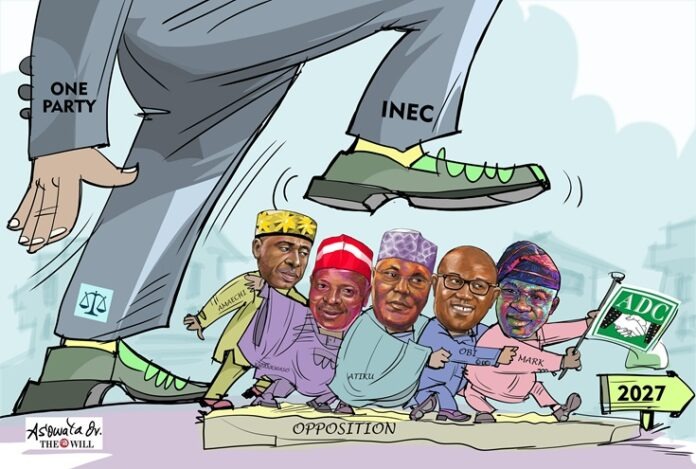
April 05, (THEWILL) — Should they come together and battle the administrative threat to their party, move to a freshly registered political party or go their separate ways in pursuit of their individual presidential ambition, following the uncertainty created by the de-recognition of the David Mark-led National Working Committee of the African Democratic Congress, ADC, by the Independent National Electoral Commission on April Fools’ Day and the pending litigation over the leadership of the party? This is the puzzle facing the four major aspirants for the ADC’s presidential ticket for the 2027 general poll, sources say, as Atiku Abubakar, Peter Obi, Rabiu Kwankwaso and Rotimi Ameachi collectively mull their next step behind the unfolding scene.
This unexpected turn of events and their timing caught them unawares and upset the plans they had carefully crafted to align with allies and thwart their rivals in their strategies to emerge as the party’s standard bearer in the 2027 general election, more so when a lifeline awaits in the wings.
That lifeline is the new party founded by Senator Seriake Dickson, the Nigeria Democratic Congress, NDC, which sources say, may become a viable fall back option for the presidential aspirants, should the ADC crisis linger dangerously close to the April 23 and May 30, 2026 deadline fixed by the Independent National Electoral Commission, INEC for political parties to hold primaries and national convention towards the 2027 general election.

Among the quartet, Obi and Kwankwaso were working as a tag team, while Atiku was eying a pact with either Amaechi or Obi in the event of a shift in the alliance between the former over who takes the lead. Senator Dickson, who sources say, had sought but failed to secure the control of ADC Chairmanship in his home state, Bayelsa before unveiling the NDC, is, however, said to be disposed to seizing an opportunity that would greatly boost the membership and status of his platform to dizzying heights.
With this window of opportunity in the background, Atiku, Obi, Kwankwaso and Amaechi have banded together in the interim to fight an identified common enemy, the INEC and its Chairman, Joash Amupitan, a Senior Advocate of Nigeria, SAN.
Their collective perception is that Amupitan is hiding behind a legal figleaf intended to cover a script against major opposition parties – the Peoples Democratic Party, PDP, Labour Party, LP and now the ADC which has suddenly waxed stronger with high profile defections that have been weakened by an orchestrated crisis, courtesy of the manipulation and intimidating of rivals by the federal government.
INEC, ADC TANGO
All through last mid-week and well into Saturday, April 4, 2026, the ADC and the INEC dominated headlines with their fire for fire approach to the leadership of the ADC. While the electoral umpire, which had explained the legal basis for its action to de-recognise the ADC NWC, took matters higher by warning the party of the legal consequences of ignoring the court rulings amid plans to go ahead with its planned primaries and convention, the party, which had called for Amupitan’s resignation, again sustained its stand by decrying his posture as the court in his interpretations. The Commission and the party have been engaging in a heated exchange since the de-recognition of the party’s NWC.
Amupitan on Friday issued a stern warning to the party against proceeding with planned congresses and its national convention without the commission’s oversight, cautioning that defiance could have serious legal and electoral repercussions. Speaking during an interview on Arise TV, the INEC Chairman emphasised that the commission’s de-recognition of the ADC leadership of Mark and former Osun State Governor Rauf Aregbesola is anchored on a subsisting court order—not arbitrary discretion.
“So, if they are going ahead with their congress, with their convention, it’s left for them to look at it, whether it is in contravention of the court. INEC didn’t just make a decision. We didn’t just wake up one day and make this decision. There was something that led to it. There was an order of court,” Amupitan said. The INEC chairman stressed that the court had explicitly instructed political parties to refrain from any action capable of undermining pending judicial proceedings. Don’t do anything. Don’t take any step that will render any proceeding before the court nugatory,” he stated.
Amupitan noted that the question of conducting congresses and conventions is currently a live issue before the courts. “So, if they are already asking that they don’t do any congress, don’t do any convention, it is a relief that is being claimed. And especially if they filed a motion for that purpose, that motion has not been determined,” he added. Citing historical precedents, the INEC chairman warned that ignoring court directives could invalidate election outcomes, potentially resulting in candidates with the second-highest votes being declared winners.
“Let me tell you what happened in Zamfara. It happened in the past. We don’t want to conduct an election without this early warning and at the end of the day, after you have won, the court again will come and declare the election invalid. The implication is that the person with the second-highest number of votes will be declared the winner,” he said.
He further referenced Plateau State as another example where non-compliance with court directives affected electoral results. “It happened in Plateau State during the last election… failure to obey the court order has consequences,” Amupitan noted. While affirming the party’s right to make its own choices, he reiterated that INEC would not allow itself to be drawn into another avoidable crisis. “They are at liberty to do whatever they want to do, but INEC does not want to go into this situation again,” he stated.
In a swift reply, the party declared that no court order bars it from holding its scheduled nationwide congresses, dismissing warnings from the INEC and reaffirming its determination to proceed with the party’s internal democratic processes. According to the party’s timetable, the screening of aspirants is slated for April 7, with appeals scheduled for April 8. Ward and local government congresses will be held on April 9, followed by appeals on April 10, state congresses on April 11, and appeals on April 12. The exercise will culminate in a national convention on April 14. Party spokesman, Bolaji Abdullahi criticised INEC Chairman, Prof. Joash Amupitan, for cautioning the party against proceeding with its congresses, citing possible violations of existing court orders.
The party described the chairman’s position as a “wilful distortion” of the Court of Appeal’s directive to maintain the status quo and warned that such an interpretation could amount to contempt of court. The ADC accused INEC of overstepping its constitutional mandate, asserting that internal party disputes do not invalidate lawful democratic activities.
“We are compelled to respond to the INEC chairman’s comments to correct legal and factual misrepresentations”, the statement added. On the Court of Appeal’s order, the party faulted Amupitan’s invocation of the status quo doctrine, describing it as selective and legally flawed. ADC argued that preservation orders are intended to prevent irreversible actions affecting litigation, not to halt routine party functions, and stressed that the interpretation of such orders rests exclusively with the courts.
The party also rejected claims that conducting congresses could undermine ongoing judicial proceedings, insisting that internal party activities carried out in line with the law do not prejudice court cases unless expressly prohibited. ADC confirmed that no court order has explicitly barred the party from holding congresses or its national convention.
Further criticising INEC, the ADC maintained that the commission’s role is statutory and limited to monitoring congresses, not determining their validity. The party dismissed references to internal factional disputes as justification for inaction, noting that such disagreements are common in democratic systems and do not warrant suspension of party activities.
Comparisons with the Zamfara State scenario during the 2019 general election were described as misplaced, with the ADC highlighting significant differences in circumstances. Reaffirming its position, the party declared: “The ADC will proceed with its activities in full compliance with the law and urges INEC to confine itself strictly to its constitutional and statutory mandate.”
LEGAL OPINIONS FAVOUR PARTY
Prevailing legal opinion is divided on the matter but the weight of the viewpoints favour the party. In obvious disparagement of the INEC’s position, some famed legal minds are even ready to stake their reputation. In his assessment of the development, Professor of Law, Chidi Anselm Odinkalu, at the weekend alleged that the “presidency pressured INEC chairman Amupitan with resignation threat, prompting removal of Mark and others from the Commission’s portal.” Odinkalu, a former National Chairman of the National Human Rights Commission, NHRC, alleged in his X that the INEC leadership, President Bola Tinubu, Court of Appeal, and the Federal High Court, held a meeting that culminated in the commission’s statement containing its interpretation of the Court of Appeal’s ruling.
“This release by @inecnigeria followed a meeting involving senior leaders of the Commission, & @NGRPresident, @CourtOfAppealNG, @FederalHigh in the last 60 hours,” Odinkalu wrote, adding that, “I have it on the most impeccable authority that there is a pre-signed resignation letter by Chairman (Professor Joash) Amupitan (INEC chairman). “It was a pre-condition for his appointment. Ultimately, that had to be called in aid by those who persuaded him to issue this release. “The threat of releasing it did the magic. It should be evident to a professor of law and #SAN that it is not the business of @inecnigeria to interpret the decision of the Court of Appeal. “If they had any doubt, an #INEC governed by good faith should have gone back to the Court of Appeal to secure an interpretation of the decision.
“But that is not where we are now. The country stares down a barrel & only those willing to enable that, make peace with it, or dare it will be able to sniff the stakes in #NigeriaDecides2027.” In another illuminating explanation, human rights lawyer and a Senior Advocate of Nigeria, Femi Falana lays the blame squarely at the doorstep of those he called senior lawyers and the courts.
Speaking at the 25th Comrade Odumakin Memorial Lecture, held at the Osun Hall of the Airport Hotel, Ikeja on Thursday, April 2, 2026, Falana, said INEC was wrong in its interpretation of the legal terminology, status quo ante bellum, as given by the Appeal Court.
Falana said, “The Chairman of the INEC, headed by a Senior Advocate of Nigeria, issued a statement on Wednesday, that based on the intervention of the courts, the ADC we shall no longer recognise. And you know when a political party is not recognised its members cannot contest any election. I say that INEC is wrong because in the order granted by the court, it says status quo ante bellum. They use such terms to deceive us. What that means is before the state of the war. So, who was the Chairman before that fellow went to court, it was David Mark. But that judgement has now been interpreted to favour the ruling party.” He argued that it is not the governing APC but the courts and senior lawyers that are working to try and turn Nigeria into a one-party state.
“It is our courts and senior lawyers that are to blame. I will mention another party that you know about. A man who was destroying a political party, campaigning for the candidate of another party, asking members of his own party to step down for the candidate of another party.
“The party now says these activities is ant-party activities. A Federal High Court said thou shall not suspend or expel him. He shall remain a member of that party to continue to destroy that party. We are making this analysis not because the APC, the PDP and the ADC are different, but the Nigerian people must be allowed to choose among the oppressors who will govern them…”
Another human rights and public interest lawyer, Inibehe Offiong, said the development is a purely party affair, explaining that the decision of its National Working Committee, NEC, is binding on all members, including those of the NWC. He said there is now reasonable basis to infer the existence of a well-orchestrated sinister conspiracy to truncate contested and credible elections in 2027. According to him, from what is publicly available, all the Executives of the ADC resigned to allow David Mark and Aregbesola to emerge as the National Chairman and the National Secretary respectively.
The man who took the case to the court, Nafiu Gombe, claims that he did not resign as Deputy National Chairman, and that he ought to have automatically assumed the position of National Chairman “in line with the Party’s Constitution”. Interestingly, the ADC held a National Executive Committee Meeting where the party ratified its new leadership led by Mark.
So, what’s the controversy here? Offiong asks and answers, Is dispute over the leadership of a political party no longer the internal affairs of the political party? It used to be the law that issues of political party leadership are non-justiciable, or forum domesticum. A party’s NEC has the authority to decide who should lead the party.
If the ADC says they want another person to assume that role instead of the Deputy National Chairman, can the Court compel the same party to submit to its Deputy? Is this dispute justiciable? Also, the Court of Appeal said the parties should maintain status quo ante bellum. This means the state of affairs before the suit before the Federal High Court was filed by the Claimant. Before the suit, who was the Chairman of the Party? Was it not David Mark? Is this INEC saying that the Order of the Court of Appeal implies that there should be leadership vacuum in the ADC until the case is determined by the Federal High Court?
Whose script is this INEC playing? It seems that the ruling party, which prides itself as having over thirty governors in its fold, is so scared of a fair contest. If it is the desire of INEC for Bola Tinubu to contest as a sole candidate – unopposed, in 2027, let the Commission say so publicly. It will save the country the billions of Naira budgeted for the ‘presidential election’.
OTHER VIEWS
A professor of political science at the Lagos State University, Sylvester Akhaine, argued that the real issue is the conflicting interpretation of judicial rulings, the need to obey the subsisting order by maintaining the status quo until matters before the courts are disposed of.
“For sure, it poses a dilemma for INEC,” he told THEWILL on Friday. He called on both parties to obey the rule of law because the issues have serious implications for the integrity of the 2027 general election. “Accusations of INEC as being an appendage of the ruling party as well as a future judicial ambush against ADC should they participate in the elections against legitimate electoral regulations and judicial pronouncements pose an integrity problem for the upcoming election.”
In its reaction, the Conference of Nigeria Political Parties, CNPP, expressed deep concern and unequivocal condemnation of what it considered the recent actions by the INEC, “which have further exacerbated the already fragile state of Nigeria’s multiparty democracy. “At a time when opposition political parties are grappling with internal crises, leadership disputes, and systemic pressures, INEC’s controversial interventions—particularly the removal and withdrawal of recognition of certain party officials amid ongoing legal disputes—raise serious questions about the Commission’s neutrality, judgment, and commitment to democratic consolidation,” its Deputy National Publicity Secretary, Comrade James Ezema, said in a note to THEWILL.
He further said, among other things, that, “INEC, as the constitutional umpire, is expected to act with utmost restraint, impartiality, and fidelity to due process. However, its recent conduct suggests a troubling pattern of actions that risk being interpreted as contributory to the destabilization of opposition parties and the shrinking of the political space in Nigeria.”
BALA DISPUTES RESIGNATION CLAIMS
In his reaction to the ongoing intra-party dispute, Nafiu Bala Gombe denied ever resigning his position in the party as claimed by the party’s NWC. According to Mark during a press conference in Abuja last week, Gombe resigned on 17 May 2025 and that his resignation was transmitted to INEC on 12 August 2025.
“Regardless of his resignation, he decided to approach the courts on 2 September 2025, four clear months after his resignation, seeking to be recognised as the chairman of the ADC,” Mr Mark said.
“According to him, what this means is that by the 2nd of September, when Gombe approached the courts, INEC was already aware that Secretary Aregbesola and I had been inaugurated on the 29 of July in a process monitored by INEC. INEC was also aware that Gombe (Bala) had resigned his position before the said inauguration on the 29 of July.” The ADC national chairman said the party was surprised by INEC’s withdrawal of recognition and wondered why INEC considered Mr Bala a factional head of the party, even though his resignation had been communicated to the electoral commission.
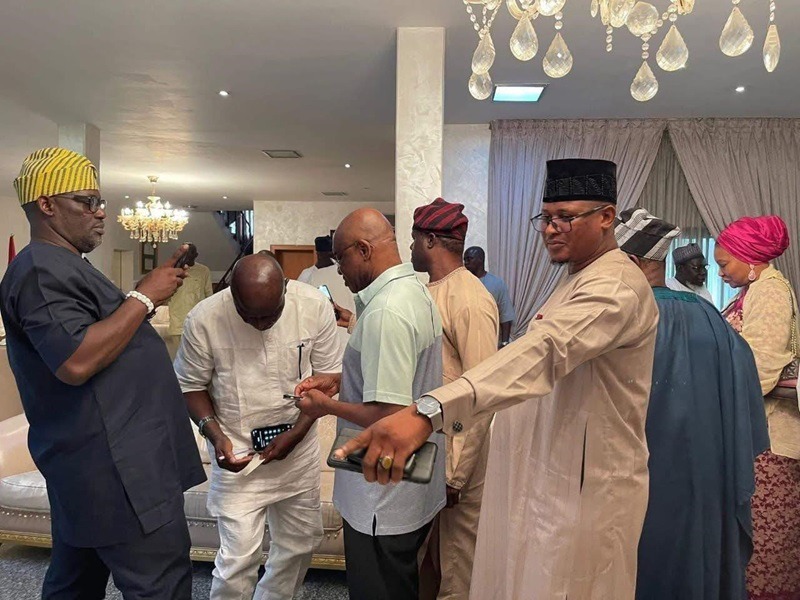
“I would like to use this opportunity to address a document currently circulating which claims that I resigned from my position as national vice chairman on May 17. I wish to state that this paper did not come from me and that is not my signature on it. The signature you see there was forged.” He also maintained that any resignation letter from him would have carried his official letterhead.
“When I was deputy national chairman, if I were to write a resignation letter, I would do it using my official letterhead. Any letter not containing my letterhead is not from me,” he added. Gombe had earlier made a similar denial in August 2025, describing the alleged resignation document as “entirely false, deceptive, malicious and fake”. According to Gombe, he assumed leadership of the party after the resignation of the former national chairman, Ralph Nwosu, and other members of the National Working Committee (NWC). His decision was announced during an event held on July 2 when new political figures showed interest in joining the party.
“On that day, the former ADC chairman, Ralph Nwosu, announced that he, his secretary and other party leaders were stepping down from their positions,” Bala said, adding that, “he told the world that I, along with other people, would continue running the party affairs until the national convention.” Gombe argued that under the party’s constitution, he automatically assumed leadership following the leadership vacuum. “Because of that, I am resuming office today as the ADC national chairman. According to our party constitution, when there is no leader, the deputy takes over,” he said.
APC TELLS ADC TO BLAME ITSELF
The governing APC asked the ADC to look inwards and stop blaming the governing party and federal government for its woes. According to the National Publicity Secretary of the APC, Felix Morka, the decision of INEC to de-recognize the “David Mark-led executives in compliance with judgment of court, is valid in law, justified in fact, and consistent with electoral policy and democratic practice. It is the consequence of the Party’s reckless and desperate misadventure. “
He said that it is “highly escapist and irresponsible for the ADC to blame the APC for its internal woes of which they are the sole architects. The ADC’s unwillingness to take responsibility for its miserable failure to follow due process, order its internal affairs, and manage its self-inflicted crisis makes ADC grossly unfit as a platform to be taken seriously by Nigerians. A party that cannot fix itself cannot possibly fix Nigeria.”

Amos Esele is the Editor of THEWILL Newspaper. He has over two decades of experience on the job.
