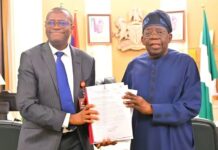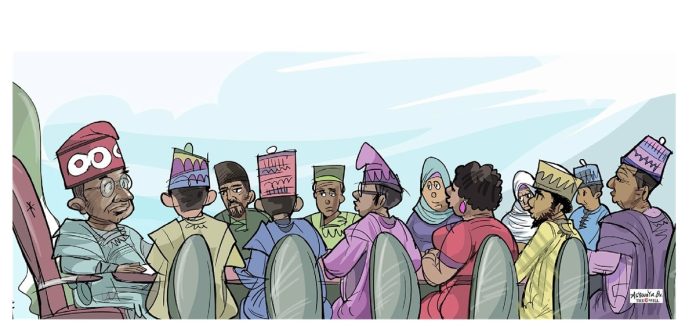
October 27, (THEWILL) – After several weeks of suspense, President Bola Tinubu last Wednesday laid to rest speculations of an imminent cabinet reshuffle. He approved the immediate implementation of eight far-reaching actions that the presidency said were meant to “reinvigorate the administration’s capacity for optimal efficiency,” pursuant of his commitment to deliver on his promises to Nigerians.
The eight measures that came into immediate effect after the meeting of the National Executive Council, NEC, on that Wednesday, include the “discharge” of five ministers, nomination of seven new ones and the merger of some ministries.
INTRIGUES, POWER PLAY
According to the presidency, the sacking, redeployment and nomination of the ministers were based on a performance assessment report mediated by Nigerians through the Citizens’ Delivery Tracker device that brought feedback on the performances of some government policies and projects of its ministries, departments and agencies.

The government’s Central Coordination Unit, headed by the Special Adviser to the President on Policy and Coordination, Ms. Hadiza Bala Usman, coordinated the project. Even so, there were some ministers whose retention had raised eyebrows as they were considered not up to par with expectations.
Three of them who dominated much of public discussion prominently after the presidential announcement were Minister of Power, Adebayo Adelabu, Minister of Marine and Blue Economy, Adegoyega Oyetola and Minister of State for Defence, Bello Matawalle.
The recent successive collapse of the national grid, leading to drastic reduction of the national wattage from 7,000 to 4,000, which plunged many parts of the country into darkness for hours threw the supervising minister up for savage public scrutiny.
Matawalle’s public quarrel with the Governor of Zamfara State, Dauda Lawal, over allegations of sponsoring banditry in the North-West state was bad for the federal government’s efforts in fighting insecurity, while Oyetola is perceived to be struggling and yet to find his footing in the new Ministry.
Investigations by THEWILL, however showed that, contrary to the presidency’s position, a high degree of intrigue and power play was at work. At one point, subtle politics was at play, at another it was an open clash of interest and inaction, as well as a display of narrow vision on the part of some of the ministers.
According to a dependable presidential source, the Ministry of Youths had found itself in a situation where the Minister of State, Ayodele Olawande was not getting along with the substantive minister, Dr Jamila Bio Ibrahim. Olawande was stronger than Ibrahim politically and so, it was difficult for both to work together smoothly.
Although she came from a political family with a father who was Minister for Transport under late President Umaru Musa Yar’Adua and Minister for Sports under ex-President Goodluck Jonathan, Dr Jamila, who was a Special Assistant to Kwara State governor on Sustainable Development Goals before her appointment by President Tinubu in September 2023, was a mismatch for Olawande.
Apart from being a personal Assistant in Vice President Yemi Osinbajo’s office from 2019 to 2023, Olawande was also a former Southwest coordinator of Asiwaju Grassroots Foundation and Deputy Director and the Presidential Campaign Youth Council in the South-West.
“Politically, Olawande was considered stronger than her and then she did not quite align her ministry to the administration’s Renewed Hope Agenda and this made her lose focus,” the source said.
In the same vein, Dr Morufu Olatunji Alausa, former Minister of State, Health and Dr Mohammed Ali Pate, Coordinating Minister for Health and Social Welfare, did not get along at all, one source told THEWILL. In fact, the source described the relationship between both ministers as “choked.” In the end, Alausa, who is also the ‘President’s man’ had to be moved to the Ministry of Education to sustain the Lagos State ministerial slot.
The other case of open display of conflict of interest was presented by Dr Doris Uzoka-Anite, Minister of Industry, Trade and Investment, redeployed as Minister of State, Finance in the shake-up. She was said to have escaped the “presidential axe in the last minute of manoeuvres.” The source of her trouble, according to sources, was a prolonged, if not embarrassing, battle with the Nigerian Association of Chambers of Commerce, Industry, Mines and Agriculture, NACCIMA. The association was said to have complained to the President severally that the minister saw them as “a competitor rather than an enabler of the associations as far as bilateral and multilateral events were concerned.”
She was not promoting NACCIMA as a champion of the Nigerian industry. Fearing the inevitable, she was said to have reached out to her close associate Olawale Edun, the Minister of Finance and Coordinating Minister of the Economy, who intervened on her behalf. Former Minister of Education, Prof Tahir Mamman, a Senior Advocate of Nigeria, presents a case of open bias that trailed his tenure. Besides controversial policies like the university admission policy and the accreditation of universities in neighbouring Benin Republic and Togo, which caused a diplomatic row between those countries and Nigeria, that dogged his tenure, the last straw for the minister was an interagency conflict triggered by his constitution of the Tertiary Institutions Management Board. For a board that is supposed to have at least 10 members from each state, the minister was said to have allocated 37 slots to his home state of Adamawa. “This action showed a lack of transparency on his part. A new committee had to be set up to review the appointments and the slots were shared among governors at 15 per state”, said the presidential source. The source added that President Tinubu did not find anything wrong with retaining Oyetola and Adelabu as they had keyed into the Renewed Hope Agenda of his administration.
“The problem with the Marine and Blue Economy is that it is still relatively new. It will take time for them to develop a working strategy before they begin to make the desired impact. In Adelabu’s case, people may not know it, but electricity supply has improved. In my house in Abuja, I get 22 hours of regular power unlike before. The man has identified the challenges of that sector, which are structural, and improved the transmission lines. Both ministers have keyed into the Renewed Hope Agenda. That is the point. In fact, many of those who were sacked had failed to key into the Renewed Hope Agenda.
“Having been appointed, the responsibility of every minister is to sit down and apply the agenda under their ministry, breakdown the agenda to suit their portfolios. An example is how the Ministry of Agriculture got 6,000 tractors to be distributed for mechanised farming. The Tourism Ministry failed to adapt. Arts and Culture did not. These are the undercurrents that played out in the cabinet shake-up.”
MASTERS OF THE GAME
Ministers who are said to be shining examples of those who quickly adapted the Renewed Hope Agenda to their portfolios and acting from that premise are Aviation and Aerospace Development Minister, Festus Keyamo, SAN. Doing so, sources said, has enabled him to bring some infrastructural and strategic development to the aviation industry, to the benefit of the airline operators and investors. FCT Minister, Nyesom Wike, is another minister. He is reclaiming the glory of the nation’s administrative capital through infrastructural development, according to its original design. The third is Minister of Interior, Olubunmi Tunji-Ojo, who has reformed the correctional centres, made access to visa and passport open and fast, as well as motivated paramilitary services under the ministry, while Dave Umahi, the Minister of Works has a firm grip on his portfolio.
ENTER THE SEVEN NEW MINISTERS
Among the seven new ministers, only two have been actively involved in the APC-dominated government before their reappointment. They are Muhammadu Maigari Dingyadi, Minister of Labour and Employment, who was Minister of Police Affairs in ex-President Muhammadu Buhari’s administration. The other is Jurist, Jumoke Oduwole who was Special Adviser to the President on Ease of Doing Business in the Office of Vice President Yemi Osinbajo. Afterwards, she served as Senior Special Assistant to the President on Industry, Trade and Investment from November 2015 to May 2019, in the immediate past government.
The other five are relatively fresh. Late Chief Emeka Odumegwu Ojukwu’s widow, Bianca, whose appointment is political. Although qualified for her posting, having served as Ambassador to Spain, her appointment serves as a contact point in the South-East for the APC’s plan to consolidate its foothold in that geo-political zone where the party already has two governors in two of the five states, namely Ebonyi and Imo, while each of Labour Party, All Progressive Grand Alliance, the Peoples Democratic Party hold sway in Abia State, Anambra state and Enugu State, respectively. The Minister of Humanitarian Affairs and Poverty Reduction, Dr Nentawe Yilwatda, was APC’s governorship candidate during the 2023 general poll in Plateau State. He fills the vacancy for Plateau State created by the exit of Senator Simon Lalong who resigned as Minister of Labour and Employment for the Senate after the Court of Appeal confirmed him duly elected to represent Plateau South Senatorial District in 2023.
Until his appointment into the Ministry of Livestock Development, Idi Mukhtar Maiha was a dairy farmer. He was Managing Director and CEO of Zaidi Farms Ltd in Kaduna, a farm that boasts of over 250 cattle, including Friesian, Simmental, and Jersey breeds, and features modern facilities such as pen houses, a milk parlour, tractors and hay barns. Apart from having a stint in Borno State Government as Commissioner for Agriculture and Natural Resources, he is a fresh hand at the national stage and is expected to bring his expertise to the new ministry, designed, among other things, to significantly address the often violent, bloody herder/farmer conflict.
Minister of Housing and Urban Development, Yusuf Abdullahi Ata is a former Speaker of the Kano State House of Assembly, while the Minister of State, Education, Dr Ahmad has been an Associate Professor of Education at Bayero University, Kano (BUK), since 2004. She is from Jigawa State and has served as the Director of the university’s Centre for Gender Studies, promoting research and initiatives focused on gender equality.
PRESIDENCY’S VERSION OF EVENTS
The Special Adviser of the President on Information and Strategy, Bayo Onanuga, through messages on his X account and interview on national television, explained how the reshuffle unfolded. He said the process began in August 2023 when the ministers were sworn-in and the President informed them that since he had the power to hire and fire and would not retain ministers who could not perform.
At a follow-up retreat in October, the President repeated the warning about his plans to always rejig his cabinet. He also told them there would be an appraisal of their performance, coordinated by Special Adviser to the President on Policy and Coordination and Head, Central Delivery Coordination Unit, Ms. Bala-Usman. So, the sacking, redeployment and nomination of fresh Ministers last Wednesday, was not done whimsically, Onanuga said. According to him, the government even asked Nigerians to score the ministers. This was done. The ministers were removed from office based on public perception and those empirical facts. It was the people who actually did the score cards based on performance. Sometimes at cabinet meetings, the President often reminded the ministers to go to the people and explain what the government was doing.
ON D-DAY
Explaining further, Onanuga said that after the National Executive Council, NEC, meeting last Wednesday, President Tinubu called the ministers for a meeting, thanked them for the services they had rendered and explained why they had to go. He did it in a polite way. The only hint that the President dropped during the NEC meeting was when at the end of the meeting, he named five ministers and asked them to see him. The administration’s Renew Hope Agenda is not a mere slogan, but in fact a manifesto encompassing all the policy direction and reforms implementation. That is the template the ministers must work with.
ON NEW APPOINTMENTS
Onanuga argued that the new appointments were done with the aim to engage the best hands for the job. Bianca Ojukwu’s diplomatic experience is said to have weighed in her favour, for which reason she was nominated as Minister of State for Foreign Affairs. Minister of State for Health, according to Onanuga, is a former US based medical doctor, “who is versatile and had done well in the Health and Social Welfare Ministry, but the president wants to challenge him to do more, hence his redeployment as Minister for Education.
He further disclosed that the President plans to expand the scope of the ministry to enable the government to fulfil its pledge to offer palliatives to the vulnerable in the society through a properly coordinated method, using identification verification like the NIN for tracking purposes.
“At a time Nigeria is having challenges in the form of food insecurity and food inflation, the President thought it wise to create a Ministry of Livestock Development, separate from agriculture, as a way to frontally address these challenges,” he said, further explaining why there was an additional ministerial portfolio.
THOSE EXPECTED TO GO BUT REMAINED
Minister of State for Defence, Bello Matawalle is one of those that escaped the hammer. He recently had a running media battle with the Governor of Zamfara State, who is also his successor in office, Dauda Lawal, over allegations of sponsoring bandits. Onanuga said the allegations were investigated by the Office of the National Security Adviser, NSA, Nuhu Ribadu and found to be false.
He said, “As far as I know, most of those things were just mere allegations. People are just bringing out all kinds of fake things and allegations. The President, I am sure, has heard many stories about him. For him to be there shows that, like I have said, some of those things have been probed. They have been found not to be true. “I even got one of such messages which I sent to the NSA and he replied he had probed and found them to be untrue.”
HOW THE CHANGES TOOK PLACE
Explaining the eight point measures it took to reposition the economy, the presidency said they included the renaming of the Ministry of Niger Delta Development to the Ministry of Regional Development, which will oversee the activities of all the Regional Development Commissions. The Regional Development Commissions to be under the supervision of the new ministry are the Niger Delta Development Commission, the South-East Development Commission, the North-East Development and the North -West Development Commission. The second measure was the immediate winding up of the Ministry of Sports Development and the transfer of its functions to the National Sports Commission.
Others were the merger of the Federal Ministry of Tourism and the Federal Ministry of Arts and Culture to become Federal Ministry of Art, Culture, Tourism and the Creative Economy; The re-assignment of ten (10) ministers to new ministerial portfolios; The sacking of five (5) Ministers; The nomination of seven (7) new ministers for onward transmission to Senate for confirmation; The appointment of Shehu Dikko as Chairman of the National Sports Commission and the appointment of Sunday Akin Dare as Special Adviser to the President on Public Communication and Orientation working from the Ministry of Information and National Orientation
The list of former ministers, who were redeployed, and their assigned portfolios are Dr Yusuf Tanko Sununu, who was Minister of State, Education now redeployed to Ministry of Humanitarian Affairs and Poverty Reduction as Minister of State; Dr Morufu Olatunji Alausa, formerly Minister of State, Health, now Minister of Education; Barr. Bello Muhammad Goronyo, formerly Minister of State, Water Resources and Sanitation, now Minister of State, Works and Hon. Abubakar Eshiokpekha Momoh, previously Minister of Niger Delta Development, now Minister of Regional Development.
Others are Uba Maigari Ahmadu, ex-Minister of State Steel Development, now Minister of State Regional Development; Dr Doris Uzoka-Anite, Minister of Industry, Trade and Investment, now Minister of State Finance; Sen. John Owan Enoh, Minister of Sports Development, now Minister of State, Trade and Investment, (Industry); Imaan Sulaiman-Ibrahim Minister of State, Police Affairs, now Minister of Women Affairs; Ayodele Olawande, Minister of State for Youth Development, now Minister for Youth Development and Dr. Salako Iziaq Adekunle Adeboye, Minister of State, Environment, now Minister of State, Health. The five ministers that were sacked are Barr. Uju-Ken Ohanenye, Minister of Women Affairs; Lola Ade-John, Minister of Tourism; Prof Tahir Mamman, SAN, Minister of Education; Abdullahi Muhammad Gwarzo, Minister of State, Housing and Urban Development and Dr. Jamila Bio Ibrahim, Minister of Youth Development. The seven new Minister-nominees are Dr Nentawe Yilwatda, Minister of Humanitarian Affairs and Poverty Reduction; Muhammadu Maigari Dingyadi, Minister of Labour and Employment; Bianca Odinaka Odumegwu-Ojukwu, Minister of State, Foreign Affairs, Dr Jumoke Oduwole; Minister of Industry, Trade and Investment; Idi Mukhtar Maiha, Ministry of Livestock Development; Rt. Hon. Yusuf Abdullahi Ata, Minister of State, Housing and Urban Development and Suwaiba Said Ahmad, Ph.D; Minister of State Education, Federal Ministry of Education.
REACTIONS
As expected, opinion is divided on the essence of the cabinet reshuffle. While the Nigeria Labour Congress, NLC, commends the President’s “bold move,” and demands “more action to address the country’s economic and social challenges,” the Federation of Tourism Associations of Nigeria (FTAN, described the news of the merger of the Ministry of Tourism and the Ministry of Arts, Culture and Creative Economy as a “rude shock,” but called on the government to see the convergence of these sectors under one ministry as a unique opportunity for a more integrated approach to development.
For Professor of Political Economy at Lagos State University, Sylvester Odion-Akhaine, no significant change is expected with the cabinet reshuffle. “It is motion without movement,” he told THEWILL on Friday, “Nothing in the cabinet that bodes well for the national economy.”
However, the National Coordinator of Shareholders Association of Nigeria, Moses Igrude, expressed the hope that the change will bring some vibrancy into governance. “We hope the new ministers will be able to drive the vision of the President because the government needs to continue to pursue policies that will enhance the business environment so that the private sector can thrive. Exchange rate fluctuation is affecting servicing of loans and affecting engagement in steady production. We also hope that ease of export will be enhanced too with this new change. The renewed fight over insecurity should be sustained so that capital can feel safe to move into the country,” he told THEWILL on Friday.

Amos Esele is the Editor of THEWILL Newspaper. He has over two decades of experience on the job.