
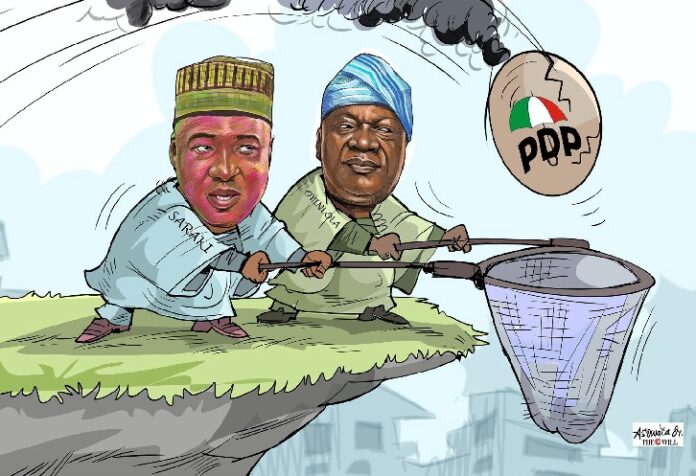
May 18, (THEWILL) – With less 10 days before the crucial meeting of the National Executive Council, NEC, of the Peoples Democratic Party, PDP, on May 27 and then the National Convention, all eyes are on the Dr. Bukola Saraki led seven-man committee and the retired General Olagunsoye Oyinlola National Reconciliation Committee.
“The tasks of the committees are very clear, to ensure a rancour-free NEC meeting, which will then plan for the National Convention of the party sometime in August this year,” a chieftain and former National Publicity Secretary party, Mr. Kola Ologbodinyan told THEWILL at the weekend. “But the success of the Saraki Committee will depend to a large extent on cooperation between members and leaders of the party, particularly on issues that have created division in the party over a long time.”
These issues are essentially politically driven by leaders who are either using fronts to settle old scores or positioning themselves for the politics of the 2027 General Election. In the end, seemingly opposing factions have emerged, leaving the party polarized, such that state governors, senior lawmakers and other members are literally defecting to the governing All Progressives Congress, APC, daily. In the end, the once all-conquering PDP that ruled the country for 16-years unchallenged until the emergence of the APC in 2013, is now almost a shadow of itself. In fact, it was the Supreme Court judgement of March 14, 2024 which reiterated party supremacy over strictly inter-party matters that halted the further slide into chaos.

As of press time, one out of the party’s 11 state governors, Sheriff Oborevwori of Delta State had defected to APC alongside 25 Local government chairmen and his cabinet; four out of 36 Senators and 16 out of 118 representatives have defected to the ruling party. More governors, senators and representatives are threatening to follow. All the defectors have claimed the prolonged party crisis as the trigger for their defections.
“The Saraki and Olagunsoye Committees will succeed in their tasks,” a dependable party source confided in THEWILL on Thursday night. “Their pedigree and status show they can deliver on their assignments. That was why the party leadership entrusted them with the responsibility.
Both Committee Chairmen were once governors on the platform of the party. For Oyinlola, also a former National Secretary of the party, his military background makes him a bridge to the retired military generals which wield a lot of influence in the party.
Saraki on the other hand has been involved in party politics since his days as aide to President Olusegun Obasanjo; Governor of Kwara State, President of the Senate whose tenure witnessed robust inter-dependent relationship with the executive arm to the point of conflict between them. He was also the party’s Chairman of Constitution Review before the 2023 election.
“Saraki has seen it all, fought and won many battles and can look at any party member or leader in the face. There is no doubt that the committees would deliver on their mandates to give the PDP a new lease of life,” the party source said.
However, the committees have different functions, though the goal is similar: The Saraki Committee, according to a party source, “ is like a Special Purpose Vehicle and adhoc, while the Oyinlola committee is more comprehensive in nature, addressing warring parties and aggrieved member in the party nationwide, moving from one geo-political zone to the other.”
In October 2024 for example, two months after it was inaugurated, the 25 member Olagunsoye committee mediated in the stalemate among members of the NWC, which resulted in Acting National Chairman, Amb. Umar Damagum, and the National Secretary, Sen. Samuel Anyanwu, issuing suspension orders to the party’s National Publicity Secretary, Debo Ologunagba and National Legal Adviser, Kamaldeen Ajibade.
In response, Ologunagba and Ajibade suspended Damagum and Anyanwu. The committee intervened before the PDP Governors Forum asked the warring parties to return to the status quo. Since then, it has gone around some geo-political zones in the country in pursuit of its mandate.
Mr Segun Sowunmi, spokesperson to the Presidential candidate of the party in the 2019, Atiku Abubakar and member of the Olagunsoye Committee, told THEWILL that the committee’s role is continuous, even up to the proposed national convention and beyond because ensuing issues involve reconciliation, managing interests and nuances of members.
He said the committee has so far made a far-reaching impact in areas of zonal collaboration in the South-West, Northeast and South-East geo-political zones.
Although he noted the short-lived nature of the Saraki committee, he expressed optimism in its success, “even though for now it will be difficult to know what they will come up with until they are ready and inform everybody.”
PREPARING THE GROUNDS FOR SARAKI COMMITTEE’S SUCCESS.
In addition to carefully choosing experienced Committee Chairmen, the party had temporarily walked the tightrope of one of the major divisive issues of the party; the position of National Secretary.
Although state governors elected on the platform of the party had tried to resolve the matter at an earlier meeting in Ibadan, Oyo State by appointing the Deputy National Secretary, Arch Setonji Koshoedo, to serve as acting National Secretary after both Senator Samuel Anyanwu and Hon. Sunday Ude-Okoye insisted on the position despite the apex court ruling, the issue has continued to linger.
Senator Anyanwu and Hon Ude-Okoye and their backers have continued to lay claim to the position on the strength of their respective interpretation of the Supreme Court ruling. This has continued to pose a legal challenge to the party. In addition, leaders at the Abuja meeting last week also expressed fear about the legal implication of allowing the Acting National Secretary to serve as a signatory to documents for the Independent National Electoral Commission, INEC. The party’s constitution only gives that power to the Deputy Secretary in the event that there is a vacancy in the position of National Secretary.
It was to break this deadlock that part leaders set up the Saraki reconciliation committee last week. Its major task therefore is to meet and listen to all the parties to the dispute and find a lasting way out of the crisis with the National Secretary position.
Along with Saraki, other members of the seven-man committee are serving and former governors elected on the platform of the party: They are Governor Dauda Lawal, of Zamfara State; Governor Caleb Muftwang of Plateau State and Governor Peter Mba of Enugu State.
Governor Seriake Dickson of Bayelsa State and former Governors of Gombe and Abia States, namely, Sen. Ibrahim Dankwambo and Chief Okezie Ikpeazu make up the other members of the Commitee.
LINGERING ISSUES IN THE PARTY
Although Saraki has expressed “ hope to do our best in delivering on the assignment given to us,” investigation shows that there is a major challenge facing his committee. According to a source, the first challenge is generational.
In the first instance, there are old party leaders and members who are said to be out to frustrate every reconciliation move unless the party does the right thing in their estimation.
The Federal Capital Territory Minister, Nyesom Wike, is said to be the leader of this group. He is a major backer of Senator Anyanwu, a claimant to the national secretary position in the party. He kicked against the Governors’ Forum decision to fix the convention for August and the NEC meeting, accusing them of usurping powers as enshrined in the party’s constitution.
His media spokesperson, Lere Olayinka confirmed to this newspaper that his boss, Wike is ever ready to legally challenge the decision to remove Senator Anyanwu from office.
He told THEWILL that people are making the mistake by saying that Wike is supporting Anyanwu whereas the right thing to say is that the FCT Minister is insisting that the right thing should be done, which is to obey the court ruling on the position of the National Secretary and follow the rules laid down in the party’s constitution.
“What is wrong in Wike being Anyanwu’s backer? When the Appeal Court ruled in favour of Ude-Okoye, did the minister kick against it? The problem in the party is very simple and straightforward, but for people who are trying to work to an answer. Anyanwu did not resign his position when he went to contest for Imo State governorship, which is not against the party’s constitution. Taraba State Governor, Agbu Kefas was state party chairman and did not resign his position before he contested for the governorship ticket of the party. Fixing a NEC meeting and National Convention without the input of the National Secretary, which is Anyanwu, will lead to an illegality. So, the real problem in the party are those pursuing an Anyanwu-must-go agenda. If the Saraki Committee goes against Anyanwu then we will challenge the matter in the courts. If my boss does not do it, I will do so. The questions will be, did Anyanwu resign as National Secretary, no? Has his tenure ended, no? For God’s sake, the tenure of the current National Working Committee expires in October this year. Why are we not ready to wait till then?”
On top of this hard- line position, there is the precondition for peace handed down by the Southeast geo-political zone of the party last week after a zonal meeting in Enugu. Arising from the meeting, the Chairman of the PDP, South-East Zonal Executive Committee (ZEC), Dr Ali Odefa said the meeting of stakeholders, including Governor Peter Mbah, reached a consensus that, “Sunday Ude Okoye should be the candidate to complete the term of office of the national secretary”.
He said the meeting mandated the “National Working Committee (NWC) to uphold its decision at its meeting on April 29, 2025, by ensuring that the Deputy National Secretary of PDP functions as the Acting National Secretary, pending the ratification of the nominee for the office of the National Secretary by the National Executive Committee (NEC) of our great party in line with the recommendations of the PDP Governors Forum.
Odeifa reminded the party leadership that the state has waxed stronger as a stronghold of the PDP from inception, following recent defections from two House of Representative members and 10 LP Assembly lawmakers of the Labour Party.
“However, in the event that our position is not properly implemented by the party, the South-east PDP as a family will be compelled to reconsider our relationship with PDP going forward,” Odeifa warned.
With the series of high profile defections from the party in the past weeks, this threat, if unattended to, may worsen the party’s misfortunes, especially in the Southeast zone. Enugu is the only state among the other four, where the PDP still maintains a foothold with Governor Mbah. At present, the governor is said to be set for defection to the APC, should the party crisis deepen.
THE FEAR OF MORE DEFECTIONS
Remotely compounding issues in the party is the fear of more defections, which is said to be spreading among many PDP leaders and members, almost to the point of panic.
To check the fever from spreading, sources say the Saraki Committee has been doing “something in addition,” to their brief. They are talking to members that the defections in the party is like history repeating itself.
According to the sources, a similar wave of defections happened during the first two years of President Muhammadu Buhari’s first term in office when the party was hit by internal crisis.
Then, APC party bigwigs, including former Vice President Atiku Abubakar, Governor Aminu Tambuwal of Sokoto State, former Governor of Kano State, Rabiu Kwankwaso and the then Governor of Benue State, Samuel Ortom defected to the opposition PDP. Then at the legislative level, President of the Senate, Bukola Saraki and House Speaker Yakubu Dogara, defected to the PDP, leading to the APC losing its majority in the National Assembly.
Moreover, they argue that defections do not necessarily translate into voter power for candidates if the performance of the three major presidential candidates in the 2023 general elections were compared, for example.
The governing APC candidate and now President Bola Tinubu who polled 8,794,726 votes won the election in Rivers, Borno, Jigawa, Zamfara, Benue, Kogi, Kwara, Niger, Osun, Ekiti, Ondo, Oyo and Ogun states, while the first runner-up, Atiku Abubakar of the PDP scored 6,984,520 and won in Katsina, Kebbi, Sokoto, Kaduna, Gombe, Yobe, Bauchi, Adamawa and Taraba states. He also won in Osun, Akwa Ibom and Bayelsa states.
Mr Obi, who had no support from any party governor, lawmakers and political heavyweights of note polled 6,101,533, and won in Edo, Cross River, Delta, Lagos, FCT, Plateau, Imo, Ebonyi, Nasarawa, Anambra, Abia and Enugu states.
“The elections will be decided by the Nigerian people. Their assessment of prevailing realities will determine the choices they make,” said Chief Sowunmi, adding, “We hope our party will settle its crisis soon enough we are able to play by the books.”
WAY FORWARD
Asked what other options are open to the party now that the South-East has handed a threat to the leadership and the pro-Senator Anyanwu supporters are sticking to their guns, Olayinka said the leaders know what to do.
“Call the aggrieved, beg them, appeal to their sense of justice and fairness and assuage their feelings and things will be resolved that way,” he said.
Sowunmi said the crisis in the party has thought everyone a lesson. “I have come to accept that human beings will take decisions as they deem fit. The Constitution allows freedom of expression and assembly. Those who want to defect can and should do so. Many of us have come to realise that these things happen and they will ultimately lead to the evolution of party processes in the country.”
Ologbodinyan said, “If the members and leaders of the party cooperate with the Saraki Committee and allow negotiations that satisfy everybody, things will be settled swiftly and the party will move on and become stronger for it. Are you sure the members and leaders will not accept to move the party forward.? They should.”
THEWILL learnt that the party will accept the pre-condition for peace issued by the Southeast, preferring Ude-Okoye to Anyanwu. But that would depend, according to My Olayinka, on how the feelings of the aggrieved are assuaged and accomodated in the scheme of things.

Amos Esele is the Editor of THEWILL Newspaper. He has over two decades of experience on the job.
