
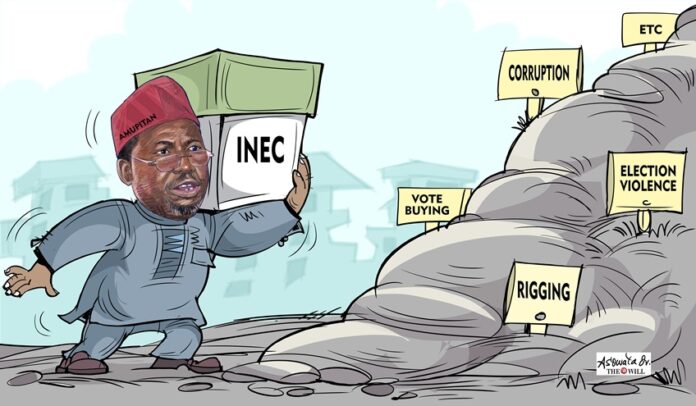
October 19, (THEWILL) — For those who read about his aspiring mission statement or listened to him speak during his televised screening at the Senate on Thursday as Chairman of the Independent National Electoral Commission, INEC, Professor Joash Ojo Amupitan, more or less delivered a manifesto by which he would be assessed on the job.
Wary of similar promises in the past by Amupitan’s predecessors who were later humbled by systemic failures in the electoral process, discerning Nigerians expect to see the new INEC chairman walk his talk.
“As one of the election stakeholders in Nigeria, we at the International Press Centre, IPC, heard the promises which the new INEC Chairman has made. He has promised to be accountable, to restore trust and ethics to the job and to earn the faith of Nigerians in the electoral process. Well, as people say, talk is cheap. He has to walk his talk,” Mr Lanre Arogundade, IPC Executive Director, told THEWILL on Friday. “We want to see how he will fulfil his promises.”

As someone whose organisation is one of the few CSOs that have been engaged in the electoral process under the European Union Support to Democratic Governance in Nigeria Project over the past five years, Mr Arogundade said that some challenges would test the will and capacity of the INEC helmsman. Funding, even when approved, is not released in full and on time, logistics, particularly with transportation and the work overload at the Commission, necessitating the need to unbundle it.
But if his leadership goes beyond rhetoric to tackle entrenched systemic weaknesses, Prof. Amupitan can deliver on his promises, said Okechukwu Nwanguma, Executive Director of Rule of Law and Accountability Advocacy Centre, RULAAC. Nwanguma told this newspaper that Amupitan’s success will depend on three critical enablers.
“The critical enablers are political will from the National Assembly and the Presidency to allow INEC to operate without interference, institutional integrity within INEC itself, that is the commitment of national commissioners and state resident electoral commissioners and staff to uphold integrity and stakeholders’ cooperation, that is political parties, security agencies civil society and the judiciary to respect and defend the integrity of the process.”
According to him, every INEC Chairman arrives amid hope and scepticism. “Each inherits both the promise of reform and the baggage of distrust. From the days of Justice Victor Ovie-Whiskey to Humphrey Nwosu, Maurice Iwu, Attahiru Jega and Mahmood Yakubu, the story has been cyclical. Reforms are announced with fanfare, integrity tested by political interference and ultimately, history left to judge.”
A FLAWED ELECTORAL PAST
Indeed, without exceptions the country’s elections from 1983 under Ovie-Whiskey through Eme Awa to Nwosu, Guobadia, Iwu, Jega and Yakubu have been characterised by systemic failures, widespread irregularities, violence and voter intimidation, snatching of ballot boxes, malfunctioned machines and vote inflation and manipulation. The story has been the same, government type-civilian or military-notwithstanding.
In 1983 for instance, an election petitions tribunal had to reverse elections of opposition strongholds in the western and eastern parts of the country before riots in those zones subsided. Addressing journalists on the conduct of the polls then, Ovie-Whiskey, said, “we did not expect to be perfect,” though he insisted that the elections were free and fair.
Similarly, under the military regime of General Ibrahim Babangida, the 1993 presidential election, presumed won by businessman Moshood Abiola, was annulled and the country was plunged into civil strife that claimed the lives of many Nigerians.
Thirty-two years later, Gen. Babangida, during a public presentation of his autobiography, ‘A Journey In Service,’ on May 2025, admitted: “Although I am on record to have stated after the election that Abiola may not have won the election, upon deeper reflection and a closer examination of all the available facts, particularly the detailed election results…there was no doubt that MKO Abiola won the June 12, 1993 election.”
In fact, the 2007 general election was so bad that even the beneficiary, late President Umaru Musa Yar’Ardua, told the world during the January 25, 2008 G8 summit in Davos, that that the election he won “had flaws and shortcomings” and promised electoral reforms to correct the system.
Reflecting on the illegitimacy that election conferred on their administration, ex-President Goodluck Jonathan said at a recent public outing that he always faced embarrassing questions during foreign trips.
He said, “Although we took oath of office and the Supreme Court declared us winners, each time one travelled abroad, people asked all kinds of questions that even got one angry. That was when I promised myself that if I have an opportunity to oversee elections in Nigeria, no other President or Vice President should suffer that kind of harassment and embarrassment by the international community.” Yet the logistics and election management issues persisted such that even Jonathan spent many hours at his Bayelsa ward polling unit on re-election day because of malfunctioned BVAS.
The arguably better tenure of Prof Attahiru Jega was also challenged. He postponed elections twice, first in 2019 when the Commission announced the postponement of the general election by six weeks less than 10 hours to the commencement of the voting process and after foreign observers had arrived in the country a day earlier. He gave insecurity as the reason. In 2011, Nigerian voters experienced another election postponement. INEC announced that the election had been moved by two days even when the National Assembly election scheduled for April 2, 2011 had begun in some states like Lagos, Kaduna, Kebbi, Delta, Zamfara and Enugu. This time around, Jega, said the postponement was due to late deployment of electoral materials.
The poll was moved to April 9, while the presidential election was moved from April 9 to April 16, 2011, and state elections April 23 from April 16.
The technical “glitch,” that marred the 2023 presidential election results is still fresh in the memories of Nigerians. Although INEC later released a report on the election and explained away the glitch as a technical, non-human error, the new INEC Chairman made reference to it during his screening at the Senate, showing that the so-called human error still needs to be properly addressed. He promised to review it.
According to Amupitan, the review would help restore credibility to the country’s electoral process and strengthen the deployment of election technology ahead of future polls.
He said, “I believe what happened in 2023 was subsumed as a glitch. Before the election, my understanding, based on a review of Supreme Court decisions, was that there was no clarity as to the purpose of IReV. The IReV was supposed to be a safeguard for comparison because the laws made by this distinguished Senate did not do away with manual collation. However, IReV was supposed to provide some guarantee for checks and balances.”
At a recent One-Day Stakeholders’ Roundtable on Premature Political Campaigns organised by The Electoral Institute (TEI) at its headquarters in Abuja, shortly before he stepped down on completion of his tenure, former INEC Chairman Prof Mahmood Yakubu restated the tone of the Commission’s major challenge as a gap in the electoral legal framework.
Citing Section 94(1) of the Electoral Act 2022, which stipulates the 150-day campaign period, Yakubu disclosed that “there is no sanction whatsoever concerning breaches for campaigns earlier than 150 days to an election. Here lies the challenge for the Commission.”
He lamented that such unethical actions “undermine the Commission’s ability to track campaign finance limits as politicians, prospective candidates and third-party agents expend large amounts of money that cannot be effectively monitored.”
Arguing that Amupitan is coming at a time that the country is weary of broken promises, Nwangunma, submitted that his task is not merely to manage an institution but to restore public trust in the ballot as an instrument of change.
“He must understand that credibility is earned, not declared and that no electoral body can stand tall when it leans towards political power.”
For Alhaji Yusuf Dantalle, Chairman of the Inter-Party Advisory Committee, IPAC, the umbrella body of registered Political Parties in Nigeria, Prof Amupitan has given his words. It is left for Nigerians in their various capacities to ensure he lives up to them.
“Even among prophets, there are deviants, ” he said in a brief interview with THEWILL., adding, “We should expect him to deliver. He should know that the Nigeria of 2023 is different now.”
Comrade James Ezema, Deputy National Publicity Secretary of the Conference of Nigerian Political Parties, CNPP, said: “The system is made up of institutions and persons. If they genuinely desire change, this will further provide the moral support for the INEC Chairman to perform. Additionally, the ongoing constitutional and electoral reform proposals being discussed at the National Assembly, including memoranda from stakeholders, will further boost his capacity to succeed.”
NASS ELECTORAL REFORM PROPOSALS
Meanwhile, the National Assembly has promised to expedite action on a series of electoral and constitutional reforms to ensure free and fair conduct of elections in the country. Though it stepped down submissions by the Senate and House Committee proposals for wider consultations, the federal lawmakers gave an inkling of what reforms to expect last Thursday.
Explaining the details of the proposal last week, the Chairman of the House Committee on Electoral Matters, Hon. Adebayo Balogun, said the move is designed to ensure that all election litigations are dispensed with before the swearing in of winners. Other proposals are that the electronic transmission of results would be mandatory, with penalties for non-compliance.
AMUPITAN’S MISSION STATEMENT
During his screening at the Senate, Amupitan, full of zeal, unveiled an assertive plan to reposition INEC for effectiveness and efficiency. He promised to do “a comprehensive audit of the 2023 general election, set up an Ethics and Accountability Committee within INEC to investigate internal lapses, review pending complaints, introduce a whistleblower policy to expose corrupt practices within the commission and among electoral officials, work with the National Assembly to establish an Electoral Offences Commission empowered to investigate and prosecute electoral crimes, including through forensic means, deploying drones and advanced monitoring devices to ensure real-time surveillance and secure transportation of materials, especially in difficult terrains.”
“We must make Nigerians believe again that their votes matter. Under my leadership, INEC would ensure a transparent process where losers will congratulate winners without disputes,” he said.

Amos Esele is the Editor of THEWILL Newspaper. He has over two decades of experience on the job.
