
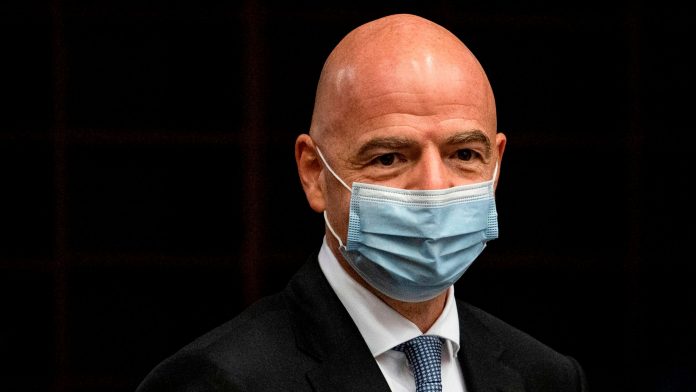
At a Wednesday, January 26 session of the Parliamentary Assembly of the Council of Europe (PACE) 2022 winter plenary, President of world football governing body, FIFA, Gianni Infantino incurred the ire of many when he expressed himself in terms that were liable to misinterpretation. Infantino was addressing the Strasbourg-hosted session on a debate on football governance: business and values and on sports policies in times of crisis, and the FIFA President stressed the need for a biennial World Cup on the basis that it would provide more opportunities for people across the globe. It was all according to script until Infantino said: “We need to give opportunities and we need to give dignity. Not by giving charity, but by allowing the rest of the world to participate. We need to give hope to Africans so they don’t need to cross the Mediterranean in order to find, maybe, a better life, but more probably death in the sea.”
Expectedly, this was not warmly welcomed by the majority of those who reacted to the migration reference and not a few found it incredulous for the knowledgeable Infantino to so offhandedly couch his arguments for more African participation in the hosting of the global football tournament with migrants who risk their lives through the crossing of the Mediterranean for a chance at a better life overseas. Yet, to make the reference even more curious, the 51-year-old football administrator appeared to concede that the availability of more hosting chances may not be the silver bullet for cross-Mediterranean migration, when he said that a biennial World Cup “might not be the answer” while adding: “We will discuss what the best way is to be more inclusive, not just to speak about saying no to discrimination, but to actually act in exactly that direction. By being more inclusive. By bringing everybody on board. By trying to give opportunities, hope and dignity to the entire world.”
The queries that that reference generated, while the TotalEnergies 2021 Africa Cup of Nations was underway in Cameroon, was swift and retributory. Racial sentiments, which had already been whipped up by the jaundiced perspective of the AFCON competition by the majority of big clubs in Europe, went overboard. These clubs, were trying to stop their players from honouring the invitations of their African nations to play at AFCON used every ploy imaginable, such as injuries, late arrival of call-up letters, COVID-related fears, threats of armed insurrection my separatists in Cameroon and arm-twisting tactics, to stop these African stars on which their team chances depended from making it to Cameroon with their compatriots. Only the insistence of the Confederation of African Football working in tandem with the local organising committee and the determination of African footballers to be at the biggest football competition on the continent saw to the overwhelming success of the competition.

It was head-scratching therefore that Infantino, who had unequivocally backed the need for AFCON while requiring European clubs to release African players and who had the support of the Confederation of African Football (CAF) in the proposals for a Biennial World Cup format, will turn around and engage in comments such as he made with a tinge of racial undertones. This discombobulating scenario underlined the general theme of reactions to Infantino’s framing of his stance. For instance, Tony Burnett, Chief Executive of “Kick It Out”, the organisation that challenges discrimination, encourages inclusive practices and works for positive change, condemned the comments in a statement that said: “FIFA is a multi-billion profit-making organisation. They already have the funds to invest in creating and inspiring opportunity for disadvantaged people around the world. It is therefore completely unacceptable to suggest that a biennial World Cup, predominantly set up to drive further profits for FIFA, could be a solution for migrants who risk their lives, sometimes fleeing war-torn countries, to seek a better life. If FIFA has a genuine commitment to tackling inequality, they should be investing time and resource into charitable causes on the ground, rather than disguising what appears to be a profit-making biennial World Cup as the answer to any existing problems.”
In a more barbed reaction to Infantino’s comment, Ronan Evain, the chief executive of Football Supporters Europe, tweeted: “How low can Infantino go? Instrumentalising death in the Mediterranean to sell his megalomaniac plan is beyond words.” The sharp criticism from Europe is to be expected as the continent’s response to the Future of Football project, led by the former Arsenal manager Arsène Wenger and under which the football body’s biennial plans are couched, has been a resounding “No”. But, the most related push back came from the professional, who work directly with those who know a lot about migration across the Mediterranean and have the insight to tell that could have informed Infantino’s linking of Football, world cups and the Mediterranean. Andrew Stroehlein, media director at Human Rights Watch (HRW) tweeted: “My colleagues at Human Rights Watch interview refugees around the world pretty much every day. We write reports about the reasons — the abuses, the hardships — that forced them to leave their homes. They never mention the timing of World Cup tournaments.”
It did not take long for it to become abundantly obvious to the FIFA President and his crew that he had inadvertently put himself in a bind. To wriggle himself free, Infantino needed to offer some clarification. For that purpose, he said: “Given that certain remarks made by me before the Council of Europe earlier today appear to have been misinterpreted and taken out of context, I wish to clarify that… my more general message was that everyone in a decision-making position has a responsibility to help improve the situation of people around the world. If there are more opportunities available, including in Africa, but certainly not limited to that continent, this should allow people to take these opportunities in their own countries. This was a general comment, which was not directly related to the possibility of playing a World Cup every two years.”
On the whole, the reason for the criticism the FIFA President faced and the defense he ventured in his efforts at clarifying what he meant were not exactly incongruent. Infantino was recommending more tournaments on the African continent based on his belief that it will, with FIFA’s support, help governments in Africa provide opportunities in their countries which were lacking and which absence led many to risk lives and limbs on the arduous and perilous journey overseas in search of a better life for themselves and theirs. While it oversimplifies a major African problem to the barest, there is no gainsaying that Infantino failed to grasp the complex nature of the problem, which football hosting rights alone cannot resolve because the man himself made this concession when, aforementioned, he admitted that their biennial World Cup Proposals ,“might not be the answer”.
There is enough literature to point to existing problems in the harvesting in young talents from the continent abroad with promises of football glory and the chance to become the next George Weah, the next Kanu Nwankwo, the next Austin Jay Jay Okocha or the next Samuel Eto’o Fils. That is well documented as is the fact that only a fraction of those who leave Africa on such promises ever make something of their lives and football careers. Nonetheless, the desire to play professional football in Europe continues to drive hundreds of young boys to embark on a perilous migrant journey. Along the way, these young Africans frequently fall into the hands of unscrupulous gamblers and swindlers posing as football agents but actually are human traffickers.
These are today’s victims of football’s version of human trafficking: a slave trade that splits families apart, transports children to foreign cities, and then abandons them in the name of profit. North Africa and the coastal nations of the Sub-Saharan west of the continent are the two main exporting “zones” for traffickers. In 2009, the United Nations Commission on Human Rights issued a report warning of the emergence of a “modern slave trade” involving young African players. Between 2005 and 2014, there were more than 7,000 recorded incidents in France alone, according to a research by the Culture Foot Solidaire (CFS), an organisation dedicated to combating football trafficking. Foot Solidaire calculates that agents pocket anywhere between £2,000 and £6,500 for each child they send to a fictitious trial. According to CFS, 98% of those would-be footballers who make it to Paris are illegal immigrants, and 70% are under the age of 18.
These are not to be jumbled in the same taxonomy as economic migrants looking for access to Europe through the Mediterranean. Yet, both of these classes of migrants require committed, complex structural solutions beyond what a biennial World Cup format, that serves to enrich FIFA’s coffers, can provide. And, it will do the President to be more circumspect about his choice of words in future.

Jude Obafemi is a versatile senior Correspondent at THEWILL Newspapers, excelling in sourcing, researching, and delivering sports news stories for both print and digital publications.
