
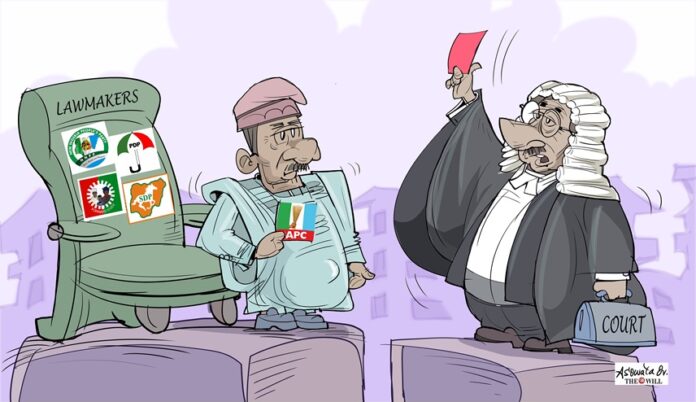
November 02, (THEWILL) — In sacking Hon. Abubakar Gummi, a federal lawmaker representing Gummi/Bukkuyum Federal Constituency of Zamfara State in the House of Representatives last week for defecting from the major opposition Peoples Democratic Party, PDP, to the governing All Progressives Congress, Justice Obiora Egwuatu opened the proverbial Pandora Box of pending lawsuits for many senior and junior lawmakers at the national and state levels.
The Abuja Federal High Court judge, Egwatu, faulted and dismissed the lawmaker’s plea that he defected due to internal crisis in his party at both the state and national levels.
Delivering judgement on the ruling following a suit marked FHC/ABJ/CS/1803/2024, filed by the PDP and its Zamfara State Chairman, Jamilu Jibomagayaki, through their counsel, Ibrahim Bawa (SAN), which listed Hon. Gummi, the Speaker of the House and INEC as first to third defendants, Justice Egwatu rested his interpretation on the moral and legal implications of Section 68(1)(g) of the Constitution. The section forbids lawmakers from abandoning the political party that sponsored their election unless there is division within the party.

“Politicians must respect the wishes of the electorate who elected them into office. When voters choose a candidate based on the manifesto of a political party, it is both legally and morally wrong for such a politician to abandon that platform midterm and cross to another party without relinquishing the mandate,” Justice Egwatu, who described such acts as “political prostitution,” said, adding, “If a person must defect, don’t defect with the mandate of the electorate. A politician has no right to transfer the votes of a political party to another. The law must punish such moves by taking away the benefits bestowed upon the erring politician by the electorate.”
He directed the Speaker to declare Gummi’s seat vacant, INEC to conduct a fresh election in the constituency within 30 days to fill the vacant seat and ordered Gummi to refund all salaries and allowances he had received from October 30, 2024, to the date of judgment and to submit evidence of repayment to the court within 30 days.
Assessing the ruling, a seasoned politician, scholar and public intellectual, Prof Udenta Udenta, praised Judge Egwatu for making what he considered one of the best ruling on defections among lawmakers in the country.
Speaking to THEWILL in a brief interview on Friday, the founding National Secretary of the Alliance for Democracy, said, “Justice Egwatu deserves a Grand Commander of the Niger, GCON, honour, if not a Grand Commander of the Federal Republic, GCFR, award for delivering his judgement with key jurisprudential clarity and moral authority. You cannot separate the fact of the case from the morality of the case. The law is not a blind piece of wood like the Constitution which people make a fetish of, quoting section this and section that. This judgement is not judicial activism. It is a measured interpretation of the law, summoning the moral fibre that a judge must be clothed with.”
According to him, there is no confusion, no ambiguity and sentiment about what the judge has ruled. “We must bring order and clarity on our constitutional development and our political evolution.”
He condemned what he considered the rash of defections by many state governors “who are chicken hearted and cowardly with their tails between their legs running from one party to the other.”
Prof Udenta canvassed the need to bring “the element of seriousness and decorum to what has become a fragmentation of political order and the decay of politics in our country.”
Even so, governors, unlike the lawmakers at the state and national levels, cannot be sacked by the court for defection.
LEGAL INTERPRETATION
Dr. Ehiogie West-Idahosa, a Senior Advocate of Nigeria, SAN, delved deeper into the matter through comparison and contrast with previous Supreme Court judgements in similar cases and submitted that the Zamfara case will set the tone for upcoming ruling on defections by lawmakers.
In an interview with THEWILL on Saturday, the SAN, said that the start for any party embarking on prosecuting lawmakers who have defected is proof of resignation of their members who defect from one political party to another.
“In the case of Rivers State, the PDP took very funny steps by presenting a register of members to the court, in which they claimed that these persons who purported to have defected from the party were still members of their party. So, the question is what is the defining moment of membership for a political party.?
“It looks to me that the most important document is the register of the party and the acknowledgement of the party that you are no longer a member. Now, if I say I have resigned from my party and my party says I have not resigned, it means that those who are taking me to court have not proved my defection.
But in the Zamfara case, it appears that it is the chairman of the party in the state that took this matter to court in which case he may have tendered the resignation letter of the lawmaker and, perhaps following the resignation, the man’s name may have been struck out of the register of the party. But the question would now be, did he prove the man’s membership of the new party. It is possible he proved it because for Justice Egwatu to have been so caustic in his language, it shows to me the evidence must have been conclusive before the judge that Mr A won election in party A and then contrary to the provisions of the Constitution, decided to leave that party on a flimsy excuse that there was some local and national crisis. But the Supreme Court has defined national crisis in any political party that may warrant legislators to move from one political party to another as one that tears the party down the line, nationwide, to the knowledge of the whole world.”
He cited the apex court ruling in the Hon. Ifedayo Abegunde case in 2018. The lawmaker who represented Akure South/North Federal Constituency of Ondo State at the House of Representatives had defected from the Labour Party, LP, to the Action Congress of Nigeria, in 2015.
“He defected from his party and funny enough, went to court to try and secure an order that would give him the validity to move from his party. Ironically, he lost the case up to the Supreme Court,” said Dr West-Idahosa, SAN.
He continued, “So, in the Rivers State matter, even when the defectors were seen waving another party’s flags of another party, a section of the PDP in the state which at the time controlled the party, according to INEC, produced a register in court saying “We are not aware they have left our party.’ You say they have left and you come to court to say they have not left, what more evidence do you need? That case was more of internal sabotage arising from the factionalisation of the political party, according to the National Secretariat of the PDP at the time. Don’t forget that the Supreme Court has said the only body that is entitled to speak for the party is its national body duly elected and recognised by the Constitution. It is the only source of the authority of the party. This is why the Rivers case was complicated.
“The Zamfara case is a bit different to sustain. The constitutional provision as it affects the Zamfara issue is clear because the party took the man to court and established the fact that it was a case of clear resignation. The man did not deny resignation, what he said was that within the ambit of the law, he was entitled to move because there has been a crisis in the local and national PDP.
“But it does appear that it is difficult to talk about the crisis in the national PDP now, because of the fact that one officer, the National Secretary who at one time was embroiled in a small disagreement did not mean there was division in the party completely in such a way that you can say factionalisation has taken place. And the PDP has not joined another party, so you cannot say a merger has occurred, according to the constitutional provision. If you factor in the Supreme Court definition of division to be one of national knowledge, can you say that PDP has a national faction? Even the issue revolving around the position of National Secretary of the party has been resolved. We all know who that person is today as Senator Samuel Anyanwu.
On the defection of some state governors who were on the platform of the PDP, Dr West-Idahosa maintained that the Constitution is on their side.
He said, “The executive has the freedom to move as they like. Movement is the middle name of the executive. The legislature is the main target of the framers of the Constitution, perhaps because the legislature is where elected representatives of the people converge. But is an elected president or governor, even local government chairman not also a representative of the people.? That, to me, seems to me to be a major lacuna in the Constitution. Former Vice President Atiku Abubakar tested this matter in court when he defected from the PDP to the Action Congress of Nigeria while still a Vice President and the court interpreted it that there was no clear provision, in fact, enough provision, that precludes an executive elected by the people from moving.
GOVERNORS’ DEFECTION
In practice, the apex court has settled the matter for the governors. In 2022, two years after former governor of Ebonyi State, Dave Umahi and his Cross Rivers State counterpart, Ben Ayade defected from the PDP to the APC, citing, “the injustice done to the South-East by the PDP, “ as stated by Umahi and “character attributes of President Buhari and marginalisation of his state from ceded oil wells,” according to Ayade, the Supreme Court upturned the Appeal Court ruling sacking both governors on the grounds that there was no provision in the Electoral Act and the Constitution that prescribed consequences for defection by a governor and by implications and elected executive.
PENDING COURT CASES ON DEFECTION
Given the current mass defections from the PDP, the New Nigeria Peoples Party, NNPP and the Social Democratic Party, SDP, to the APC, only the PDP and SDP have actively filed cases in court to reclaim their mandate. NNPP, which had indicated interest in prosecuting defectors from their parties, is yet to do so.
Currently, the PDP has urged the Federal High Court in Abuja to order the removal of four lawmakers representing Osun State at the National Assembly, NASS, for defecting to the All Progressives Congress (APC). Also, the SDP has begun legal action against two lawmakers in Nasarawa State who defected to the APC in October 2025.
The suits filed by the Social Democratic Party (SDP) against the lawmakers who defected to the APC were filed at the Federal High Court, Abuja.
By the provisions of Section 272(3) of the Nigerian Constitution, the Federal High Court has the exclusive jurisdiction to determine the question of whether or not the seat of a member of a House of Assembly has become vacant due to defection.
The PDP made the application in four separate suits dated August 20 and filed by its counsel, Rapheal Oyewole. The affected lawmakers include two senators and two members of the House of Representatives. They are Mr Wale Oke, representing Obokun/Oriade federal constituency of Osun State, Omirin Olusanya, who represents Atakumosa East/West and Ilesa East/West Federal Constituency, Taofeek Ajilesoro, representing Ife Central/East/North and South Federal Constituency. Others are Senator Francis Fadahunsi, representing Osun East Senatorial District and Senator Olubiyi Oluwole Fadeyi for Osun Central Senatorial District.
The plaintiff had, in the originating summons marked FHC/ABJ/CS/1725/2025, FHC/ABJ/CS/1728/2025, FHC/ABJ/CS/1727/2025 and FHC/ABJ/CS/1726/2025, sued Messrs Fadahunsi, Fadeyi, Olusanya and Ajilesoro, respectively, as the 1st defendant in each of the cases.
While the Senate President is sued as the 2nd defendant in the suit against the senators, the speaker is named as the 2nd defendant in the matter against the two House members.
However, the National Assembly, Clerk of NASS and Independent National Electoral Commission (INEC) are listed as 3rd to 5th defendants in the suits, respectively.
The party, which sought six questions for determination, asked whether, by virtue of Section 68(1)(g) of the 1999 Constitution (as amended), a senator or House member, such as the lawmakers are not liable to forfeit their legislative seat after resigning the membership of the plaintiff political party on whose platform they were elected, before the end of the term for which they were elected, devoid of any division, merger and/or faction in the plaintiff’s political party.
The PDP, therefore, prayed the court to declare that the continued occupation of the legislative seats by the four lawmakers after defecting from the party on whose platform they were elected, without satisfying the express provision under Section 68(1)(g) of the 1999 Constitution, constitutes a breach of the constitution and renders their seats vacant by operation of law.
The party equally sought an order directing the embattled lawmakers to refund all salaries, emoluments, benefits and allowances received from the date of their resignation from PDP to the date of judgement, having unlawfully retained a legislative seat in violation of Section 68(1)(g) of the 1999 Constitution.
The PDP said the court decision would be in strict compliance with Section 68(1)(g) and (2) of the Constitution of the Federal Republic of Nigeria.
As at press time, the suits were yet to be assigned to a judge.
DEFECTORS AMONG LAWMAKERS
As at last week, even as the Zamfara case was ongoing, lawmakers from Enugu State defected to the APC, a week after three members of Taraba State House of Assembly elected on the platform of the SDP defected to the APC.
As of press time, APC had 59 Senate seats at inauguration on 13 June, 2023, and 73 senators. PDP, which once had 36 members now has 27, LP has dwindled from 8 to 4, NNPP from 2 to one. SDP, APGA have one each.
With this number resulting from defections, APC, the main beneficiary, now has 73 senators. This number constitutes a two-thirds majority in the Senate, the threshold required to easily pass and approve key legislation or government policies.
In the House of Representatives, the APC led other parties with 175 seats, followed by the PDP with 118, the LP with 35, while NNPP with 19, APGA with five, ADC 2, while SDP had 2 and YPP, one.
Following the serial defections from other parties, the political balance in the House is also in favour of the APC. As of Oct 31, 2025, the APC now controls 243 seats in the 360-member Green Chamber, surpassing the two-thirds majority threshold of 240 seats.
At the state level, Assembly members are known for their readiness to defect with the governors as it happened in Delta State in May, 2025, when Governor Sheriff Oborevwori defected from the PDP to the APC, Enugu State where Governor Peter Mbah recently defected from the PDP to the APC. 22 out of 23 Assembly members in Bayelsa, resigned from the PDP along with Governor Duoye Diri a fortnight ago. Similarly, in Akwa Ibom State, 24 out of 26 lawmakers defected alongside Governor Umo Eno from the PDP to the APC.
That apex court ruling sealed the fate of governors who defect. The provision in section 68 and 109 of the Constitution as amended on crisis within political parties is what lawmakers are exploiting to defect. So, it would be left for the parties to prove that in court.
Dr West-Idahosa, however, warns: “Apart from the power of the political parties to prove their cases against lawmakers who defect, I also think the Zamfara man’s case and others like him, is coming at a time when the judiciary is getting tired of political movements by politicians.”

Amos Esele is the Editor of THEWILL Newspaper. He has over two decades of experience on the job.
