February 15, (THEWILL) — Nigerians are witnessing a strong performance of the naira, 32 months after it was devalued on June 14, 2023, by the President Bola Tinubu administration. The devaluation, which resulted from the unification of the multiple foreign exchange windows, was part of the government’s wider reforms of the economy.
The devaluation triggered a steep fall of the national currency which, prior to the June 14 2023 devaluation, had traded at N467/$1 on the official window and N760/$1 in the parallel market. It thereafter began a hemorrhage that saw the naira plunge to over N1,600/$1 on the official market and nearly N1,900/$1 in the parallel market in February 2024.
Current trend
Since the third quarter of 2025, the Naira has recorded significant growth – a massive reversal from the excruciating crisis that attended it in the two previous years, with inflation rate projected to decelerate further in January 2026 from the 15.15 percent in December 2026.

In a dramatic turn of events, the Naira hit a two-year high last week at the Nigerian Foreign Exchange Market (NFEM), due to record foreign exchange inflows from investors, increased oil exports and activation of Dangote Refinery. Data by the CBN showed that the Naira strengthened marginally on Wednesday, February 11, 2026, appreciating to N1,348.95/$1 compared to N1,351.02/$1on Tuesday.
To sustain the rally, the CBN last week reopened access to the official foreign exchange market for more than 80 Bureaux De Change following reports of widening gap between the official and parallel markets which reached N90 on Monday, February 16 – the widest spread since the unification of the foreign exchange windows.
The divergence has been driven largely by demand for physical dollars, with political actors reportedly stockpiling cash ahead of the 2027 general elections. Under the arrangement, each BDC operator would access a maximum of $150,000 weekly, a sizeable jump from $40,000 sold weekly under the previous CBN administration.
Counting the gains
Analysts note that the manufacturing sector is responding well under the liberalised FX regime. According to Victor Ogiomwonyi, an investment expert, for the first time in years, manufacturers can buy FX for raw materials at market rates without bribing officials. There are no longer multiple “windows” or hidden prices. Even bureau de change operators buy at the same market rate without the controversial subsidy.
Ogiomwonyi further argued that the stock market is also surging as prices are rising while stocks reprice to match inflation and growth trends.
Diversification is also rewarding. In the third quarter of 2025, Nigeria’s non-oil sector accounted for 96.56 per cent of real GDP, reinforcing its role as the primary engine of economic expansion. This dominance reflects years of deliberate diversification policies, coupled with recent currency reforms that have altered incentives across the economy. By allowing the naira to better reflect market realities, policymakers have boosted the competitiveness of locally produced goods and services, particularly in export-oriented segments.
The results are visible in trade figures. Non-oil exports surged to a record ₦9.2 trillion in the first nine months of 2025, representing a 48 percent increase over the same period in 2024. While part of this growth is attributable to higher naira valuations following currency adjustments, it also signals genuine volume growth and improved market access for Nigerian products, ranging from agricultural commodities to manufactured goods and services.
This broad-based growth has helped cushion the economy against external shocks and has given investors a clearer sense of where long-term value lies. Increasingly, that value is being expressed through the capital market.
Nigeria’s capital market has become a mirror of the wider economic transition. Rather than being driven primarily by oil-linked companies, market performance is now heavily influenced by resilient, high-performing non-oil firms.
Analysts project further strengthening of the Naira after a strong close in 2025, with 2026 expected to perform just as well as Dangote Refinery intensify petroleum product export to strengthen the FX environment.
Regulatory intervention
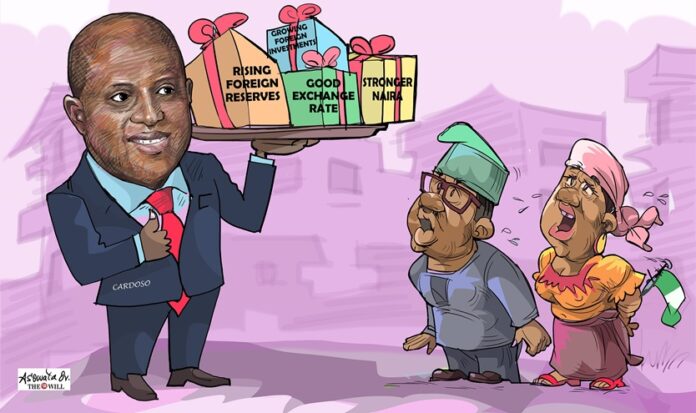
The success story of today stemmed from the measures adopted by the apex monetary policy authority. Under Governor Olayemi Cardoso, implemented aggressive monetary policies and structural reforms to combat high inflation and stabilise the naira. As of late 2025, these measures have resulted in a significant deceleration of headline inflation to 15.15 percent in 2025 from over 33 percent in 2024, and the appreciation of the naira, with foreign reserves exceeding $45 billion.
The key measures taken include:
1. Monetary Policy Tightening (Interest Rates & Liquidity)
- High Interest Rates: The Monetary Policy Committee (MPC) raised the Monetary Policy Rate (MPR) multiple times, reaching 27.5 percent by mid-2025 to curb money supply and reduce inflation.
- Cash Reserve Requirement (CRR) Increase: The CRR for commercial banks was increased to 50 percent to limit the lending capacity of banks and tighten liquidity.
- Restricting Money Supply: The CBN adopted an “orthodox” approach, focusing on controlling inflation through high rates rather than direct financing of the government.
2. Foreign Exchange (FX) Market Stabilization
- Unified Exchange Rate: The CBN abolished multiple exchange rate windows, collapsing them into the Nigerian Foreign Exchange Market (NFEM) based on a “willing buyer, willing seller” model to reduce arbitrage and speculation.
- Clearing FX Backlog: The CBN cleared over $7 billion in verified FX forward backlogs to boost investor confidence and reduce market volatility.
- Regulatory Oversight on BDCs: Over 4,000 Bureau de Change (BDC) operators were revoked for failing to meet compliance standards, and a new licensing framework was introduced.
- Electronic FX Matching System (EFEMS): Launched in December 2024, this system aims to enhance transparency, eliminate non-compliant activities, and ensure fair pricing in the FX market.
- Revaluation of FX Proceeds: Guidelines were issued to International Oil Companies (IOCs) to cap the immediate repatriation of export proceeds at 50 percent, requiring the rest to be brought into the domestic market.
3. Banking Sector & Operational Reforms
- Bank Recapitalisation: The CBN introduced new minimum capital requirements for banks (effective March 2026) to ensure resilience, with international banks required to have ₦500 billion.
- Crypto Regulation: Guidelines were issued for Virtual Asset Service Providers (VASPs) to manage the risks associated with cryptocurrency, which had previously fueled currency speculation.
- Electronic Payment Monitoring: The CBN mandated geo-tagging for all PoS terminals to curb fraud and ensure compliance in the financial system.
4. Structural & Strategic Initiatives
- Inflation Targeting Framework: A shift to a formal, explicit inflation-targeting framework to guide monetary policy and anchor consumer expectations.
- Dis-inflation and Growth Acceleration Strategy (DGAS): A collaborative effort with the government to boost local production, reduce import reliance, and improve food supply.
- Encouraging Inflows: The CBN introduced the Non-Resident Nigerian Ordinary Account (NRNOA) to attract foreign remittances and encourage investment in local assets.
These combined actions have helped improve the external reserve position, which was reported at over $40 billion by December 2024 and maintained strong through 2025, providing a buffer for the naira.
Tough-minded optimism
Mr Cardoso had said in 2025, “Our focus must remain on price stability, the planned transition to an inflation-targeting framework, and strategies to restore purchasing power and ease economic hardship.”
He noted that as macroeconomic indicators continue to show signs of recovery, the CBN’s policy direction is earning praise for restoring stability and laying a foundation for long-term economic resilience.
“The foreign exchange (FX) reforms instituted by the Cardoso-led CBN, alongside Federal Government policies aimed at boosting local production, reducing FX demand pressure, and easing domestic prices, have been instrumental in achieving macroeconomic stability,” said Dr Kingsley Ikeokwu, an Economist.
He added that the positive performance represents a notable turnaround for the currency, which had faced significant challenges in recent years. The recovery stems from a combination of strategic foreign exchange reforms implemented by the Central Bank of Nigeria and favourable external conditions.
Enlarged coast
The Nigerian naira achieved a significant milestone by ranking among Africa’s ten best-performing currencies for October 2025, according to data from financial platforms Investing.com and Trading Economics.
The reports noted that Nigeria’s local currency demonstrated impressive strength during October, appreciating by 3.4 percent against the US dollar. The naira strengthened from ₦1,478 per dollar to ₦1,427.50 per dollar, outperforming six other African currencies in the process.
In a report to investors, analysts at Cordros Securities wrote: “We expect inflation to remain on a downward trend, particularly as the naira is projected to stay stable. Additionally, stable global oil prices should help keep domestic fuel and transportation costs in check.”
They also noted a resurgence in capital inflows, following a moderation in global financial pressures since May. Elevated naira yields and a more stable FX market have continued to attract foreign portfolio investment (FPI) and restore investor confidence.
Nigeria recorded $21 billion in capital inflows in the first ten months of 2025, up 75 percent from $12 billion in the same period of 2024 and more than five times under $4 billion recorded in 2023, signaling a sustained recovery in foreign investment.
Officials at the Ministry of Industry, Trade and Investment attribute the surge to structured interventions and stronger investor confidence. Over $5 billion in bankable projects were curated across manufacturing, technology and agribusiness, creating ready channels for foreign capital.
Sector-specific deal rooms helped match investors with vetted projects and resolved 50 longstanding bottlenecks, accelerating financing closures. Nigeria also hosted its first domestic investors’ summit to unlock stalled commitments and strengthen engagement between regulators, sponsors and investors.
Bilateral outreach further boosted inflows, with more than 100 investment meetings held with partners including the UK, US, UAE, Brazil and Japan. UK investors accounted for about 65 per cent of total inflows.
The rebound was supported by improved macroeconomic conditions, including a trade surplus, growth in non-oil exports and foreign exchange market stabilisation. Together, structured project pipelines, investment diplomacy and macro reforms delivered Nigeria’s strongest capital inflow performance in years, positioning the country to sustain momentum into 2026.
Preceding hemorrhage
The massive devaluation, and the removal of petroleum subsidy, resulted in several consequences that impacted adversely on the people. This included the sharp rise in inflation rate which saw Nigeria’s headline inflation hit a record 34.60 percent in November 2024, the highest in 28 years, reflecting a corresponding surge in the costs of goods and services across the country. The last time Nigeria’s inflation rate reached that band was in March 1996 when it rose to 41.9 percent.
High inflation consequently depressed household consumption, causing a shift from discretionary spending to basic necessities particularly food, which had also hit over 40 percent inflation rate. According to the National Bureau of Statistics (NBS), high inflation, particularly in food and transportation (driven by fuel costs) strained household budgets. Savers experienced negative returns leading to a negative attitude towards future savings.
Nigerian companies recorded huge losses arising from the foreign exchange revaluation with many rationalizing their workforce. Backward integration also suffered as the local supply chain was severely impacted due to high unemployment and capacity shrink. Investment inflow also experienced a record low with foreign direct investment the worst.

Sam Diala is a Bloomberg Certified Financial Journalist with over a decade of experience in reporting Business and Economy. He is Business Editor at THEWILL Newspaper, and believes that work, not wishes, creates wealth.