
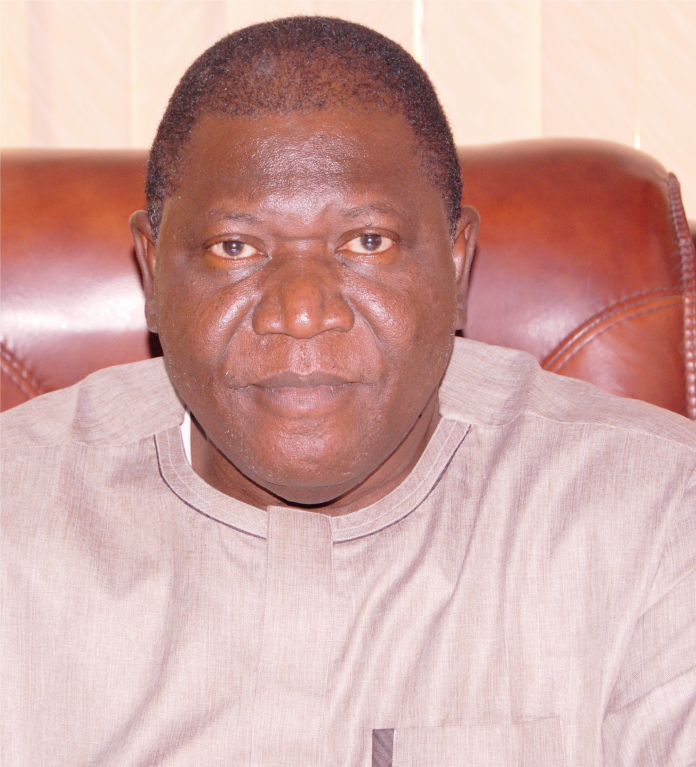
BEVERLY HILLS, May 30, (THEWILL) – Prof Yakubu Ochefu specialises in Economic history and Development studies. A former Vice-Chancellor of Kwararafa University, he is currently the Secretary-General of the Committee of Vice-Chancellors of Nigerian Universities. In this interview with AMOS ESELE, he points out some of the root causes of the current crisis in the country, proffers solution and declares that the country will surmount its challenges and remain indivisible
As a professor of economic history and development studies, how would you characterise Nigeria’s current state of development?
First, I would say the state of development is very poor. We are not taking advantage of the opportunities of our human resources, physical population and natural challenges. We are playing too much politics with our challenges. Then, there is the matter of the relationship between a knowledge-driven society and a religion-driven society. We have to agree that countries that have developed have placed a lot more emphasis on knowledge than religion. We agree that religion is very important, but it should not take pre-eminence in development agenda. We should use knowledge to drive our development agenda.
But we have had development agenda, such as Vision 2010 and 2020 and the Millennium Development Goals, yet nothing is happening. What is your take on this?
No. We had Vision 2000 before the ones you mentioned. Right from Independence in 1960, we have had development plans. The first National Development Plan was supposed to end in 1964. The second plan was truncated by the Nigerian Civil War. The third plan was called the 1970 to 1975 Lagos Plan of Action. So, we had those plans and there were a number of things that are necessary in the planning process, that is, you have to plan with numbers and data. And right from the first plan, we began to play politics with our numbers, not just in terms of population; but also in terms of schools, roads and other data, so much so that the consultant that was contracted by the World Bank to help drive the first plan, an American called Stopler, I think, after the exercise wrote a book called, Planning Without Faith. In it, he raised the matter of whether Nigerian leaders had the political will to implement the plan. So, you can see how far that mistake goes back. So, the Visions 2000, 2010 and 2020 shows how our leaders lack the political will to use empirical and statistical data to tell the story of what we needed and how to achieve it.

Is that how we progressively became the poverty capital of the world? Does it also explain the worsening insecurity and economic downturn in the country?
How else are you going to explain that we have over 20 million out-of-school children and the largest unemployment rate in the world? These are the fallouts of bad planning for many years in the making. So, it is the result of bad planning that is manifesting in all manner of outcomes.
As National President, you represented the Historical Society of Nigeria at the 2014 National Conference. Many believe that was easily the best we have come to finding answers to our challenges. How would you explain that?
The conference was easily the best platform that provided the environment where issues of Nigeria were debated in a brutally frank manner. I recall that the debates started with our fault lines, that is, ethnicity, religion and mutual suspicion of the various enclaves we have found ourselves. I remember when the Chairman, retired Justice Idris Kutigi, said the opening prayer in Islam, Pastor Tunde Bakare rose to challenged him that he did not understand the language the Chairman used. So within the first few weeks we thought the thing was going to collapse. So too was when it came to the turn of the different ethnic blocs to speak; the Yoruba who wanted an Oduduwa republic to include Lagos, the representatives from Lagos rejected the suggestion and said Lagos would rather stand on its own, that it was rich and big enough to stay alone. The audience was stunned because everybody believed the SouthWest was one bloc. It was the same thing with Ohanaeze Ndigbo’s call for an Eastern Nigeria with Enugu as capital. Delegates from Ebonyi said that would happen over their dead body. A professor of physics from the state disclosed further that he was a member of Jamatu Nasri Islam of Nigeria. People were stunned. When it came to the turn of the Arewa Consultative Forum’s call for one North, minorities from Southern Zaria, Zuru in Kebbi State and the Kare Kare from Yobe state, who claimed to be the original owners of the land but have been oppressed, opposed the idea of one North. Even the North cried about marginalisation at that national level of discussion because the way delegates emerged, which included professional, labour groups and political parties though the All Progressives Congress did not attend, tended to favour the South and Middle Belt.
So, these new conversations all came up and we said we needed to understand the fears and aspirations of everybody. Discussions held around issues like the Land Use Act, state police, regional autonomy, devolution of power, states having their Supreme Courts and resource control beyond oil and gas, because some groups within and without the conference did a lot of research to show that every state have large resources in commercial quantities to remain viable and make contributions to the centre.
So what happened to the recommendations that conferees submitted to the government?
There were certain recommendations that needed executive order by ex-President Goodluck Jonathan to sign and about 40 per cent of the recommendations would have been solved. Then there were others that required a change in specific legislation and yet a few that required constitutional amendments. But Jonathan, in my estimation, needed a validation of what came out of the conference and so he set up a committee to review the recommendations. They sat on it until December of that year. By January, when it was submitted, elections were around the corner and that was it. If he had signed the executive order, we would have not been experiencing some of the things we are going through today.
What, in your estimation, is the way forward now?
Between 2015 and now, our fault lines have become wider. Conversations have become difficult because trust has been eroded even at the level of political leadership. The two major political parties, the APC and the PDP, are struggling with their challenges. The presidency is perceived as weak and indifferent to challenges in the land. Conspiracy theories are being bandied around. Poverty and hunger have increased. The solution? We have to take the challenges one at a time. For every conversation, there is what I call the big elephant in the room. You can discuss the smaller issues that can be resolved and that have to do with the governance structure in the country. The big elephant in the room is what I call restructuring.
For some reasons, many still say they do not know what restructuring means, even as all groups in the country are now insisting there must be a form of restructuring. How do you react to this?
People who say they do not understand restructuring are being mischievous. Anybody who can read the constitution cannot claim we are running a federal government while in reality there are 60 per cent items in the exclusive legislative list. If you compare our constitution and the mode of its operations with countries that are federal in nature, you will see that we are operating a quasi-federal state. Restructuring, for all intents and purposes, has been going on at the legal angle that many are not aware of. Just like Mr Femi Falana, SAN, said in a recent conference that the Federal Government had been challenged by some states in three fundamental laws, for instance, up to the Supreme Court. Recall that during ex-President Olusegun Obasanjo administration, the Lagos State Government had its local government allocation withheld for creating additional Local Council Development Areas until the late President Yar’Adua obeyed the Supreme Court ruling and the sum of N10 billion from the seized money was returned to the state. The same case also happened with the inland waterways and the regulation of hotels business in Lagos State. But what we have now is a situation where state governments are calling for more power, but they are unwilling to transfer the same to local government areas. Recall the current strike by judiciary workers over autonomy and new salary scale for teachers. I do not believe that the Federal Government has any business owning and managing secondary schools. It should occupy itself with more serious things.
Are you not worried that you may wake up one day to another Nigeria as self-determination and self-help groups are springing up in response to the insecurity and general uncertainty in the country?
That experience at the National Conference and my own training as a professor of history, my knowledge of the country and our conversations that the country be split into six zones as some are suggesting is going to be a tall order. The reason is because the connections are strong and deep and the boundaries are not as sharp as many are thinking. It is going to cost us more than we have on the ground. Why would anyone want to leave a big country for a smaller enclave? Take for example the main agitations in the South-Wast, South-West and Middle Belt. The driver of Oduduwa republic cannot go to Lagos and stake any claim. The Igbo in Lagos are not going anywhere because they are stakeholders like anybody there. Same with the Edo and Ijaw. Lagos was saying at the conference that they are bigger than Singapore, so the South-West stay on their own and do not include us. Promoters of the Middle Belt are saying Abuja would be their capital and every other person would have to leave. The Igbo have invested heavily in real estate there. When Biafra was declared before the civil war, they did not foresee the creation of states by the Federal Government and now states like Rivers are saying they do not want to be part of any agitation for Biafra. What I am saying is that we are so intertwined that all this agitation for this or that is not going to happen.
Former President Obansajo warned us about the dangers of Fulanisation that the government, by omission and commission, is encouraging in its nonchalance to the lingering herdsmen/ farmers conflict?
That is why I keep saying that it boils down to lack of political will of the leadership. President Muhammadu Buhari has done a lot more to endanger his Fulani people than any president has done. He should try and protect his people from any backlash that may follow his exit from office. The whole crisis that is going on in Zamfara State is between the Hausa and the Fulani. For the first time in the history of the country, Hausas are saying we are not Fulani. President Buhari’s foot soldiers and lieutenants have not been sensitive enough to see certain issues that are driving destructive interests. They are a small minority. If the anger of the rest of Nigeria were weaponised against them, where would they sta nd?
Recently the Federal Government granted licences to 20 more private universities. Given that media big wigs such as Netflix, Apple, Google, Tesla and Amazon may not require a university degree for employment. Do you not think the acquisition of university degree may become obsolete?
They are talking about a niche industry. There are hundreds of disciplines and new knowledge that are coming out on a new basis that require some form of education. I will be the first to argue that technology has disrupted the way we now teach and conduct research. In that disruption, we have skill sets that do not call for the kind of education required. Some of the skill sets required in technology at a certain level do not require a university degree. Beyond that, there is still a lot of thinking power required at a certain level that a university degree cannot go away now.
As keynote speaker at the Dr Edwin Madunagu 70-year anniversary lecture, you shocked your audience at the end by saying you would run for governorship in your state in 2023. Why would an accomplished scholar want to join the murky waters of Nigeria politics?
In 2017 when I finished my tour of duty as Vice-Chancellor in Kwararafa University, I asked myself what other challenge was left for me in my field of calling? Where can I go to get further education that can deepen my knowledge of society. And since I have been consulting for politicians, advising them on development plans and I have never been a party man. I decided to join a political party. I joined the Action Development Party after going through their profile online. I was soon elevated to the position of state Chairman of the party in Benue State. That period was the biggest political school I have ever attended in my life. It convinced me that the reason why we are having challenges is that the platforms on which our leaders are being recruited are very poor ones.
How?
What goes on in the ward, LGA and state levels of the party machinery is enough to see that what goes on there is not the discussion of any development agenda at all and this is how the ethos cascades down from the top to the bottom. I understood how politics works. Things you must do if you call a meeting, how you provide entertainment and transportation to members. Then there are things you would do in IPAC and INEC situation room. Things the majority of Nigerians do not know. People say if I want to run, I must have deep pockets and resources and I say resources will come from creativity. What is the model of Alibaba, Amazon and Uber for instance? So, it is creativity.

Amos Esele is the Editor of THEWILL Newspaper. He has over two decades of experience on the job.
