
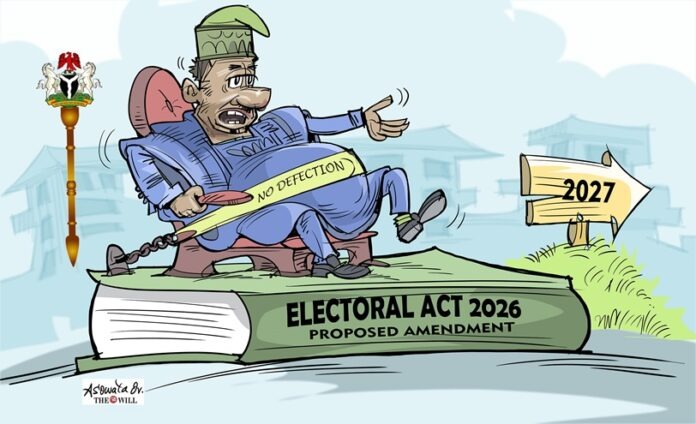
March 15, (THEWILL) — Barely a month after President Bola Tinubu approved the Electoral Act 2026, the National Assembly has tweaked sections of the electoral law on political parties in a move described by insiders as a game changing legislation for the 2027 general election.
Proposed by the House of Representatives, the new amendment deals with prohibition of dual political party membership and the prescribed sanctions for violators. The amendment adds three new subsections 8, 9 and 10 to Section 77 of the Electoral Act dealing with party membership.
The provision in clause 8 says: “A person shall not be registered as a member of more than one political party at the same time.”

Clause 9, states: “Where it is established that a person is registered as a member of more than one political party at the same time, such dual membership shall be void and the person shall cease to be recognised as a valid member of any political party, pending regularisation in accordance with the provisions of this Act and the constitution of the political party concerned.
And 10 says, “A person who knowingly registers or maintains membership in more than one political party at the same time commits an offence and is liable on conviction to a fine of N10m or to imprisonment for a term of two years, or both.”
THE PROPOSED AMENDMENT
The common view about the proposal is that, once it is signed into law, it would provide political parties with the legal structure for the regulation of membership, thus enhancing party loyalty and discipline and improving internal party democracy.
Lawmakers who took positions for and against the proposal during the clause by clause debate in the House on Wednesday, March 11, 2026, argued “that introducing strict penalties for dual party membership would help reinforce party discipline, improve transparency in party registers and strengthen the integrity of Nigeria’s electoral process overseen by INEC.”
Cases of elected or appointed politicians who retain membership of two or more political parties leading to their suspension or expulsion on the basis of anti-party activities abound. Between 2023 and 2026, for example, the Labour Party, the Peoples Democratic Party, PDP; the African Democratic Congress, ADC; and the governing All Progressives Congress, APC have suspended their members for alleged anti-party activities. In another, remarkable instance, aspirants sometimes plant allies as “placeholders,” in other political parties as fall back options when they lose out in primaries or congresses.
The law courts have continued to arbitrate and mediate in disputes of political parties following political defections, lingering crisis over party membership registers and ownership.
However, the proposal is, in actual fact, a reality check for political parties in the wake of the section in the Electoral Act 2026, which provides for parties to submit their digital membership register to the Independent National Electoral Commission, INEC, 21 days before any party primaries, congress and convention. Failure to do so would lead to the disqualification of the party from fielding candidates for the particular election.
Furthermore, the new law provides only two options- direct and consensus- for primaries, meaning that only members would participate in direct primaries.
“I think it is high time we stopped political prostitution among politicians in this country if we want to grow our democracy with strong political parties and committed, disciplined membership,” Mr Monday Ubani, a Senior Advocate of Nigeria, SAN, told THEWILL in a brief interview on Saturday.
To him the proposal is a welcome development, even though he expresses concern about the position of the Senate on the proposal. “This provision has a tradition in many developed countries where they prohibit dual membership of political parties. You cannot belong to one political party in the morning and another in the night because you lack principle and do not believe in what it wants to achieve when it gets to power. If passed into law, it will prevent people from moving from one party to another because they lost primaries.
Deputy Speaker of the House, Benjamin Kalu, who presided during plenary when the amendment was adopted, agrees with Ubani.
“To deliberately register in two political parties is deceit. You should identify with one political ideology and stand by it,” he said.
WHAT THE ACT SAYS ON POLITICAL PARTIES
Section 77, clauses (1-7) of the Act deals with the administrative, political and legal conduct of political parties in any given election cycle in such a way that it has become controversial as party leaders, particularly from the opposition, have opposed it and called on the National Assembly to revisit and amend the clauses.
The clauses read: (1) A political party registered under this Act shall be a corporate body with perpetual succession and a common seal and may sue and be sued in its corporate name. (2) A party shall maintain a digital register of its members containing the name, sex, date of birth, address, State, Local Government, ward, polling unit, National Identification Number and photograph in both hard and soft copies. (3) Upon registration, a membership card shall be issued to the member. (4) Each political party shall make such register available to the Commission not later than 21 days before the date fixed for the party primaries, congresses or conventions. (5) Only members whose names are contained in the register shall be eligible to vote and be voted for in party primaries, congresses and conventions. (6) A political party shall not use any other register for party primaries, congresses and conventions except the register submitted to the Commission. (7) A party that fails to submit the membership register within the stipulated time shall not be eligible to field a candidate for that election.
THE GAME CHANGING LEGISLATION
Given the compressed schedule in the INEC timeline for the 2027 general poll, the current House of Reps proposal to criminalise dual party membership is viewed by pundits as part of a design, a last- ditch attempt to control an envisaged fallout in the upcoming party primaries in the big parties, especially the governing APC, which has harvested many high -profile defections in recent time. According to INEC, presidential and national assembly elections will now be held on Saturday, 16th January 2027, while governorship and state houses of assembly elections will now be held on Saturday, 6th February 2027.
Conduct of party primaries, including resolution of disputes arising from primaries, will commence on 23rd April 2026 and end on 30th May 2026. Presidential and national assembly campaigns will commence on 19th August 2026. Governorship and state Houses of Assembly campaigns will commence on 9th September 2026.
THEWILL gathered that following a wave of defections, lawmakers, mostly, are jostling to get the support of state governors who always want to impose their preferred choice of candidates on the party. For the governors, having their loyalists in the National Assembly is not just part of a larger scheme to control the federal lawmakers but also a grand plan to decide their successors from among the senior lawmakers who often openly display their ambition to be governors in their respective states. This challenge is more pronounced in states that witnessed defections of governors from the rival PDP to the APC. As party leaders of the party in their states, many of the governors want to have a say in deciding the fate of many lawmakers, junior or senior.
President Tinubu ignited this rivalry between the governors and federal lawmakers recently when he subtly hinted at his readiness to seek the re-election of lawmakers on the governing party’s platform during an inter-faith breakfast with members of the House of Representatives at the Presidential Villa on March 1, 2025.
In his response to the plea by Speaker Tajudeen Abbas for support toward the return of members of the House in 2027, the President said it was a good idea but left it in the hands of the party.
“I will do everything within our party’s power. In several constituencies, there are rotational arrangements. I wish that everyone would return,” the President said, parrying the request.
OPPOSITION GROWS
Although analysts foresee the likely impact of the proposed amendment, if passed, on internal party democracy, loyalty and discipline among members, they argue that the lawmakers are as guilty in their retroactive actions as the opposition who have criticised certain perceived controversial sections in the Electoral Act 2026 after it was enacted. According to the opposition, Sections 60(3) and Section 84 were anti-democratic and should be amended. At their recent outing, National Chairman of the New Nigeria Peoples Party (NNPP), Ajuji Ahmed, National Chairman of the African Democratic Congress (ADC), David Mark, as well as former Vice President Atiku Abubakar, ex-Transportation Minister Rotimi Amaechi and former Anambra governor, Peter Obi, among others, urged the National Assembly to revisit the Act and amend the identified Sections of the Act.
On Section 60(3) of the Act, they argued that it “grants sweeping discretionary powers to presiding officers in the transmission of election results, effectively negating mandatory electronic transmission of results from polling units by creating room for delays under the guise of network failure.”
They considered Section 84 of the Act limiting parties to direct primaries and consensus for candidate selection, “as an unconstitutional encroachment on the autonomy of political parties and warned that it could destabilise opposition parties ahead of 2027. They canvassed for indirect primaries as legitimate democratic option which should be retained in the Act.
Although the leadership of the National Assembly had urged the opposition politicians to allow the new Act to run its course, blaming them for being passive during the amendment process of the Act, the current proposal on dual party membership has reopened the debate all over again.
Reacting to the new proposal at the weekend, Obi drew the lawmaker’s attention to another awkward section in the Act, justifying the need to heed the call by the opposition for the amendment of sections considered anti-democratic by the opposition.
He said on his verified X handle: “Nigeria is facing a troubling contradiction. What type of country are we trying to bequeath for our children.” The same lawmakers who have proposed a fine of N10 million and up to two years in prison for dual party membership have simultaneously removed certificate forgery, age falsification and false declaration as grounds for challenging an election in a tribunal. This is a direct contradiction of the Constitution of Nigeria (1999, as amended.” He expanded on the legal and moral implications of these sections of the Act on the growth of democracy and leadership in the country.
Efforts to get reactions from the Spokesperson of the House, Hon. Akin Rotimi, failed as he did not respond to phone calls.
Ubani, SAN, who explained that the lawmakers acted within the law in deciding to amend provisions of the recently passed Electoral Act 2026, advises politicians opposed to certain provisions in the Act to seek redress in the court of law.
“Any law that anybody considers anti-democratic can be challenged in court. Any provision in the Act that is inconsistent with the provisions of the Constitution can be declared unconstitutional by the court. So, the opposition has the right to challenge any provisions they consider unconstitutional.”

Amos Esele is the Editor of THEWILL Newspaper. He has over two decades of experience on the job.
