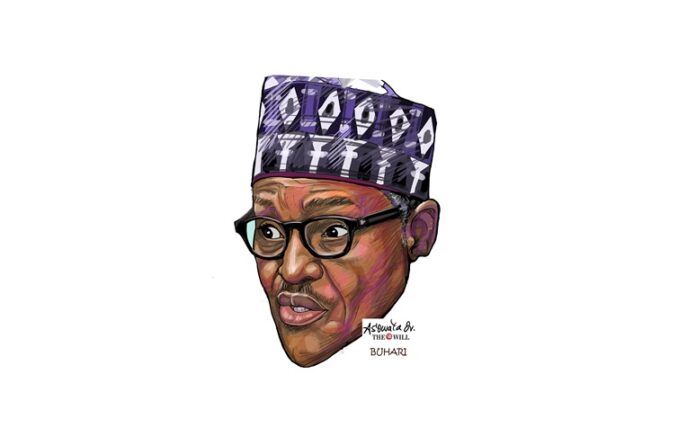
July 13, (THEWILL) — As the politics of 2027 gets going, players, followers and sympathisers alike are seizing every change to throw jabs and reclaim some space under the sun. That was the case last Tuesday when Mallam Garba Shehu, former President Muhammadu Buhari’s spokesperson, publicly presented a book on his boss, titled, ‘According to the President: Lessons from a Presidential Spokesperson’s Experience.’
Held at the Shehu Musa Yar’Adua Centre, Abuja, the event, which was chaired by former military Head of State, Gen. Yakubu Gowon (retd) was attended by some frontline coalition opposition leaders, such as former Vice President Atiku Abubakar; Nasir El-Rufai, former governor of Kaduna State; Buhari’s Ministers like Hadi Sirika, (Aviation); Kayode Fayemi (Solid Minerals), Prof. Ibrahim Gambari, ex-Chief of Staff; ex-Secretary to Government of the Federation, Boss Mustapha; Mustapha’s immediate successor, George Akume; and Bayo Onanuga, special adviser to President Bola Tinubu on information and strategy.
Minister of Information and National Orientation, Mohammed Idris and Nduka Obaigbena, publisher of ThisDay Newspapers and chairman of Arise TV make up the list of dignitaries.
Aware that he was about to begin a controversy that would reverberate in the polity and get a rebuttal, Mustapha began his statement at the event with a disclaimer, saying, “I do not intend to stir controversy.” But that was exactly what he got, the next day after dismissing the contributions of President Bola Tinubu to Buhari’s emergence as president in 2015.
According to the former SGF, President Tinubu’s claim that he was solely responsible for Buhari’s emergence as President in 2015 was unfounded.
Tinubu, in a 2022 address in Abeokuta, Ogun State, had claimed that he played a pivotal role in Buhari’s victory after three failed attempts, including nominating Prof. Yemi Osinbajo as Buhari’s running mate and helping Ogun State Governor Dapo Abiodun win his election.
Tinubu had said: “If not for me that stood behind Buhari, he wouldn’t have become President. He tried the first time, he failed. Second time, he failed. The third, he failed.
“He even wept on national television and vowed never to contest again. But I went to Kaduna and told him, ‘You will run again. I will stand by you and you will win. And he agreed.”
But Mustapha dismissed the claim as historically inaccurate, noting that Buhari’s consistent political base in the North had already guaranteed him 12 million votes in every election cycle, a foundation which no single individual could claim credit for.
Mustapha argued, “In 2011, we needed a coalition, but that didn’t work. It wasn’t until 2013 that the merger between the CPC, ACN, ANPP and a faction of APGA formed the APC. That coalition produced three million additional votes. But the truth remains that Buhari had 12 million votes intact, always. When we were conceptualising the merger that birthed the APC, we knew Buhari’s cult-like following was key. In 2011, he polled 12.2 million votes. By 2015, the total votes that gave us the presidency were 15.4 million. So, the contribution from other blocs aside Buhari’s base was about three million votes.”
He stressed that Buhari’s credibility and persistence were the real game changers, adding that Buhari’s credibility, cult-like following in the North, and persistence played a more significant role in his eventual victory than any single political alliance or endorsement.
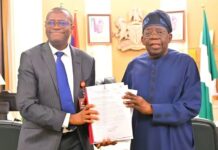
On Wednesday, expectedly, the Presidency countered claims by Mustapha, asserting that President Bola Tinubu played a decisive role in Muhammadu Buhari’s emergence as the All Progressives Congress (APC) presidential candidate in 2015.
Presidential aide, Tope Ajayi, who is the Senior Special Assistant to the President on Media and Publicity, stated on Wednesday that Buhari could not have clinched the APC ticket — let alone win the presidency — without Tinubu’s political machinery and mobilisation of key delegates.
However, Ajayi in a post on X (formerly Twitter), described Mustapha’s narrative as revisionist and misleading.
“Let’s even leave the general election that brought Buhari to power in 2015. There is no way he would have won the APC presidential primary without President Tinubu,” Ajayi wrote.
He said Buhari’s victory at the APC primary in 2014, held at the Teslim Balogun Stadium in Lagos, was largely due to Tinubu’s influence in rallying governors and delegates, especially from the South-West.
“Buhari had his 12 million captive Northern votes, yet he lost three presidential elections — in 2003, 2007 and 2011. It was Tinubu’s mobilisation of APC governors and delegates that gave him the edge at the convention,” Ajayi insisted.
He added that while Buhari’s mass appeal was undeniable, credit must be given to the strategic alliances and political investments made by Tinubu at a critical point in Nigeria’s democratic transition.
Ajayi concluded that Mustapha’s remarks did “a disservice to recent political history” and downplayed the collective efforts that delivered victory to the APC in 2015.
Garba Shehu, spokesperson to former President Muhammadu Buhari, says there is no rift between his principal and President Bola Tinubu.
A Buhari ally, Faroul Aliyu and former Chairman of the Board of the Niger Delta Development Commission, NDDC, later joined the fray.
In his reaction, Aliyu, disagreed with Mustapha’s view.
“My senior brother, Boss Mustapha, certainly got it wrong, because I can’t even remember where he was at that time,” Aliyu said.
Aliyu who served as the returning officer for Buhari during the APC primary in Lagos and highlighted Tinubu’s behind-the-scenes support during that process credited Tinubu with helping Buhari secure the APC ticket and win the election.
He said,“Tinubu assisted, contributed, and helped Muhammadu Buhari to get the ticket and by extension win the election.” He also rejected claims that Buhari did not repay Tinubu’s support in the lead-up to the 2023 election, arguing that Buhari could have sabotaged the APC’s victory if he wanted to.
Lauretta Onochie, a former Chairman of the Niger-Delta Development Commission, responded on X platform at the weekend, stating that Mustapha’s revelation marked the expiration of what she termed a political falsehood.

“Every lie has an expiry date. Yesterday, the lie that BAT (Bola Ahmed Tinubu) made Buhari president expired. Thank you, Boss Mustapha, for puncturing the lies of those unsuccessfully trying to rewrite history,” she wrote.
Onochie went further to claim that President Tinubu never supported Buhari’s candidacy in 2014, adding fuel to the ongoing debate about internal party dynamics and historical revisionism within the governing APC.
In what looked like an intervention a few days later, Shehu said claims of a soured relationship between President Tinubu and ex-President Buhari are speculative and not backed by any formal disagreement.
He said, “When people are entitled to their own opinion and your own interpretation of it is purely your own entitlement. I don’t think in a formal and official sense anybody would talk about distrust or mistrust or a façade between the Buhari administration and the Tinubu administration.”
Shehu said Buhari remains committed to the All Progressives Congress (APC), which brought him to power after three unsuccessful attempts.
“Muhammadu Buhari is essentially an APC member,” he said, adding that the former President has not forgotten the fact that he ran one, two, three times and failed to get the presidency until they cobbled together the APC. APC came together and gave him two terms, for which he has remained grateful and says—and that’s what I’ve learnt from him—‘I will never be ungrateful. I will never betray the party that gave me two terms in office.”
Speaking on the way forward for the party and both leaders, Shehu further said, “We see statements; we read them when people say these things. Do we get disturbed? I don’t think that is the word,” he said, “It took a lot of doing, energy and sacrifice for the APC to have been put in place, for the desperate opposition elements to come together,” he said, adding, “They tried one, two, three times, and they failed. But by this time, they came together in 2014, formed a party, and ran in 2014. They won.
“Which means, in effect, that the people who were around, who saw how much sweat it took to build this coalition—I think they are not likely to be the ones who are trying to fracture it.”
Felix Ifijeh is a journalist with years of professional reporting experience. Known for his keen news sense, compelling storytelling and commitment to accurate, impactful reporting, he has built a reputation for turning leads into clear, engaging, and well-structured reports that resonate with readers. His work reflects deep newsroom experience and a commitment to accurate, impactful journalism.