
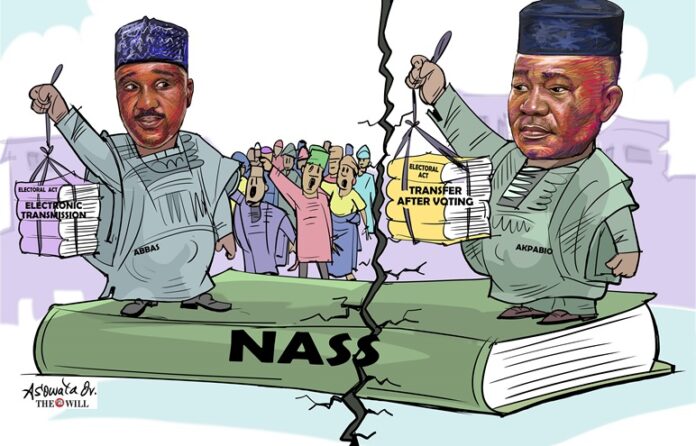
February 08, (THEWILL) — As the Conference Committee of the National Assembly gets underway this week to harmonise the unequal positions of the House of Representatives and Senate on the Electoral Act bill 2026, the public outrage against the Senate for failing to mandate the real-time electronic transmission of election results continues.
There are fears that the Committee is a mere window dressing and lacks capacity for the assignment, which may further delay the passage of the Electoral Act 2026. THEWILL gathered at a Saturday night webinar, titled, 2027 Elections: Why Electronic Results Transmission and Collation Matter, that the Senate is yet to adopt its votes and proceedings, which means that its members on the Joint Committee cannot work. Yaiga AFRICA, International Press Centre, The Albino Foundation, Enough Is Enough, Youth Movement for Electoral Reforms and Kukah Center organized the webinar.
Senators Natasha Akpoti-Uduaghan and Eyinanya Ababribe who attended the webinar as speakers confirmed that the Senate has not adopted its votes and proceedings and therefore the Senators on the Joint Committee has nothing to work with.

“This means that the Senate has to reconvene and pass votes and proceedings before the group at the Committee, unlike their House counterparts, can work,” Senator Abaribe said and lamented that, “in a situation where legislation is treated in a whimsical manner, we have always insisted that our leadership should do things orderly.”
He added that the Senate is currently on recess and would reconvene on February 24, 2025.
As a result, leaders of civil societies in attendance disclosed that they were going to mobilize about 5,000 protesters to storm the Senate on Monday at 9 a:m and on February 24, and make a case for the Senate to adopt the position of the House on e-transmission of results in real time.
“What transpired during the passage of the Electoral Act Amendment Bill, 2026 (at the Senate) is not a disagreement over policy details. It is a calculated rollback of hard-won democratic gains secured after years of struggle, civic mobilisation and painful lessons from flawed elections.” Executive Director of Rule of Law and Accountability Advocacy Centre, Mr Okechukwu Nwanguma said in a note to THEWILL on Friday.
“This Senate’s actions sharply contrast with the more progressive position taken by the House of Representatives, which has shown greater sensitivity to public interest and electoral credibility. Reports that the Senate version of the bill reflects the personal whims of its leadership rather than collective democratic reasoning only deepen concerns about arrogance, impunity and contempt for citizens,” Nwanguman said.
THE CORE MATTER
The bone of contention is a specific section in the amendment dealing with election results. The Senate, while passing its amendment after five hours of debate on Wednesday, February 4, 2026, following several closed-door sessions and ad hoc committees to reach agreement since January 27 when the bill was first planned for passage, rejected a proposed amendment to Clause 60, Subsection 3, of the Electoral Amendment Bill 2026. The proposal seeks to make the electronic transmission of results from polling units compulsory.
The House of Representatives in its amendment on December 15, 2025, stipulated in clause 60(3) that, “The commission shall electronically transmit the results from each polling unit to the IREV portal in real time and such transmission shall be done simultaneously with the physical collation of results.”
The proposed legislation also states that in “Situations where results are in dispute, the collation officer shall use the original of the disputed result, the BVAS or other technological devices used for accreditation in the polling units, data of accreditation and the votes and results of the election to determine the correctness of the results.” Having preceded the Senate’s amendment, the House of Reps’ proposal had raised similar expectations in the Senate among Civil society organisations, youth movements, labour unions, professional bodies and faith leaders who had attended town hall meetings, public hearings and retreats on constitutional amendment. In contrast, the Senate’s amendment looks like an anti-climax, judging by the ongoing public backlash.
INTERPRETATION
Technically, the Senate allowed electronic transmission of results. But it failed to make it compulsory. The catch is that (Section 60(2) of the 2022 Act empowers INEC to prescribe the manner of transmission, a discretionary power. In exercising that power in 2023, INEC chose not to transmit the presidential result promptly, citing technical, “glitches.” In the ensuing litigations after the polls up to the Supreme Court, the courts ruled that electronic transfer of results to IREV portal is not a mandatory legal requirement under the Electoral Act. Meaning that, even though INEC admitted “glitches,” for only the presidential poll, it did not break any law.
Recalling that 2023 electoral debacle, Dr Tanko Yinusa, National Coordinator of Obidient Movement, OM, said the Senate President has learnt nothing and forgotten everything. In a statement made available to THEWILL, Yinusa said, “This action is a slap in the face of millions of Nigerians who have tirelessly advocated for greater transparency and accountability in our elections.”
“Nigerians were fed excuses of a fabricated ‘glitch’ that never existed, while the will of the people was blatantly subverted. This latest move by the Senate only serves to entrench the same systems that enable electoral malpractice. This failure to pass a clear safeguard is nothing short of a deliberate assault on Nigeria’s democracy.
By rejecting these essential transparency measures, they are eroding the very foundation of credible elections,” he said, adding that, “By refusing to mandate the electronic transmission of results from polling units to the Independent National Electoral Commission’s (INEC) Result Viewing Portal (IREV), the Senate has chosen to institutionalise chaos and opacity, thereby eroding public trust in the electoral process.”
DIVISION IN THE SENATE
Unlike the House of Representatives where lawmakers in the lower chamber passed the proposed amendments of the Act with unanimity, the Senate has been struggling to maintain unity since last Wednesday’s session on the Act. In what appeared as a contradiction of what transpired at the Senate, some senators addressed the press on the outcome of the amendment session at the Senate.
At the heart of the amendment saga, however, is the President of the Senate, Godswill Akpabio. While the House spoke with one voice on the Act, the Senate is divided. His handling of the voting process has opened him to accusation of impropriety.
According to the lawmakers drawn from the ruling All Progressives Congress, APC, the Peoples Democratic Party, PDP, Labour Party, LP, the African Democratic Congress, ADC and the All Progressives Grand Alliance, APGA, the Electoral Act amendment passed by the Senate on Wednesday accommodates the electronic transmission of election results.
The lawmakers were Enyinnaya Abaribe, APGA, Abia South; Abdul Ningi, PDP, Bauchi Central; Austin Akobundu, PDP – Abia Central; Peter Jiya, PDP – Niger South; Ireti Kingibe, ADC – FCT; Victor Umeh, LP – Anambra Central; Binos Yaroe PDP – Adamawa South; and Kabeeb Mustapha, PDP, Jigawa South-West.
Others were Khalid Mustapha, PDP Kaduna North; Mohammed Ogoshi Onawo, APC – Nasarawa South; Aminu Tambuwal, PDP – Sokoto South; Tony Nwoye (LP – Anambra North; and Natasha Akpoti-Uduaghan, PDP – Kogi Central.
Senator Abaribe, who spoke on behalf of the lawmakers, said “What we passed is ‘transmission’ of results. What is in the 2022 Act is ‘transfer.” The distinction is important. We do not want a law that is vague or capable of misinterpretation. We want a law that is clear, concise and unambiguous electronic transmission of results,”
According to Senator Abaribe, both the Senate Committee on Electoral Matters and the ad hoc committee recommended electronic transmission of results, a position he said was agreed upon during the clause-by-clause consideration.
“On the honour of all of us standing here, both the Senate electoral committee, the ad hoc committee and the executive session agreed on the provision for electronic transmission of results in real time. Confusion arose due to movements and side conversations in the chamber, giving the impression that something different had been approved. We went back individually to confirm what was done and we were reassured,” he said.
A member of the group, Senator Ireti Kingibe reinforced this position again at the weekend. Taking to her X platform, Kingibe who is a member of the Senate Committee on Electoral Matters, disclosed that public hearings, policy retreats and consultations with civil society and INEC provided a three-pronged approach to the amendment proceedings at the National Assembly.
“Electronic transmission of election results and real-time upload to the INEC Result Viewing Portal (IREV); Recognition of three modes of party primaries — direct, indirect, and consensus, as well as clearly defined election timelines to ensure orderly, credible polls,” were the three pillars highlighted in the resulting report which an ad hoc Senate committee reviewed and about 85 percent of senators supported the electronic transmission of results.
“When this report was presented to the Senate, an ad hoc committee was constituted to review it. The committee’s recommendations were largely aligned with the original report. Notably, about 85 percent of senators supported the electronic transmission of election results’, she said, adding, “While the 2022 Act used the term “transfer” of results, the committees, after careful deliberation, specifically recommended that the Commission SHALL electronically transmit results and upload to the IREV in real time. These amendments are documented and still to be harmonised.”
Kingibe explained that the harmonisation process between the Senate and the House of Representatives is ongoing and a correspondence committee has been constituted to align both versions into a single final bill.
She urged Nigerians to remain calm, engage actively and hold their representatives accountable to ensure the final bill protects votes and democratic rights. “We are your representatives. We are your voice. And your will must shape the laws that govern you,” she said.
Addressing the Senate’s justification that operational challenges such as poor network coverage in remote areas informed its position, the Conference of Nigeria Political Parties, CNPP, acknowledged infrastructural limitations but insisted that flexibility must not come at the expense of accountability.
“While acknowledging infrastructural limitations, flexibility must not translate into institutional immunity from accountability. Retaining discretionary powers ensures that INEC cannot be legally compelled or held liable for failing to upload results electronically, thereby rendering the IReV portal largely ceremonial and restricted to mere public viewing without enforceable legal consequence,” Deputy National Publicity Secretary, Comrade James Ezema told THEWILL.
Arguing that modern Internet devices like Starlink, which offers affordable, unlimited high-speed data, even in remote areas, where available, he faulted the idea about poor network coverage as part of the reason for retaining the provisions in the 2022 Act, saying, “Without mandatory electronic uploads, Nigeria risks institutionalising opportunities for result tampering.”
Director of Programmes at Yaiga AFRICA, Cynthia Mbamalu, stated that from experience on election coverage both at the off-cycle polls and general elections, electronic coverage has never been a problem, even in remote areas of the country. She said that elections held in the country since the deployment of the Bimodal Voter Accreditation System, BVAS, have recorded 95 percent e-transfer of results to the IREV portal. Even when there is a problem with the Internet in remote areas in the country, the polling officers move around until the uploaded messages are sent,” she said.
The Presidency joined the fray on Saturday. Mr Temitope Ajayi, Senior Special Assistant to the President on Media and Publicity, urged all parties in the public debate for and against the Electoral Amendment to reflect deeply. Arguing that he supports every move to make electronic transmission of result legal, he, however, submitted that more attention should be focused on the institutions and personnel charged with the electoral process rather than to the law.
He said, “We must understand that laws do not conduct elections. People do. The fixation on legal amendments often obscures a more uncomfortable truth. Nigeria’s electoral problems are less about rules and more about conduct. Our political class and increasingly, civil society have become addicted to buzzwords. Elections will only improve when politicians accept a basic democratic reality. In every contest, someone wins and someone loses. But it is drunkenly optimistic to assume that merely writing it into law will automatically improve electoral outcomes.”
AKPABIO EXPLAINS SELF
In his reaction to mounting public backlash against the amendment, President of the Senate, Akpabio appealed to his colleagues to refuse to be swayed by reactions in the social media which he said seemed to suggest that the Senate rejected electronic transmission of results. But his explanation raises the question whether the voting process at the Senate was transparent.
Curiously, in his explanation to his colleagues, he said: “Please, do not allow people to confuse you. If you are in doubt, we will make our final votes and proceedings available to you if you apply,” adding that “What we did was to retain the electronic transmission which has been in the Act and was used in 2022”.
This Senate under my watch has not rejected the electronic transmission of results. It is in my interest as a participant in the next election for such to be done. So please don’t go with the crowd. We have retained what was in the previous provision by way of amendment. That was all we did. The previous provision has made allowance for electronic transmission. So, it is still there as part of our law. We cannot afford to go backwards.”
Efforts to get responses from Spokespersons of the National Assembly, Adaramodu Adeyemi and his House counterpart, Akin Rotimi, failed as none of them replied to repeated calls to their phone and delivered messages. So too did some members of the conference committee whose phones rang without reply.
CONFERENCE/HARMONISATION COMMITTEE
Meanwhile, the NASS has appointed a conference committee, comprising nine Senators and 10 members of the House of Reps, to harmonise the position of both chambers. The senators are Simon Lalong, Adeniyi Adegbomire, Tahir Monguno, Adamu Aliero, Orji Kalu, Abba Moro, Auquo Ekpenyong, Aminu Abass and Tokunbo Abiru. The House members are Bayo Balogun, Ahmed Idris, Fred Agbedi, Sada Soli, Ahmada Jaha, Igariwey Iduma, Saidu Musa Abdullahi, Dr. Zainad Gimba, Dr. Awaji-Inombek Abiante and James Abiodun Faleke.
Public appeals are being directed at them to weigh the options in the public interest, particularly against the background of Akpabio’s ambiguous statement to Senators about making, “our final votes and proceedings available to you if you apply.”
The CNPP called on the Conference Committee of the National Assembly to adopt the House of Representatives’ provisions mandating real-time electronic transmission of election results, remove all discretionary clauses granting INEC unilateral authority to determine the mode of result transmission and enshrine clear legal obligations compelling presiding officers to upload polling unit results immediately after declaration at polling units.
RULLAC’s Okechukwu called for intensified advocacy and sustained public pressure to compel the Conference Committee to “reject the Senate’s regressive provisions and restore the progressive safeguards necessary to make votes count in 2027.”
“Democracy is not gifted by politicians; it is defended by citizens. If Nigerians allow this betrayal to stand, we should not feign surprise when our votes no longer matter and our elections lose all meaning,” he said.

Amos Esele is the Editor of THEWILL Newspaper. He has over two decades of experience on the job.
