The number of ‘Estimated Billing’ customers in the books of Nigeria’s 11 electricity distribution companies (DisCos) rose to 5.93 million in the fourth quarter (Q4) of 2022, according to the National Bureau of Statistics (NBS). This represents a 3.4 percent rise from 5.74 million customers they recorded in the estimated billing category in Q4 2021; and higher by 0.34 percent in the preceding quarter (Q3 2022) which had 5.91 million estimated billing persons.
Estimated billing is a system of arbitrary charge against unmetered electricity consumers for electrical energy they did not actually consume. The billing is based on perceived pattern of consumption, or on the ‘best of judgement’, with unjustified high revenue targets as the motive.
Consumers in this system are mandated to pay far above what they consumed on a monthly basis and the charges are usually outrageous. “It is a system that thrives on corruption and is driven by tardy inclination to exploitation which defines a commodity in the category of monopoly,” said Gab Madu, an electrical installation contractor.

The NBS in its Nigeria Electricity Report for Q4 2022 showed that the DisCos recorded a decline in electricity supply amid rise in revenue and in estimated billing customers.
In terms of revenue, N232.32 billion was generated by the 11 DisCos in Q4 2022 compared to N202.62 billion in Q3 2022. On a year-on-year basis, revenue collected rose by 16.02 percent from N200.23 billion in Q4 2021.
Similarly, on a year-on-year basis, electricity supply declined by 3.48 percent compared to Q4 2021. However, the 2022 figure stood at 5,611 (Gwh) from 5,024 (Gwh) in Q3 2022, showing a rise of 11.68 percent.
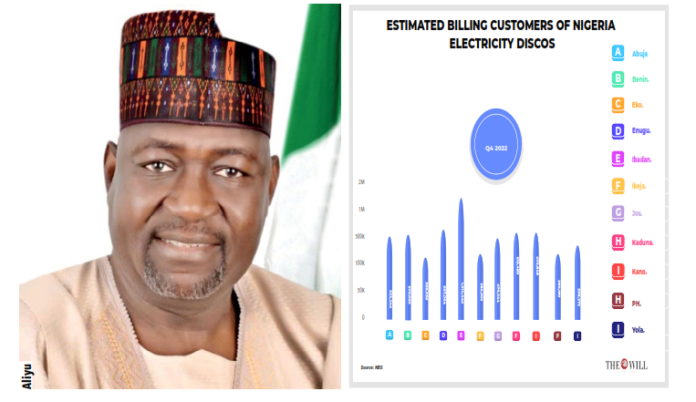
The report showed that Ibadan Electricity Distribution Company (IBEDC) has 1.3 million estimated billing customers – the highest in Nigeria, as the country grapples with perennially poor supply. Ibadan also belonged to the league of top revenue generating DisCos – after Ikeja (IEDC), Eko (EKDC) and Abuja (AEDC), which raked in N45.6 billion, N35.5 billion and N35.2 billion respectively in Q4 of 2022.
Ibadan (which covers Oyo, Ogun, Osun, Kwara and parts of Niger, Ekiti and Kogi states), pooled N28.4 billion during the period.
Yola, Kaduna and Jos DisCos had the lowest revenue pools: N4.2 billion, N7.6 billion and N8.6 billion respectively.
The DisCos’ estimated billing customer numbers rose to 5.93 million from 5.91 million in Q3 22. Ibadan had a total of 1.3 million, representing 22 percent of the entire estimated billing customers.
The DisCos had a total of N5.1 million metered customers in Q4 2022 as against 5.0 million in the preceding quarter, while 11.0 million customers were in their registers during the reporting period, compared to 10.9 million in Q3 2022.
“Electricity supply in Q3 2022 stood at 5,024 (Gwh) from 5,227 (Gwh) in the previous quarter. On a year-on-year basis, electricity supply declined by 8.53% compared to 5,493 (Gwh) reported in Q3 2021,” the NBS report stated.
Since the Federal Government introduced the metering system in 2018, it has maintained that electricity consumers face no hurdles in procuring meters. The government has on several occasions declared that it had millions of units of the pre-paid meters for supply to the consumers. But that is contrary to what obtains in the industry where corruption and sabotage have been elevated to an art of priority.
In reality, many Nigerians are yet to exit the estimated electricity billing fraud due to the high cost of meters, which the DisCos are supposed to release under the Meter Asset Providers (MAPs) programme.
Besides the cost, the supply system is very slow and anxious consumers are subjected to extortion in the guise of processing fees. To crown it all, many of them have to endure long periods of inactivation of the meters for one technical reason or the other.
The affected consumers are charged for the transportation and other routine matters that ordinarily should be the responsibility of the DisCos. And the most ironic is that the meters are properties of the DisCos.
“In a country of highly unstable power supply, the prepaid meter is the only panacea to prevent undue exploitation of consumers from the estimated billing system of power distribution companies.
“The Federal Government ought to pay a greater attention to the frustrations being experienced by many Nigerians in the course of procuring prepaid electricity meters.
“But the racketeering is enriching the operators exceedingly; that is why they would stick to estimated billing,: said Mike Iheakor, a property developer.
According to the meter cost approved by the Nigerian Electricity Regulatory Commission (NERC) since November 2021, a single-phase meter sells for N63,061.32 inclusive of a 7.5 per cent VAT, while a three-phase meter costs N117,910.69. Some consumers who paid and got the meters said the installers often demanded for more payment “to cover transport fare”, which should not be the case.
Although the NERC has reiterated an end to estimated billing with adequate meter supply, in reality, the country is far from reaching that target. The meters are hardly seen in the quantity being declared by the authorities.
In 2019 the House of Representatives passed a Bill prohibiting and criminalising the use of estimated electricity bills in all instances except where a consumer’s meter cannot be accessed by the service provider.
Titled the ‘Electric Power Sector Reform Act (Amendment) Bill, 2018,’ the proposed legislation sought to address the concerns of many electricity consumers in Nigeria who believe that they are often overcharged under the estimated billing system.
Under the Bill, Electricity Distribution Companies must install pre-paid meters on the premises of a consumer within 30 days of receiving his/her application and payment or face penalties. Electricity distribution companies who fail to provide pre-paid meters within the stipulated time frame are prevented from refusing a consumer access to power supply, disconnecting him/her (where connection has already been granted) or reverting to the estimation of bills. The National Electricity Regulatory Commission was given powers in clause 70 to ensure that licensed Distribution Companies comply with the Bill’s provisions. Regrettably, the proposed legislation eventually died a natural death.
The CBN in August 2020, introduced the N120 billion intervention fund to close the wide electricity metering gap in the country under the National Mass Metering Programme (NMMP), a move commended by stakeholders. However, it did not change anything as the operators continued in their own ways.
The 11 electricity distribution companies had insisted that payment for meters by end-users remains justified despite the mass-metering programme of the government, which is premised on free meters.
The Association of Nigerian Electricity Distributors (ANED), the umbrella body of the utility companies said that not all approved metering schemes, currently active in the country, come at no immediate expense to customers. But shortage of the meters has remained the consumers’ nightmare as electricity supply remain epileptic across the states.
Sam Diala is a Bloomberg Certified Financial Journalist with over a decade of experience in reporting Business and Economy. He is Business Editor at THEWILL Newspaper, and believes that work, not wishes, creates wealth.