Sport is an essential part of any society and it can have significant impact on social and economic development. For Nigeria, sport has been a vital tool for promoting national unity and identity, as well as providing avenues for youths to showcase their talents and develop their skills. As a result, the government and private entities have invested in the relevant infrastructure for hosting local and international sporting events.
However, despite substantial investments, most sports facilities have deteriorated due to poor maintenance. The general state of sports infrastructure in Nigeria has given cause for concern, with many facilities in disrepair and unable to meet the needs of athletes and fans.
The need for Nigeria to pay attention to sports infrastructure maintenance is no more crucial today as is has been from the early days of the country’s dominance in sports on the continent. The National Stadium in Surulere, Lagos, is a prime example of the state of sports infrastructure in Nigeria.

The stadium, commissioned in 1972, holds a significant place in the country’s history and serves as a testament to Nigeria’s past greatness in the sports sector. The stadium has played a crucial role in promoting sport in Nigeria, hosting numerous national and international tournaments that have put Nigeria on the global sports map.
It was once the pride of the nation and the best in West Africa. One of the most significant events held at the National Stadium was the 1973 All African Cup, for which the stadium was renovated to meet the standard requirements. This event was a turning point in Nigeria’s football history, as the national team won the tournament, defeating Guinea 2-0 in the final. In 1980, the National Stadium hosted the African Cup of Nations, which brought global attention to the stadium’s facilities and its beautiful architecture. The Super Eagles defeated Algeria 3-0 to lift their first African trophy. The stadium’s capacity was expanded to accommodate more spectators, and the facilities were upgraded to meet international standards. The tournament was a success, and the stadium received praise for its exceptional facilities.
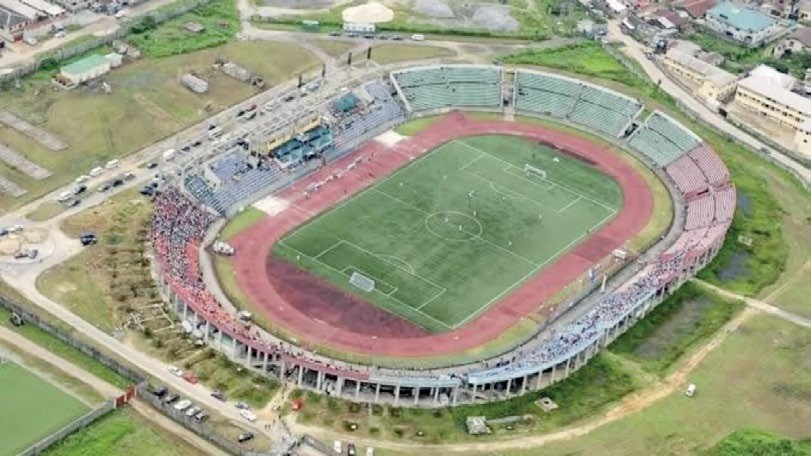
The National Stadium has also played a crucial role in promoting youth sports in Nigeria. In 1999, it served as the host stadium for the FIFA Under-20 World Cup, which showcased the country’s young football talent to the world. It hosted other major sporting events, including the 2000 Africa Cup of Nations. However, over the years, successive administrations have left the stadium to deteriorate. It became a venue for social gatherings, religious crusades, and housing for street urchins, squatters, hawkers, bar operators, and commercial sex workers.
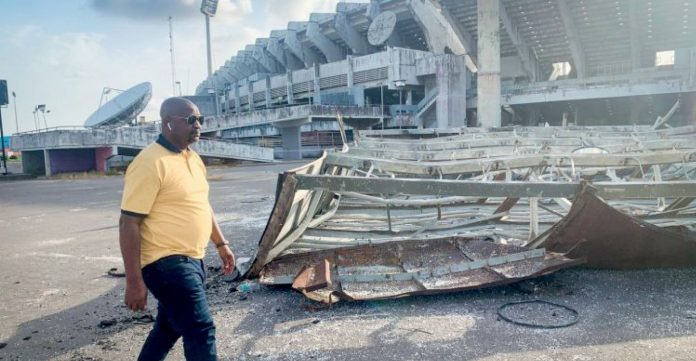
This sorry state of affairs made the news again when the Honourable Minister of Sports and Youth Development, Sunday Dare, ordered the temporary closure of the Stadium after one of the giant floodlights at the arena collapsed due to a windstorm. The floodlights pillar caved in from the middle, bringing down the ramshackle floodlights.
Dare, upon personal inspection of the facilities, stated that a large percentage of the stands were in a precarious state and could crumble as well. The remaining three floodlights had also been affected by “age and weather elements.” This is only natural for a stadium that was left in a state of disrepair for 17 years.
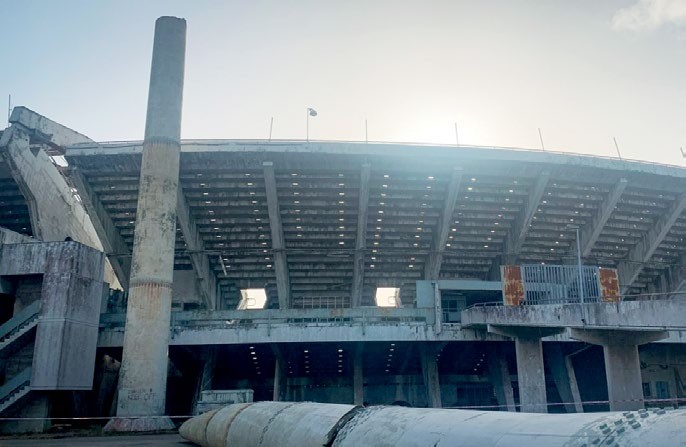
The Minister, quoting an expert report that checked the stands and their integrity, remarked that 40 per cent of the stands had cracked and that they would have to be knocked down completely because they are dangerous. He was mindful of the fact that other repair work on the stadium made it frightfully dangerous for people in and around the stadium.
While work on new chairs were going on, Dare noted that should people sit on them, and the aged stands collapsed, there could be casualties recorded.
He hinted during his penultimate inspection that the floodlights were in bad shape, adding that the Federal Government would need at least N10bn to fix these and other parts of the stadium infrastructure in need of fixing.
THEWILL recalls that in 2019, the founder of Premier Lotto, Sir Kessington Adebutu, pledged to renovate the National Stadium, during the Dare-led launch of the Adoption Campaign at the Civic Centre.
Africa’s leading billionaire Aliko Dangote had earlier promised to renovate Moshood Abiola Stadium in Abuja, following a meeting with the minister.
The need for these private-involved investments in infrastructure resuscitation, upgrading and maintenance was due to the fact that the Nigerian government had only allocated N2bn in the budget for the preparation of the 2020 Olympics in Tokyo, Japan, while N14bn was the amount the Ministry required. The sum covered getting the athlete ready and bringing the facilities where they will train up to the standards required. The shortfall meant the Ministry had to be proactive in searching for private investments and that was the initial prompting that led to the call for corporate bodies to support the initiative.
Since assuming office, Dare had been faced with the renovations of the country’s stadiums and in the lead-up to the Olympics, the budgetary deficiency evoked the Adopt-A-Stadium initiative of 2019. Kessington, a philanthropist and lover of sports, was announced to be taking over the renovation of the main bowl of the National Stadium in Surulere Lagos.
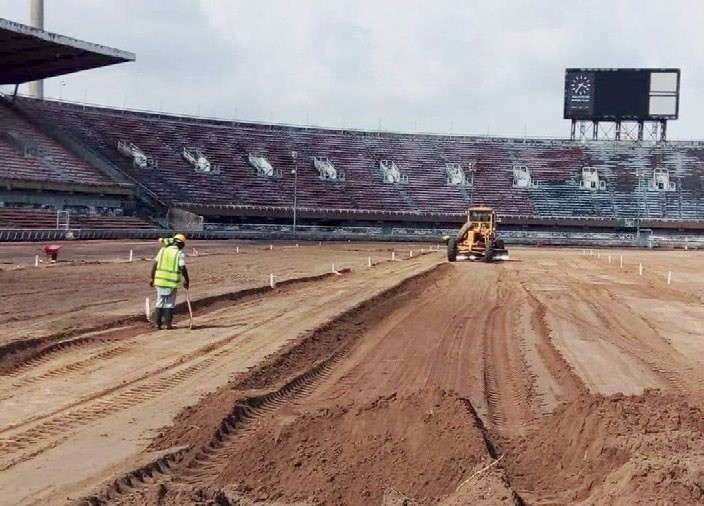
The eminent sports backer chose to assist with several items requiring fixing including the tartan track, and scoreboard of the stadium. In September 2020, illegal shops that had taken advantage of the dilapidated nature of the ground were demolished and their owners sent packing in preparation for the renovations. However, despite assurances that the renovations would be completed in May 2021, visits to the stadium revealed that the main bowl was still undergoing renovations as at April 2023.
In delineating the costs of overall revamping of the Stadium, the Minister revealed that the process will require a total of N21 billion. The government therefore approached funders for assistance. These funders, of which Dangote and Kessington were among, asked the government to prioritise the projects. The Sports Ministry listed eight priority projects, and these funders agreed to refurbish the football pitch, tracks, and digital scoreboard.
Adebutu, the chairperson of Premier Lotto, agreed to fund the refurbishment of Lagos facilities with N400 million, which is about 4% of the required amount. According to Dare, Adebutu’s funds have been used to renovate the football pitch, tracks, and digital scoreboard. Almost 80% of the job for these three items was almost done in the Lagos Stadium while Dangote had concluded work in Abuja.
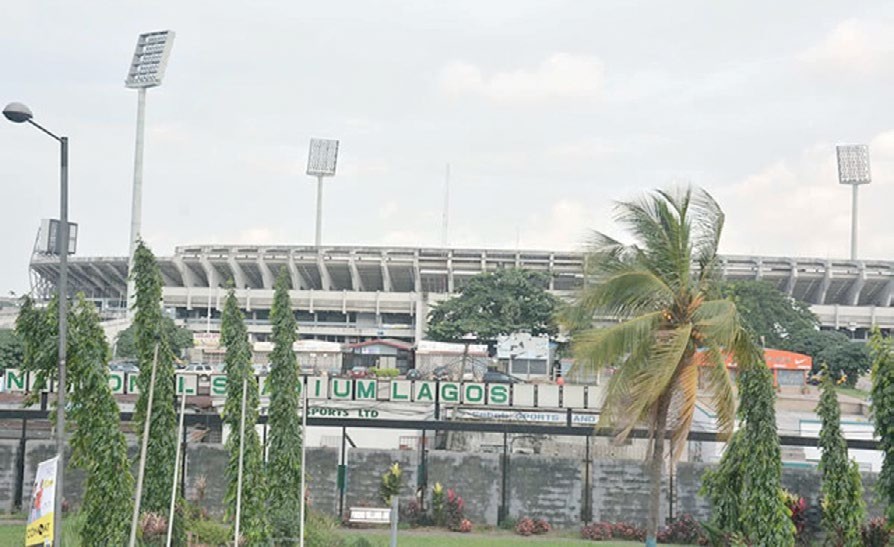
However, the Minister highlighted the fact that the Lagos stadium had a huge debt profile, with electricity and water bills amounting to at least N600 million and N150 million, respectively. Due to limited funds, the government had to make choices between paying off the stadium’s debt and refurbishing the football pitch and tracks. They opted for the latter, as it was a priority project that needed urgent attention.
Not long after the Minister’s comments, critics harped on Dare’s claim of needing N21bn as a desperate cash-grab especially with his term nearing its end with the outgoing Buhari administration. To quickly eliminate any such allegations, the Director of Press and Public Relations of the ministry, Mohammed Manga, put out a statement that categorically denied the allegations and clarified that no such request had been made or received. Manga emphasised that the ministry had only mentioned the figure of N21bn as an estimated cost for the complete rehabilitation and upgrade of the stadium based on submissions made by different companies and contractors. The ministry was currently reviewing the proposals, and no request or approval has been made yet.
On the bright side, Dare announced that there will be change in the maintenance culture. This comes with the latest news that the Nigerian government has now reclassified sports as a business and is in the process of enacting policies that will prioritise sports infrastructure maintenance. The Sports Industry Policy, this new reclassification step, is aimed at ensuring that Nigeria’s sporting infrastructure is never neglected again, and the Federal Executive Council has approved incentives that leverage private sector financing to renovate stadiums and other infrastructure.
However, the critics of the N21bn required to revamp the stadium have a point as there is evidence to show that the work can be done at much less.
Ebi Egbe, the CEO of Monimichelle Group, has expressed his willingness to repair both the Abuja and Lagos National Stadiums in eight months if given the opportunity. Egbe stated that his company could fix the playing turf, tartan tracks, seats, scoreboards, public address system, and all other auxiliary works that meet FIFA and CAF standards for high-profile games in both stadiums in eight months at a less cost than stated. Unfortunately, Monimichelle’s expertise is not being fully utilised in the country, according to Egbe, and it is regrettable because the state of the national stadiums in Abuja and Lagos remain so poor.
Private and public efforts to improve sports infrastructure in Nigeria are commendable, but more needs to be done to ensure that stadiums and other facilities are adequately maintained. The involvement of private investors and the enactment of policies that prioritize sports infrastructure maintenance are essential steps in the right direction.
Indeed, Egbe’s willingness to repair both the Abuja and Lagos National Stadiums in eight months is a positive development, and the Nigerian government should consider working with Monimichelle Group to renovate other sporting facilities in the country.
With the right investments and policies, Nigeria can have world-class sporting infrastructure that benefits Nigerians, tells of the country’s sporting pedigree and provide the youth with facilities that are of international standards.

Jude Obafemi is a versatile senior Correspondent at THEWILL Newspapers, excelling in sourcing, researching, and delivering sports news stories for both print and digital publications.