
Some 40,000 migrants could arrive in Germany over the next two days, officials say – double the number who entered the country last weekend.
Most are expected to arrive in the southern city of Munich but there are concerns about how the region will cope with another large influx.
Around 4,000 troops are being deployed in Germany for logistical support.

Germany has become an attractive destination for Syrian refugees since it waived EU rules.
The government announced in August that it would deal with Syrian asylum applications regardless of where the migrants first arrived in the EU. Up until then, people had to claim asylum with the first EU country they reached.
Tens of thousands of mainly Syrian migrants have been making their way from Turkey, through the Balkans and Hungary to reach Austria, Germany and Sweden.
Migrants have continued to arrive in Macedonia from Greece. More buses were reported to be making their way towards the Hungarian border this weekend.
Munich Mayor Dieter Reiter, has appealed urgently for other German regions to do more to process and accommodate the new arrivals.
He described as “scandalous” the failure of other regions to provide more accommodation, according to state broadcaster ARD.
Reports suggest the government is considering new temporary powers to take control of unoccupied rental property to accommodate migrants.
A large processing hub is planned for northern Germany, on Lueneburg Heath. Trains would take migrants there directly from Austria.
Analysis: Damien McGuinness, BBC News, Berlin
Germany has been overwhelmed, not by refugees, but by an impressive wave of goodwill towards people fleeing war. Donations have flooded in, large numbers of volunteers have come forward and some Germans have even opened up their homes for migrants.
After years of nasty Nazi comparisons over Greece’s debt crisis, many Germans are rather enjoying the sudden image boost as a beacon of humanitarian generosity.
But the mood could be shifting. Right-wing allies of Chancellor Angela Merkel have attacked her open-door policy, calling it “irresponsible” and “a political error.”
And on Saturday, some commentators in mainstream papers are questioning whether Mrs Merkel’s promise that Germany is able to shelter an unlimited number of migrants is really true.
The mainstream feeling remains impressively generous. But the fear is that if things get difficult, will there be a backlash?
In Hamburg, a demonstration by the far-right was banned earlier this week but the main railway station was closed on Saturday after left-wing demonstrators attacked a train believed to be carrying neo-Nazis.
Several thousand people joined a peaceful demonstration in the city centre in support of tolerance and diversity.
Across Europe, thousands of people are participating in a “day of action” to welcome refugees with dozens of events taking place.
A handful of rival anti-migrant protests are also due to take place.
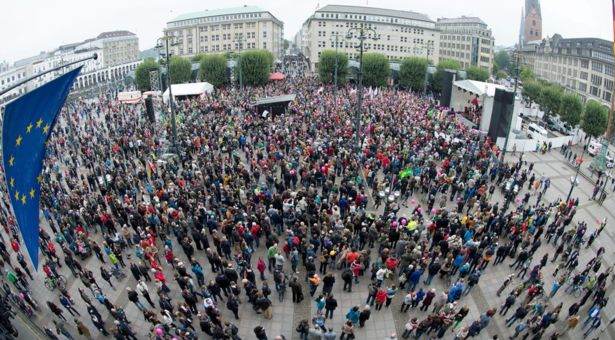
The crisis has exposed deep divisions within the European Union. The European Commission announced plans for obligatory quotas to share out 120,000 additional asylum seekers among 25 member countries.
The Czech Republic, Hungary, Poland and Slovakia oppose being forced to take in new arrivals.
Hungary, which has struggled to cope with some 150,000 migrants who have crossed its borders so far this year, has been criticised over how it treats them.
Austrian Chancellor, Werner Faymann, in an interview with Der Spiegel (in German), strongly condemned a decision to place migrants on a train after leading them to believe they were heading for the Austrian border when they were in fact destined for a processing camp in Hungary.
“Putting refugees on trains in the belief that they are going somewhere totally different awakens memories of our continent’s darkest time,” he was quoted as saying – comments seen as a reference to the Nazis’ treatment of Jews.
For its part, Hungary insists it is trying to fulfil its obligations as an EU member and register all new arrivals.
Hungarian Prime Minister Viktor Orban has called on the European Union to give Syria’s neighbours €3bn (£2.2bn; $3.4bn) in financial aid to help those displaced by the civil war.
Mr Orban said supporting Turkey, Lebanon and Jordan with such a package would end the mass migration to Europe.
In the past few days, aid workers have spoken of “abysmal” conditions for refugees at a camp in Roszke on the Hungarian-Serbian border.
BBC