December 16, (THEWILL) – Nigeria’s 36 states and the Federal Capital Territory (FCT) have been awash with cash in the past one year, following the surge in their share of the Federation Account Allocation Committee (FAAC).
However, this does not seem to impact on the profile of the sub-nationals who have continued to be heavily indebted with domestic and external commitments.
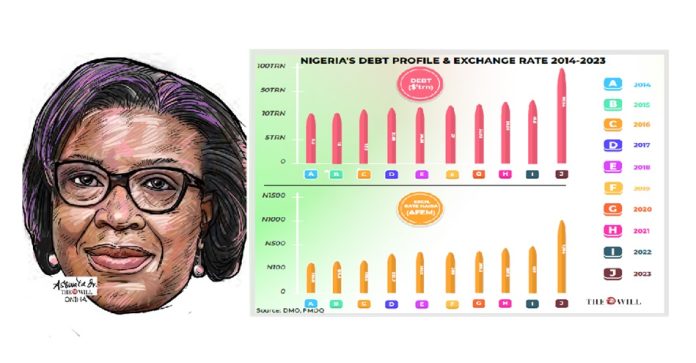
According to an analysis of data from the public debt reports released by the Debt Management Office (DMO), the total debt of the states rose to N11.47 trillion as of June 30, 2024 despite higher FAAC allocations.
.
The figure for the second quarter of 2024 represents a 14.57 percent increase from the N10 trillion recorded in December 2023.
A closer look at the data showed that the increase was driven primarily by a sharp rise in external debt, worsened by the devaluation of the naira.
External debt for the states and the FCT climbed from $4.61 billion to $4.89 billion, reflecting a 6.14 percent increase.
However, in naira terms, this figure surged by a staggering 73.46 percent, from N4.15 trillion to N7.2 trillion from N899.39/$1 in December 2023 to N1,470.19/$1 by June 2024 following the devaluation of the naira
Although domestic debt for states and the FCT saw a decline of 27.12 percent, dropping from N5.86 trillion to N4.27 trillion earlier, it did not reflect the effect of the revenue surge.
A closer look at the data showed that there was an increase of N200 billion or 4.91 percent between March 31 (N4.07tn) and June 30, 2024, which means that the subnational debt is on the rise after a fall earlier this year.
Analysis of the monthly FAAC reports in the past one year shows that total allocation to the three tiers of government (federal, state and local government) rose by N1.37 trillion from N14.60 trillion in November 2023 to N19.94 trillion in November 2024, constituting a 36.5 percent increase.
The increase derived from the upward trajectory during which the three tiers of government benefited from the high figures recorded by the various revenue agencies.
For instance, revenue from the Value Added Tax (VAT) rose by N2.8 billion from N2.5 billion to N5.4 billion in November 2023 and 2024 respectively. This represents an increase of 109.2 percent during the review period.
Furthermore, revenue from the Electronic Money Transfer Levy (EMTL) introduced in the Finance Act of 2022, dropped to N171.3 billion in 2024 from N314.4 billion in the previous year due to the accumulated January – August 2022 figures captured in 2023.
Following the trend, the states and the local governments witnessed huge revenue increase of 42.5 percent and 38.2 percent, from N3.2 trillion to N4.6 trillion; and N2.3 trillion and N3.2 trillion respectively.
Further analysis of the reports revealed that the highest allocation in 2024 was recorded in February when the three tiers of government shared N2.33 trillion, while the least amount of N1.20 trillion was shared in
July
In the case of 2023, the highest amount was recorded in June when the FAAC allocation for the three tiers of government was N1.89 trillion, while the least — N860.04 billion, was shared in February of that year.
On the face value, the federal, state and local government councils are harvesting an incredible volume of FAAC revenue which is largely attributed to the removal of fuel subsidy by the federal government in May 2023.
However, a closer look at the state of the nation’s affairs would reveal that the source of the ‘voluminous’ naira is the significant depreciation of the local currency.
Data from FMDQ platform that publishes the Nigerian Foreign Exchange Market (NAFEM) daily rate showed that the naira has lost over 150 percent of its value since June 14, 2023 when the currency was floated under the foreign exchange reform policy of the Bola Tinubu-led government.
On the abolition of the multiple exchange rate windows, which signified the devaluation of the naira on June 14, 2023, the local currency slumped to N665/$1 on the same day, from N472/$1 the previous day, representing a depreciation of 40.8 percent in one swoop.
This triggered a roller-coaster trend for the naira which suffered intense volatility that the monetary policy authorities have struggled to control.
As of Thursday, December 12, 2024, the naira exchanged N1,547.45/$1 at NAFEM, indicating a value loss of N1,075 as at date.
Industry experts see the states being entangled in debts for a long time to come because of the wasteful management character of the governors. For instance, many state governments embarked on white elephant projects such as fly-overs and airports which do not have immediate and direct impacts on the lives of the people battling with high cost of living.

Sam Diala is a Bloomberg Certified Financial Journalist with over a decade of experience in reporting Business and Economy. He is Business Editor at THEWILL Newspaper, and believes that work, not wishes, creates wealth.