
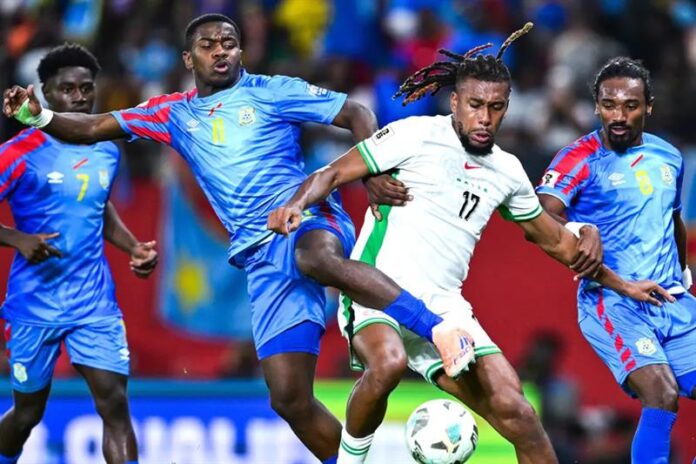
March 22, (THEWILL) — Nigeria’s last legal avenue to the 2026 World Cup closed this week after FIFA dismissed the Nigeria Football Federation’s eligibility protest against the Democratic Republic of Congo, confirming that the Super Eagles will miss a tournament they have graced six times in their history and one that, with its expanded format, offered more places to African nations than any edition before it.
The governing body’s Disciplinary Committee issued its ruling on March 16, rejecting the federation’s claim that several Congolese players were ineligible to represent their country. Alongside that decision, FIFA imposed fines on both associations for crowd misconduct during the qualifier in Rabat, Morocco last November. The Nigeria Football Federation was ordered to pay 1,000 Swiss francs after supporters threw objects onto the pitch; the Congolese Football Association received the heavier sanction of 5,000 Swiss francs for the use of laser pointers directed at opposing players. Neither penalty carries the weight of what has truly been decided. The result from the Crown Prince Moulay El Hassan Stadium stands, and with it, Nigeria’s absence from a tournament that will feature 48 nations and offer nine guaranteed places to African football.
The Rabat match itself, played on November 16, 2025, finished 1-1 after 120 minutes before DR Congo prevailed 4-3 on penalties. It was a painful exit from a qualifier the Super Eagles believed they could win. What followed was four months of legal pursuit, sustained by the federation’s contention that the documentation underpinning nationality changes for several European-based Congolese players did not comply with domestic Congolese law, which restricts dual citizenship for adults. Players, including Aaron Wan-Bissaka and Axel Tuanzebe, both English Premier League footballers, had switched international allegiance to represent DR Congo and the NFF argued that irregularities in the passport issuance process should have rendered them ineligible.

FIFA’s rejection of that argument rested on a distinction that sits at the heart of how international football governance operates. The governing body does not adjudicate on the internal citizenship laws of sovereign nations. What it examines is whether a player holds a valid national passport and whether any required change of association has been formally approved through the correct administrative process. On both counts, FIFA found the Congolese federation to have followed procedure. The domestic legal question of whether those players might be in breach of Congolese nationality law fell outside the scope of what the Disciplinary Committee was empowered to consider.
This is a principle FIFA applies with considerable consistency. The governing body’s preference is to preserve match results except in cases where there is clear, direct evidence of a breach falling within its own statutes. Even where irregularities have been identified in other disputes, the standard response has tended toward disciplinary sanctions rather than the reversal of competitive outcomes. The threshold for overturning a match result is deliberately high, and Nigeria’s case, as constructed, was unlikely to clear it.
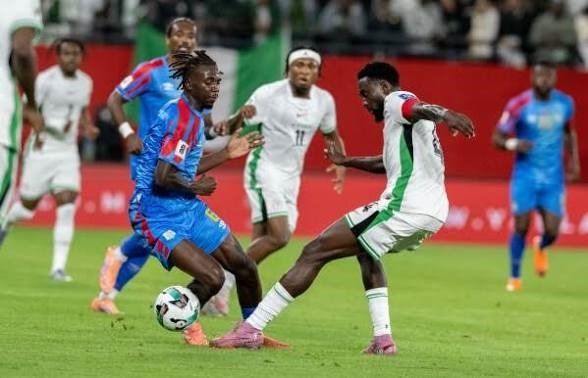
The Nigeria Football Federation’s General Secretary, Mohammed Sanusi, confirmed on March 17 that the federation had received the ruling and remained dissatisfied. An appeal has been lodged with the higher body within FIFA’s governance structure, which represents the final internal mechanism available. Should that fail, the Court of Arbitration for Sport in Switzerland remains a theoretical option. Practically, however, the timeline renders any reversal almost impossible. DR Congo are already preparing for the intercontinental play-offs in Mexico, where they face the winner of the tie between Jamaica and New Caledonia on March 31. Coach Sébastien Desabre has named his squad for the fixtures in Guadalajara and Monterrey, and the Congolese camp has remained focused on preparation throughout the legal proceedings.
The handling of information throughout this episode deserves scrutiny of its own. Between the filing of the protest and FIFA’s ruling, a period marked by limited official communication allowed speculation to flourish. Statements from federation officials that no final decision had been received, combined with social media activity that consistently overstated the legal prospects of success, sustained public hope well beyond what the regulatory framework could reasonably support. That false comfort has made the eventual confirmation harder to absorb.
The episode has also sharpened criticism of the federation’s overall strategy. The protest was within the NFF’s rights to file, and defending the integrity of qualifying competition is a legitimate concern. Yet the extent to which the case relied on arguments drawn from domestic Congolese law, rather than from demonstrable violations of FIFA’s own statutes, raises serious questions about the legal advice the federation received and acted upon. Filing a protest and framing it to succeed are very different undertakings.
What makes Nigeria’s position especially sobering is the broader context. The Super Eagles also missed the 2022 World Cup in Qatar, falling to Ghana on away goals in another agonising play-off. Two consecutive absences from the global stage, across different squads and coaching regimes, suggest something systemic rather than circumstantial. The 2026 tournament, with its expanded field, was widely regarded as Nigeria’s most straightforward opportunity in years to return to the finals.
The financial consequences will compound the sporting ones. World Cup participation carries significant revenue in broadcast rights, FIFA prize money and commercial sponsorship. Without that income, the federation’s capacity to invest in coaching, youth development and infrastructure will be constrained at precisely the moment when such investment is most necessary. Rebuilding a national programme after back-to-back absences from the world’s largest sporting event is a formidable task even under favourable financial conditions.
For Nigeria, the road forward is longer than any appeal committee can shorten. It begins with an honest accounting of why this generation of talented players has twice failed to qualify for the sport’s most important tournament. Governance and administration matter, and the failures in both have been evident throughout this cycle.

Jude Obafemi is a versatile senior Correspondent at THEWILL Newspapers, excelling in sourcing, researching, and delivering sports news stories for both print and digital publications.
