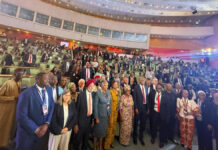
May 24, (THEWILL) – The forthcoming United Nations Tourism (UN Tourism) Secretary General election will be a historic one and this is mainly due to the complexities of it and more importantly, the high wire politics surrounding it, regardless of perspective, High octave politics is already unfolding ahead of the Executive Council Meeting of UN Tourism, which is scheduled to hold at the Madrid, Spain headquarters of the global body between May 28 and 30, with the nomination and election of the Secretary General as the major agenda on May 30, as whoever emerges as the Secretary General will be formally ratified at the UN Tourism General Assembly holding in November 2025 in Riyadh, Saudi Arabia.
Until last week, six candidates were in the race for the post, with the incumbent occupier of the position, Zurab Pololikashvili of Georgia, who was bidding for an unprecedented third term, whose candidacy was withdrawn by his country, leaving only five candidates in the race.
Pololikashvili was first elected to the position in 2017, with his nomination and election ratified at the 22nd General Assembly of UN Tourism. He assumed office on January 1, 2018, for a four-year term and was later re-elected in 2021 for a second tenure of four years, making a two-term tenure of eight years that is expected to expire in November this year.

He threw his hat into the ring, generating a lot of talk, with many people and blocs both within and outside the UN Tourism opposed to it on the grounds that it will be against precedent of the body or any UN body, as no elected officer is on record to have served beyond two tenures.
With his country withdrawing him from the race, only five candidates are now in the running for the position, namely:
Gloria Guevara is a Mexican and is seen as the most qualified and influential candidate, having served as the President and Chief Executive Officer of the World Travel and Tourism Council (WTTC), a very powerful body in global tourism. She was also a former Tourism Minister of her country.
Guevara once headed the Sustainable Tourism Global Centre (STGC) and was a former top advisor of HE Ahmed bin Aqil al-Khateeb, the Minister of Tourism for Saudi Arabia.
She is believed to represent the Latin America bloc within the body, and also women given a major agitation within the global body for a woman to lead it, which has never happened in its 50-year history.
Harry Theoharis is from Greece; he is seen as another frontline candidate for the position. He represents the European bloc and comes with a lot of experience and knowledge. He is a former Greek Tourism and Finance Minister.
He also served as a former member of the Sustainable Tourism Panel in Saudi Arabia under HE Ahmed bin Aqil al-Khateeb, the Minister of Tourism for the Kingdom of Saudi Arabia.
Habib Ammar is a Tunisian and is seen as Africa’s leading hope for the position. He is a former Minister of Tourism. He presently holds the position of Executive Director at the Tunisian Ministry of Transport.
Between 2010 and 2014, he headed the Tunisian National Tourist Office (ONTT) and held a number of positions in various ministerial departments. He graduated from the Advanced Cycle of the National School of Administration of Tunisia, and also holds a Master’s degree in Management Sciences.
Shaikha Al Nasser Nowais is from the United Arab Emirates (UAE) and represents the Gulf States region. A graduate of Business Administration from Zayed University in Dubai, she currently serves as Vice President of Corporate Relationship Management of the renowned Rotana Group.
She is an experienced private sector operator, and before joining Rotana, she worked for three years at the Abu Dhabi-based audit firm, KPMG.
Nowais believes strongly in the critical role of the private sector leadership in shaping the future of global tourism. She is also hoping to capitalise on the sentiment for a woman to lead the global body.
Muhammad Adam, a diplomat, is from Ghana and another African in the race. Adam was his country’s ambassador to Spain and also served as Ghana’s Consul General in Jeddah, Saudi Arabia, and as Counsellor at the Embassy in Spain.
He enjoys the support of his country, with the President of his country, John Dramani Mahama, said to support his candidacy.
Regional representations
In terms of regions, Africa has two candidates in Adam and Ammar; Latin America has Guevara, Europe has Theoharis, while the Gulf States or Arabs have Nowais.
In terms of gender, two women and three men are fighting for the UN Tourism crown.
Africa may have two candidates in the race, however, they are not strongly placed, and the fact that Africa itself is divided is another strong factor that would work against them, with the African Union (AU) position not clearly stated days ahead of the election.
One thing that’s clear, is that Africa will continue to play the second fiddle in UN Tourism and this is because the continent’s leaders are yet to master the politics of the body while the self-centred nature of its people who are in positions of influence has worked greatly against the continent, which has never marshalled a common ground in matters of this nature.
Presently, there is division within its ranks as some of the high-profile bodies and individuals, as well as countries, have openly voiced their endorsements for other candidates in negation of the two candidates from the continent.
Theoharris, for instance, is enjoying the support of African Travel Board (ATB), West Africa Travel Organisation (WATO) and others within and outside the continent.
For instance, Theoharris was in Nigeria recently, with his backers from ATB, to meet with some officials of the federal government, including the Director General/CEO of the National Institute for Hospitality and Tourism (NIHOTOUR), Dr Abisoye Fagade.
On the other hand, Guevara is also enjoying the same support from the continent, with bodies such as the African Travel Commission (ATC) endorsing and campaigning for her.
Faouzou Deme, a Senegalese, who had earlier declared his ambition for the post and earned the support of his government and other bodies within the continent, gave up his ambition in support of Guevara.
What played out about eight years ago that saw two African leading candidates; Dr Walter Mzembi of Zimbabwe and Alain St.Ange of Seychelles (Though St.Ange later withdrew from the race), going against each other in the race and then losing out to Pololikashvili, is also likely to play out if the continent goes into the election with what is playing out presently.
Nigeria’s position
As for Nigeria, it is not yet clear where the country stands because it has a vote. Before the withdrawal of Pololikashvili from the race, indices on the ground indicated that Nigeria was most likely going to line behind him.
But with him out of the race, no one is certain how the country will vote. However, sources close to the Minister of Tourism, Hannatu Musawa, disclosed that she is in support of Guevara, while another source also revealed that Theoharris is being seriously considered by the federal government, as he is seen as the only candidate who has reached out openly to the Nigerian government.
The major contending issue in this election before now was the third-term ambition of the incumbent. Although he may be out of the race, his image and influence still loom large and may indeed have a huge bearing on who emerges as Secretary General.
For instance, his country, Georgia, has already disclosed that its vote is for Nowais. There is also the belief that Pololikashvili, who has before now lined up heavy machinery and support for his bid, may sway the final outcome of the election, as whoever he and his team lean towards may come out on top.
Another major issue is that of regional representation. There is a group, within and outside the UN Tourism, canvassing seriously for a shift from the Europe and Asia blocs to other regions that have never produced a Secretary General, as Europe and Asia are said to have had a fair share of the position in the last two decades.
There is also a call by a number of people on the UN agency to live up to its preaching of the UN when it comes to Diversity, Equity and Inclusion (DEI). What this simply means is that for a woman to be considered for the position, as they have never had a look in before now, and they play key roles in tourism globally.
Experience and vast knowledge of the workings of UN Tourism is also canvassed, with many saying that they don’t want an outsider and a repeat of Pololikashvili, who they say was an outsider and brought in a lot of changes that they argue compromised the workings of UN Tourism.
Composition of UN Tourism Executive Council membership
The UN Tourism Executive Council has 35 Member-States that will determine the fate of the new Secretary General, with Africa having 11 Member-States presently on the Executive Council.
Namely: Cabo Verde, Democratic Republic of Congo, Ghana, Morocco, Mozambique, Namibia, Nigeria, Rwanda, South Africa, Tanzania, and Zambia.
Other voting blocs include: Europe – Bulgaria, Croatia, Czech Republic, Greece, Italy, Lithuania, Spain, Armenia, Azerbaijan, and Georgia:
Middle East – Bahrain, Iran, Saudi Arabia, and the United Arab Emirates:
Asia and the Pacific – China, India, Indonesia, Japan, and the Republic of Korea:
Americas and Caribbean – Argentina, Brazil, Colombia, Dominican Republic, and Jamaica.
It should be noted that UN Tourism presently boasts over 150 full Member-States, with several affiliate members.

Janefrances Ebere Chibuzor is a Tourism Writer at THEWILL