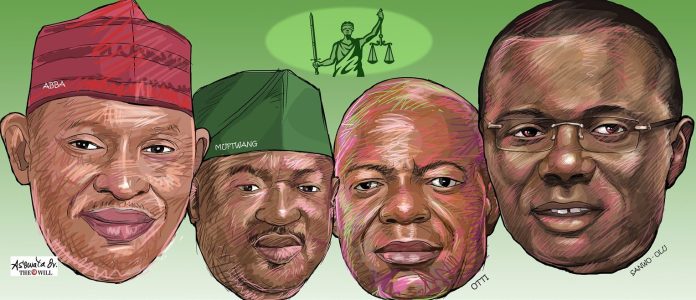
January 14, (THEWILL) – At the Supreme Court on Friday, some of the eight governors with election disputes arrived early and sat with their lawyers to await the arrival of the justices handling their cases amid palpable tension, some lawyers told THEWILL.
Of the eight cases for ruling, two were particularly tricky from the point of social justice: Kano and Plateau States.
Others, namely Abia, Bauchi, Cross Rivers, Ebonyi and Lagos States had got concurrent judgements at the Tribunal and Appeal Court and therefore, were as good as done for the respective governors, while the Appeal court declared the March 18, 2023 governorship poll in Zamfara inconclusive and ordered re-run elections in three local government areas of the state.

For Kano, where the two main contending parties, the ruling New Nigeria Peoples Party, NNPP and the All Progressives Congress, APC, had been tearing at each other despite signing a peace accord and the police had repeatedly warned against violence, tension had been raised by a muddled and controversial Appeal Court ruling that warranted the withdrawal and re-issue of a Certified True Copy, CTP, for the Counsels of the litigants.
Particularly unique was Plateau State where the governor, who was elected on the platform of the Peoples Democratic Party, PDP, had lost at both the Tribunal and Appeal Court because his party breached an order from a Plateau State High Court in Jos directing it to conduct valid ward, local governments and state congresses before nominating its candidates for the various elective positions.
On the basis of that, the party lost two elected senators, three House of Representatives members and a score of House of Assembly members to the rival APC.
The tension in the courtroom of the apex court on that Friday was therefore understandable. Dressed in a grey caftan with serrated white strips, Plateau State Governor, Caleb Mutfwang sat at the back of the courtroom in studied silence. Of course, his opponent and candidate of the All Progressives Congress, APC, Dr Nentawe Yilwatda, who was dressed in an off-white overall with a black cap, sat far away, looking quite hopeful.
But right after the judgement had gone Mutfwang’s way, Yilwatda got up and walked straight to congratulate his rival. It was a display of sportsmanship, though occasioned by a fait accompli.
Back home in Plateau State, the judgement has opened a Pandora box of sorts – a process that has been considered resolved, but may generate complicated problems.
“The judgements against our elected National Assembly and State Assembly members will be reversed. The Supreme Court which is the highest court in the land has given judgement, saying we have a structure for the 2023 polls in the state, unlike the Appeal Court and Tribunal that ruled against us on that basis. If the Supreme Court has said so, it will be a binding judgement,” an elated Chairman of the PDP in Plateau, Chris Hassan, told THEWILL in a phone conversation on Friday.
When reminded that cases of the National Assembly and State Houses of Assembly ended at the Appeal Court, Hassan waxed analytical. “Elections are not won in the courts, but in the polling units. The Supreme Court called the Appeal Court ruling perverse. So, if a decision is considered perverse and we are in a country governed by law, do you leave that judgment like that or correct it?”
WHAT THE SUPREME COURT JUSTICES SAID
While the Justices of the apex court affirmed the elections of all the eight governors whose cases appeared before it on Friday, they carefully elaborated on their past rulings on party supremacy in the presentation of candidates for election. On that basis, they dismissed APC’s Nasiru Gawuna’s petition against Governor Abba Yusuf of Kano and painted a dismal picture for the judiciary with the ruling of the Appeal Court against the PDP in Plateau State for breaching a High Court ruling that directed the party to conduct congresses from ward to local government and state levels.
Like his colleague, Justice John Okoro, who delivered the judgement on Kano, saying that Governor Yusuf was a member of the NNPP and party membership is an internal affair of the party, Justice Emmanuel Agim, who led the judgement of Plateau State, described the ruling of the appellate court as perverse.
He held that the issue of the primary election that produced Mutfwang was outside the jurisdiction of the lower court and pointed out that the validity of nomination and sponsorship is not a valid ground to void an election.
According to the apex court, the lower court erred in its judgment since the petitioners, not being members of the Peoples Democratic Party (PDP), had no locus to challenge the party’s primary election.
On the issue of a Plateau High Court order affecting the National Executive Committee (NEC) of the party, the apex court held that the appellate court was wrong in holding that the order affected the NEC.
Justice Agim described the issue of primary election as an internal matter of political parties, in which the Tribunal and Court of Appeal lacked jurisdiction.
The Court also pointed out that contrary to the claim of the petitioners and the judgment of the appellate court, the order of the Plateau High Court was not disobeyed by the PDP as evidence showed that a fresh primary was conducted.
He warned the legal profession to wake up or else it would render itself irrelevant to society.
The Presiding judge, Justice John Okoro, also lamented that a lot of people had suffered because of the wrongful judgments of the appellate court, which had sacked several legislators who won elections under the platform of the PDP.
In her submission, Justice Helen Ogunwumiju berated the appellate court for going into the issue of nomination and sponsorship despite several decisions of the apex court to the effect that a political party cannot challenge another party’s primary election.
Justice Elfrieda Williams-Dawodu, led a three-man panel of the Appeal Court that gave that baleful judgement on Sunday, November 19, 2023.
AWAITING JUDGEMENT ON DELTA, NASARAWA GOVERNORSHIP ELECTIONS
Two other pending petitions that may require a similar treatment by the apex court are the Delta State and Nasarawa State governorship elections. On the one hand, Governor Sheriff Oborevwori of Delta State secured a concurrent judgement at the tribunal and appellate court, which usually gets the nod of the apex court. But Nasarawa presents a different picture and the litigants are looking up to the Supreme Court to do the needful.
In Nasarawa, Mr David Ombugadu of the PDP defeated Governor Abdullahi Sule at the election petition tribunal whose two members, forming the majority, declared him winner of the March 18, 2023 poll. But the Appeal Court, led by Justice Uchechukwu Onyemenam, upturned the tribunal’s judgement on the grounds that the evidence provided by 20 witnesses, who testified for the PDP governorship candidate, was insufficient to prove Mr David Ombugadu’s allegations of electoral fraud.
Justice Onyemenam faulted the tribunal’s deduction of 1,868 votes credited to Mr Sule. The tribunal had reduced the governor’s scores because over-voting occurred in four polling stations.
REACTIONS AND IMPLICATIONS
A Senior Advocate of Nigeria, Ebun Adegboruwa, SAN, told THEWILL he was aware of the supreme court’s rulings, but he would advise that “we wait to get the details to see the reasons the apex court justices gave before one can comment fully on it,”
However, Barr. Douglas Ogbakwa, a lawyer who chairs a group, Vanguard for the Independence of the Judiciary, comprising lawyers dedicated to “total independence and financial autonomy of the judiciary so that Nigerians will have a judiciary that dispenses justice without fear or favour,” thinks otherwise. He told THEWILL that what the apex court Justices said about the Appeal Court ruling on Plateau governorship is a serious indictment of the Appeal Court Judges.
“Those judges who are involved in the perverse judgement should be made to face the music. It again raises the question that the National Judicial Council of Nigeria should begin to do self-review of justice and justices of the judiciary rather than wait for petitions to be written against judges, which often lead to black listing of petitioners.”
Arguing that though the Nigerian judiciary is one of the most vibrant globally, he however thinks that the apex court justices’ remarks on the shoddy case by the Appeal Court judges in question should serve as a wake-up call on the judiciary to embrace the peer review mechanism before the untold happens to it.
The National Publicity Secretary of the PDP, Debo Ologungba, said the party was not in a hurry to make a statement on the implications of the Plateau judgement until it had studied the judgement carefully.
Ologungba’s APC counterpart, Felix Morka, was more forthcoming. He told this newspaper that the party was as concerned with other rulings as that of Plateau State.
He said, “APC has been consistent in its position that the judiciary must be left alone to perform its important duty of resolving disputes, including electoral disputes, as constitutionally mandated. The decisions today provide a strong affirmation of the authority, vibrancy and independence of the Judiciary.”
Morka’s counterpart in Plateaus State made a similar assessment: “Whatever the direction of the apex court goes, the APC, which is a respecter of the rule of law and a string believer in our judicial system welcomes the outcome in good faith.”
Unsure of how events will unfold in Plateau State in the days ahead, he called on the police to ensure there is law and order.
Meanwhile, normalcy has returned to Kano after the Supreme Court judgement affirming the election of Governor Abba Yusuf, which electrified the town with wild jubilations.
Before the judgement, most residents of the state capital stayed indoors, while the streets remained deserted, for fear of possible violent reactions to the Apex Court’s verdict had it ruled against the very popular NNPP.
Similarly, markets, shopping malls, banks, motor parks and eateries, among other public places, remained shut as their operators refused to open them, for fear of any possible breach of the peace.
However, the situation remained largely peaceful as the commercial city witnessed an eruption of wild but peaceful celebrations by supporters of the NNPP in reaction to the judgement.
The NNPP faithful trooped to the major streets of the state capital in cars and motorcycles, chanting the party’s slogans in celebration of the judgement.
The celebrations had hardly died down when the residents gauged the peaceful atmosphere and resumed their normal activities, opening businesses and other public areas.
Our Correspondent also observed that the tension that enveloped the city for several months before the judgement had been doused, with the residents now exchanging banter and thanking God for the return of normalcy to the city.
An indigene of Kano and a senior journalist currently living in Liberia, Abubakar Hashim, told THEWILL that as “a bonafide member of the APC and a die-hard and fanatical supporter of Asiwaju Bola Tinubu, right from the campaign days,” the judgment of the Supreme Court saved the state from avoidable violence.
“Kano is a politically enlightened and volatile state. The governor, Abba Kabir Yusuf, is unquestionably popular, hence his nickname in Hausa, “Gida Gida”, meaning ‘house to house.’ APC can still win Kano in the next election through the current policies of President Tinubu anchored on social welfare for the people, which Nigerians desperately need today,”Hashim said.
According to him, the judgement had avoided “unnecessary bloodbath in the state, which could have spilled over into neighbouring states.”
Barr. Ogbakwa gives legal support to Hashim’s observation. “I agree with the Supreme Court justices that judgement must not follow what goes on in the social media. I however hold that the judiciary must be sensitive to its environment and feel the pulse of the people as long as the fact of the case tallies with the expectations of the people.”
WAY FORWARD
Unlike Hassan, who is very optimistic about the reversal of the electoral fortune of his party at the National and State Assembly poll in Plateau State, following the apex court ruling, Ogbakwa is decidedly pessimistic.
Hassan said the party’s legal team would look into the judgement before the party makes a decision on its next line of action. “There is serious hope for all our candidates,” he said.
Since petition cases on State and National Assembly elections ended at the Appeal Court, Ogbakwa said the PDP lawmakers who were sacked by the Elections Petition Tribunal and Appeal Court “can do nothing.”
He suggested two long term solutions. The first is constitutional and the second, political. According to him, the Section 121, sub-section 3 of the 1999 Constitution as amended, which states that all monies allocated to the judiciary should be paid directly to the Heads of the Court, should be implemented to the letter or else, “ there will be no head way.”
Secondly, Ogbakwa called for a review of the Constitution to allow the extension of National and State Assemblies election cases to go up to the Supreme Court. “If a case dealing with a 100 feet by 100 feet parcel of land goes up to the Supreme Court, how many more election cases at the National and State Assembly levels? It is unfair. It gives the appellate court powers that amount to dictatorship.”
On the political solution, he said, “The danger to judgments are done at the tribunal level. The appellate court will only review. All justices of the election petition tribunal are drawn from the states. The states have governors. I leave you to work out the mathematics. The judiciary in the 36 states of the federation are mere agencies of governors. That is why the statement by the apex court justices is very unfortunate.”
A Chieftain of the NNPP, Chief Ajadi Oguntoyibo, concurs with Barr. Ogbakwa. “Despite the past rulings by the apex court on party membership as an internal affair of a political party and issues of pre-election matters, the Appeal Court still went ahead to upturn the election of Governor Yusuf. It took the Supreme Court to do the right thing.” Raji Adebayo, his spokesperson told THEWILL.
Amos Esele is the Editor of THEWILL Newspaper. He has over two decades of experience on the job.