
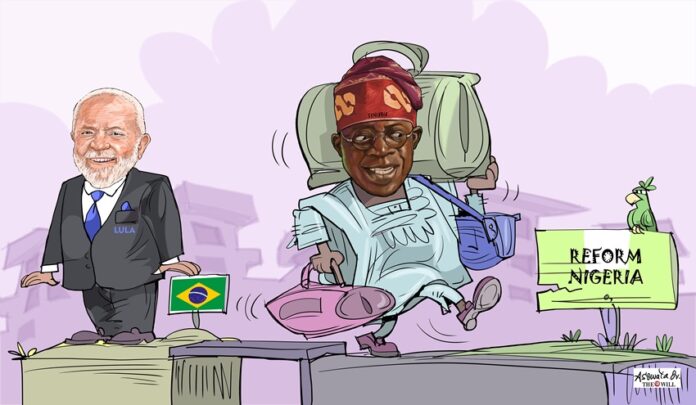
August 31, (THEWILL) — President Luiz Inacio Lula da Silva of Brazil made a prediction about Nigeria and Brazil on April 12, 2005.
During a state visit to Nigeria, he affirmed before his Nigerian host, then President Olusegun Obasanjo at a joint media address: “If the 19th century was the century for Europe, the 20th century was the century for the United States. Why can’t the 21st century be ours? It only depends on us and if we can believe in that. I believe that the time has come that we should look towards each other and that we should proceed. There are many things that we should do together which we have not yet done. Our trade relations could be much more intense. Our cultural relations can be much more intense too. Then our political liaison can be definitely much more than it is today.”
20 years later, President da Silva, who returned to office in 2022 after winning Brazil’s presidential poll that year, consummated his forecast for his country and Nigeria.

On August 27, 2025, President Silva, welcomed Nigerian President Bola Tinubu to Brasília for a two-day state visit and together they concretised the 20-year-old dream in signed MoU in five key areas: Aviation, agribusiness, livestock security, trade and cultural exchange.
The agreement marked a significant step in strengthening bilateral ties between the two largest economies on their respective continents and opened a vista on many fronts for Nigeria, which is still struggling with slow economic growth, high inflation and waning household purchasing power after 26 months of painful economic reform.
President Tinubu led a powerful delegation comprising senior government appointees, aides and players in the private sector to the South American powerhouse.
A major highlight of the visit was the signing of a Memorandum of Understanding (MoU) formalising a Bilateral Air Service Agreement (BASA) between Nigeria and Brazil.
The agreement was signed by Keyamo alongside Brazil’s Minister of Transport, Silvio Costa Filho, in the presence of both presidents.
The BASA establishes a new framework for direct air connectivity between Nigeria and Brazil, opening fresh avenues for trade, tourism, investment and people-to-people exchanges. It is expected to foster stronger economic integration, facilitate cultural ties and enhance diplomatic cooperation between the nations.
Both countries adopted Nigeria’s Air Peace as the operator of the Brazil-Nigeria route with the airline expected to begin commercial flights in the last quarter of the year. The airline will also build a Maintenance, Repair and Operations (MRO) facility with Brazilian aircraft manufacturer, Embraer providing technical assistance.
This agreement is a strategic milestone that underscores the Bola Tinubu administration’s commitment to expanding Nigeria’s global partnerships and creating an enabling environment for commerce and mobility.
The Brazilian President, Luiz Inácio Lula da Silva, in his remarks, lauded the partnership, emphasising Brazil’s readiness to deepen ties with Nigeria in multiple spheres, including infrastructural development.
Also, Nigeria’s Minister of Innovation, Science, and Technology, Geoffrey Nnaji and Brazil’s Minister of Science, Technology, and Innovation, Luciana Santos, signed an MoU on cooperation in biotechnology, bioeconomy, ocean science, innovation ecosystems, energy, space development, digital transformation and raw materials research.
Moreover, Managing Director of Nigeria’s Bank of Agriculture, Ayo Sotinrin and Brazil’s Minister for the National Bank for Economic and Social Development (BNDES), Aluísio Mercadante, signed an MoU for cooperation on trade and investment promotion, harmonising efforts to expand agricultural financing, investment and joint projects.
The Minister of State for Foreign Affairs of Nigeria, Ambassador Bianca Ojukwu, and Minister of Foreign Affairs of Brazil, Ambassador Mauro Vieira, signed an agreement on Diplomatic Training Cooperation and an MoU on political consultations to address bilateral, regional, and international issues of common interest.
As part of measures to build a future of mutual growth and prosperity, President Tinubu met with the President of the Brazilian Senate at the National Congress, the President of the Chamber of Deputies, and the President of the Supreme Federal Court.
REFORMS BEFORE MoUs
Interestingly, the Tinubu’s government had embarked on reforms in the sectors that the MoUs were signed thus laying a foundation for integration and smooth implementation of the agreements.
The agricultural sector received a big boost in July when the President commissioned 2,000 tractors for nationwide deployment under the Renewed Hope Agricultural Mechanisation Programme.
The commissioning ceremony marked the programme’s formal launch at the National Agricultural Seeds Council, Sheda, along the Abuja–Lokoja Expressway.
President Tinubu reaffirmed his administration’s commitment to transforming Nigeria’s agriculture sector by modernising farming practices and ensuring national food security.
“We are very proud of what we are doing. We made a promise when we came in. We are fulfilling that promise. Two years ago, I sounded the alarm on our nation’s food security crisis. I demanded immediate and innovative solutions. That, again, is answered today—this is the first phase of it,” the President said at the occasion…
“This government recognises that agricultural productivity is synonymous with national stability and food sovereignty. The ability to nourish our population forms the bedrock of a prosperous nation. Our ambition extends beyond mere self-sufficiency.”
The President disclosed that the 2,000 tractors and accompanying implements would be distributed nationwide through a service-provider model to support small holder farmers with access to modern equipment, reduce manual labour and increase yields.
“We must seize this opportunity to achieve agricultural independence. Nigeria has the land, the people and the tools. Let history recall this day as the beginning of Nigeria’s agricultural renaissance—where modern technology met our farmers’ legendary resilience to usher in greater prosperity,” he said.
Minister of Agriculture and Food Security Abubakar Kyari recalled four key initiatives launched under the Tinubu administration’s mechanisation policy. These include the John Deere Tractorisation Programme, the Greener Hope Project, the Green Imperative Programme and the newly launched 2000 tractors procured from Belarus.
According to him, the Belarus Project, implemented in collaboration with AfTrade DMCC and supported by the Republic of Belarus, delivered 2,000 high-quality tractors, 10 combined harvesters, 12 mobile workshops, 9,000 implements and 9,000 spare part kits. He added that the programme is expected to cultivate over 550,000 hectares of farmland, produce more than 2 million metric tons of staple food, create over 16,000 jobs and directly benefit over 550,000 farming households.
Other programme components include mandatory operator training, GPS-enabled tracking for accountability, a structured repayment model and pro bono equipment allocations to research and training institutions.
He further stated that the initiative will engage Nigeria’s youth through new roles in equipment handling, maintenance, logistics, extension services and agri-tech innovation.
The continued sordid operations in the oil sector, particularly with the country’s manager of the sector, the Nigeria National Petroleum Company Limited, NNPCL, has warranted the partnership of true, professional oil companies like Petrobras.
Harping on these deficiencies last Thursday, Bayo Ojulari, the GCEO of the NNPCL, said Nigeria was losing between $300 million and $500 million each month while the Port Harcourt Refinery was in operation. Ojulari, who made this statement during his meeting with the leadership of the Petroleum and Natural Gas Senior Staff Association of Nigeria (PENGASSAN) in his Abuja office, added that upon review of the refinery, he found why the country was pumping about 50,000 barrels of crude to go into the refinery, less than 40 per cent equivalent of what was coming in.
“The solution you are proposing (the NLNG model) is what we are working on. We’ve completed a technical review of the three refineries, but it’s not just about technical. It’s also about commercial viability. It has to make money. Maybe not a lot, but it should not be a loss. We’ve completed the commercial review of the Port Harcourt refinery and from that commercial review, we have come to the conclusion that the best way forward is to get a true professional refinery company to join us and co-operate with us.”
In the Aviation industry, Keyamo has been implementing policies that address mismanagement challenges, poor infrastructure, regulation, and improved airport facilities to support growth. Notable reforms include securing compliance with the Cape Town Convention, which facilitates aircraft leasing and financing, strengthening the Nigerian Civil Aviation Authority, NACA, NCAA, with a new digital portal and addressing issues like foreign airline trapped funds and the operations of a consumer protection portal to handle passenger complaints and enforce rules of engagement against airlines. Recently, the Federal Executive Council, FEC, approved N712 billion for the comprehensive renovation and modernisation of Murtala Muhammed International Airport, Terminal One.
IMPACT OF THE AGREEMENTS: OIL SECTOR, AGRIC, AVIATION, DIPLOMACY
The impact has been swift in the aviation industry. Within hours of signing the Bilateral Air Services Agreement (BASA) between both countries, the direct flight operated by Air Peace from São Paulo, Brazil, route landed at the Murtala Muhammed International Airport, Lagos, at about 3:15 pm on Wednesday, August 27, 2025.
Speaking on the development on arrival at the Lagos Airport, the Minister of Information and National Orientation, Muhammed Idris, said the direct flight reflects Tinubu’s policy of placing Nigeria first in global partnerships.
“This is not only about trade and investment; it is also about cultural and social connections between two parts of the world”, he said.
Noting that the direct flight would strengthen ties between the two countries, Idris commended Air Peace for its resilience and commitment to expanding Nigeria’s footprint in global aviation.
The Minister of Aviation and Aerospace Development, Festus Keyamo (SAN), who came on the flight, said the development marks a turning point in Nigeria’s aviation history and bilateral relations with Brazil.
As the third largest producer of civil aircraft worldwide after Boeing and Airbus, Brazil’s Embraer S.A., a multinational aerospace corporation which develops and manufactures aircraft and aviation systems, provides leasing, equipment, and technical support services, holds brighter prospects for Nigeria aviation industry in the light of the relations between both countries.
Mr Biodun Ajiboye, Executive Director and Chief Executive Officer of the National Institute for Orientation and Culture Development foresees the BASA agreement impacting culture, businesses between Nigeria and Brazil deeply.
Speaking on Friday night on national television, he said, “To fly to Brazil, Nigerians used to spend almost three days. They first go to Ethiopia and then fly 14 hours to Sao Paulo, the centre of cultural ties between both countries. The Air Peace direct flight from Brasília to Nigeria, took seven hours and thirty minutes. For the 90 million Brazilians who are spiritually connected to Yoruba culture and used to visit in trickles, this aviation agreement is going to impact the tourism culture which is a N200 billion business. All we need to do now is to build infrastructure that would accommodate the expected influx of tourists.”
For the oil sector, Petrobras, the Brazilian state-owned oil giant is making a return to Nigeria’s energy sector, five years after halting its joint venture operations in Nigeria.
The Brazilian state-owned oil company has critical expertise in gas and oil development, specialising in deepwater oil exploration, gas development and operational excellence. Its return could be crucial for aiding the development of Nigeria’s vast hydrocarbon resources, estimated at 210 trillion cu. Ft., opening chances for domestic energy development, industrialisation and export growth.
“The planned return of Petrobras to Nigeria is a landmark moment that signals confidence in Africa’s energy sector and its long-term growth prospects,” said NJ Ayuk, Executive Chairman of the Africa Energy Chamber, AEC.
The AEC Chairman further said that the implications of this renewed partnership extend across multiple sectors. “For Nigeria, Petrobras’ presence will stimulate local content development, technology transfer and workforce capacity building. For Brazil, it presents new export and investment opportunities in a rapidly growing economy. For Africa at large, it signals that international investors recognize the continent as a strategic frontier for energy development and sustainable industrialisation.”
On diplomacy, the partnership with Brazil will open new vistas in geopolitics for Nigeria. Brazil is a founding member of the BRICS countries with a leverage beyond the South American continent. Yet to become a full member of the major bloc moving the world towards multi-polarity, Nigeria’s MoU with Brazil could further reinforce her status as “partner country” of the BRICS economic and political bloc since January 2025, thus providing a platform for independent action on the diplomatic front.
The most welcome prospect lies in agriculture. Nigerians need food, abundant, wholesome food for a majority of her over 200 million, known to be suffering from multi-dimensional poverty and hunger. For a country that deploys it mechanised agriculture to feed the world on soybeans, poultry, sugarcane production and Nigeria’s 80 million hectares of arable land is still largely operated on subsistence and threatened by prolonged insecurity until recently when the government made a major breakthrough in turning the tide in the war on insecurity with the arrest of leaders of the deadly Ansaru terrorist outfit.
“Brazil has a cattle herd of 238 million, even more than its human population. This success in agribusiness offers valuable lessons for us as we expand our livestock industry,” said Mr Sunday Dare, Special Adviser to the President on Media and Public Communication.
WAY FORWARD
Taking a general view of the historic agreement between Nigeria and Brazil, Sunday Dare said, “It’s about transforming historic and cultural ties into practical, mutually beneficial investments that will boost Nigeria’s growth and global standing and greatly assists the government’s ‘Renewed Hope Agenda’ in harnessing Nigeria’s vast human and natural resources to create a diversified, self-reliant economy recognized as a global investment hub.”

Amos Esele is the Editor of THEWILL Newspaper. He has over two decades of experience on the job.
