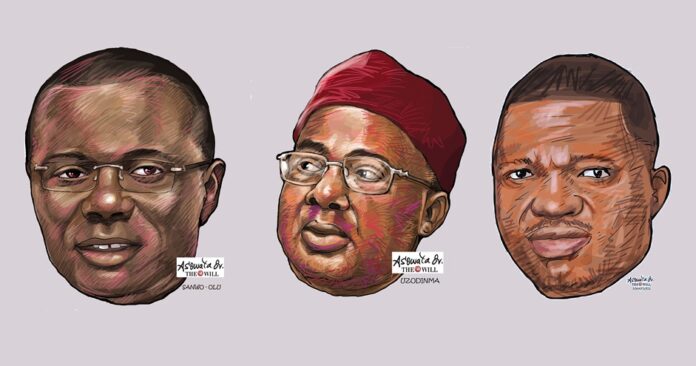
September 01, (THEWILL) — A few days after Governor Hope Uzodinma of Imo State and his Ebonyi State counterpart, Francis Nwafiru, raised the minimum wages of workers in their states, workers in other parts of the country are beginning to have second thoughts about conditions in their respective states.
Governor Uzodimma recently announced an increase in the state’s minimum wage from ₦76,000 to ₦104,000. The governor also approved salary adjustments for key sectors: doctors’ pay rose from ₦215,000 to ₦503,000, while teachers in tertiary institutions saw their wages jump from ₦119,000 to ₦222,000.
Similarly, the Ebonyi State Government raised its workers’ minimum wage from N70,000 to N90,000. The state Commissioner for Information and Orientation, Chief Ikeuwa Omebe, made the disclosure last Thursday while briefing journalists on the outcome of the state’s Executive Council meeting.

Reacting almost immediately, the Lagos State Chapter of the Nigeria Labour Congress, NLC, demanded a new minimum wage of N150,000 for workers in the state, citing rising costs of living and recent wage increases in Imo and Ebonyi states.
The Chairperson of the state chapter of the NLC, Funmi Sesi made the demand in response to the upward wage review by the two states.
Sesi said that Lagos workers currently earn N85,000 as minimum wage and deserve an upward review in line with the rising costs of feeding, accommodation, transportation and utilities in the state.
She said that accommodation, transport, feeding and utilities were more expensive in Lagos than in other states.
“The time has come for an upward review of minimum wage in Lagos. At least, someone has taken the bull by its horns and opened the space,” she said.
She added that no one could blame Governor Sanwo-Olu now if he implements a higher wage for Lagos workers, stressing that they deserve a better wage and decent working conditions commensurate with the economic realities, especially in Lagos.
“We can’t wait for an engagement with the government with a view to approving an improved welfare package for Lagos workers,” she said.
The State NLC boss expressed optimism that all state governments would emulate Imo and Ebonyi. The chairperson said that the minimum wage increase for Imo and Ebonyi workers was a welcome development for the labour force in Nigeria.
National President of the NLC, Joe Ajaero concurs with Sesi that workers have taken a hard hit with the comatose economy, double digit inflation that has reduced the purchasing powers in households.
According to Ajaero, both federal and state governments should urgently take a cue from Imo State by implementing higher minimum wages for workers.
Speaking on Thursday in Abuja at the seventh quadrennial delegates’ conference of the National Union of Civil Engineering Construction, Furniture and Wood Workers, Ajaero commended Governor Hope Uzodimma for his bold decision to significantly raise salaries across Imo State’s workforce.
Ajaero described the move as both “real and commendable”. “So many people were asking me, Is this real? I said, this is a report from Imo state so far. I have reached out to him. Although he told me about it before, now. It is real. That is the highest and, to a very large extent, commendable,” he said.
He further urged other governors to act without waiting for the statutory three-year wage review cycle.
“If the states have the capacity to pay ₦100,000 and above, and considering that Imo state is not the highest in terms of revenue, it then means others are encouraged to do more. Minimum wage is the least; states can do better. I think this is an initiative that other governors are supposed to follow. You must not wait for the next three years for a wage to be reviewed, especially given the current economic situation, so that people can at least survive,” he stressed.
Beyond wages, Ajaero also expressed concern over developments at the Nigeria Social Insurance Trust Fund.
He accused the government of diverting 40 per cent of workers’ contributions and attempting to amend the NSITF Act to gain greater control over the fund.
“The state, having diverted 40 per cent of workers’ contributions in NSITF, is now seeking to unilaterally amend the NSITF Act. This is to allow the government to control a fund that entirely belongs to workers. We had demanded that the funds be accounted for and returned so that Nigerian workers would enjoy the benefits of the agency,” he said.

Felix Ifijeh is a journalist with years of professional reporting experience. Known for his keen news sense, compelling storytelling and commitment to accurate, impactful reporting, he has built a reputation for turning leads into clear, engaging, and well-structured reports that resonate with readers. His work reflects deep newsroom experience and a commitment to accurate, impactful journalism.