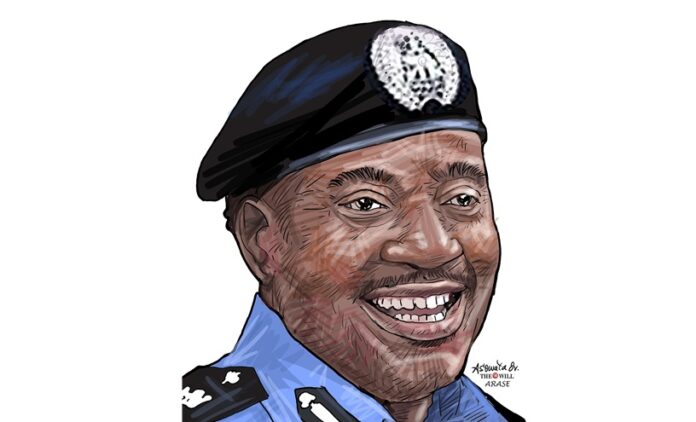
September 01, (THEWILL) — Glowing tributes have continued to trail the passing of former Inspector General of Police, Dr. Solomon Ehigiator Arase, who died on Sunday at Cedarcrest Hospital in Abuja while receiving treatment for cancer. He was aged 69.
THEWILL gathered that Dr. Arase, according to a source close to him, had received treatment in Abuja this year for the ailment, which appeared to be successful. He had been travelling since his remission. He returned to Nigeria on the 17th of August from Europe and travelled again to Morocco for a formal event where he suffered a relapse and had to be hurriedly flown to Abuja for treatment. His death was officially communicated to the incumbent Inspector-General of Police, IGP, Kayode Egbetokun, by his first son, Mr. Solomon Osabohien Arase Jnr.
President Bola Tinubu, Edo State Governor, Monday Okpebholo, IGP Egbetokun and the Rule of Law Accountability and Advocacy Centre, RULAAC, a civil society organisation working on police reform and accountability on Sunday lauded the departed late Arase as one of the most dedicated, effective and professional IGP, who modernised the Nigeria Police Force.

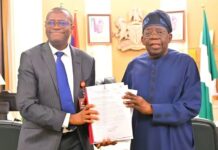
According to President Tinubu, Arase’s reforms as IGP and later, as Chairman of the Police Service Commission, brought lasting changes to the Force.
Presidential Spokesperson, Bayo Onanuga, quoted President Tinubu as saying that, “Arase who served the police force meritoriously from 1981 to 2016, enhanced security in the country, through initiatives such as the Intelligence Response Team, the Complaint Response Unit and Safer Highway Patrols.
“After retirement, he continued to serve the nation in various public roles, such as Chairman of the Police Service Commission and head of the Task Force on implementing the Edo State Anti-Community Development Association Law.
“His expertise extended to consultancy roles with the Office of the National Security Adviser (ONSA), the European Centre for Electoral Support, the Human Rights Centre at the University of Oslo and as a member of the Committee on Prevention of Torture in Geneva, Switzerland.”
For Governor Okpebholo, Arase was a patriotic Nigerian who contributed immensely to Nigeria’s security architecture.
“The late IGP was an illustrious son of Edo State and a dedicated public servant. Late Solomon Arase was a patriotic Nigerian whose contributions to the country’s security architecture were immeasurable. Dr. Arase was a man of integrity and honour who served our nation with distinction, rising to the pinnacle of his career through sheer hard work and dedication,” Okpebholo said, adding that “As the 18th Inspector-General of Police, Arase’s tenure was marked by significant reforms, professionalism and a strong commitment to community policing.
IGP Kayode Egbetokun, who paid a condolence visit to the family of the late Police Chief in Abuja, expressed heartfelt sympathies on behalf of the officers and men of the Nigeria Police Force.
Egbetokun praised Arase’s contributions to national security and Police reforms, describing him as a man who served with honour and left behind a legacy that will remain etched in the history of the Force and the country.
RULAAC ‘s Executive Director, Okechukwu Nwanguma in a note to THEWILL described Arase as a reform-minded police chief and a rare breed of officer
“In a country where the police institution is often associated with impunity, corruption and brutality, Arase stood out as a shining example of what policing in a democracy should represent. He was an exceptional and exemplary cop, a reformer and a rare breed of officer who made a significant difference.
“As Inspector-General of Police, Arase prioritised intelligence-driven policing over brute force, emphasising smarter and evidence-based strategies in crime prevention and control. He believed that policing should be about service, trust and legitimacy – not intimidation.
According to Nwanguma, Arase also demonstrated an uncommon commitment to police accountability and reform.
He said Arase’s tenure reflected a clear focus on institutional improvements that went beyond personalities and were aimed at laying a foundation for lasting change. He understood the critical importance of community partnership, consistently advocating for trust-building between the police and citizens.
“As a civil society organisation working on police reform and accountability, RULAAC particularly recalls with admiration how open and receptive Arase was to civil society engagement. Unlike many before and after him who perceived rights groups as adversaries, Arase welcomed constructive dialogue and collaboration, making him a true partner in the quest for a better police force.
“Equally significant was his role in reforming the police recruitment process. At a time when recruitment was deeply compromised by corruption, nepotism and political interference, Arase insisted on a transparent and merit-driven process. Despite opposition from vested interests who thrived on the status quo, he stood firm and restored credibility to recruitment, giving hope to thousands of young Nigerians aspiring to join the police based on merit rather than connections or bribery.”
LIFE AND TIMES
Dr. Arase was born on June 21, 1956, in Ora, his late mother’s hometown in Owan West Local Government Area of Edo State. His father hailed from Benin in Edo South.
Arase had an illustrious academic background before joining the Force. He studied Political Science at Ahmadu Bello University, Zaria, and later obtained a Law degree from the University of Benin, went on to earn a Master’s in Corporate Management and Financing from the University of Lagos and capped his academic pursuit with a Ph.D. in Public Law from Ambrose Alli University, Ekpoma.
Arase was enlisted into the Nigeria Police Force on December 1, 1981, beginning a career that spanned over three decades.
JOINING THE FORCE
According to him in one of his most recent interviews, he joined the “police force by accident.” As a National Youth Service Corps member serving at the old Federal Secretariat in Ikoyi, Lagos, he was always amused by the constant stream of applicants going in and out of the Police Service Commission located a walking distance at Okoti-Eboh Street.
“So, at the end of my service year I went for an interview at the Police Service Commission. We were 100 applicants and 15 of us were selected and posted to Police College in Jos for training.”
Explaining his academic background, Arase who grew up in the midst of his mother who was a teacher and an uncle, who later went on to become a professor in the sciences, stated that mother and uncle insisted he must pursue academics. “My uncle had a library and made me read African Writers Series novels such that I wanted to become a journalist. But when I joined the Police force after my NYSC year, my mother insisted that I should go on to do a Masters and a Ph.D.”
In the Police Force, he held key positions, including Principal Staff Officer to three different IGPs between 2002 and 2008, Commissioner of Police in Akwa Ibom State and the pioneer Assistant Inspector-General of Police in charge of the Force Intelligence Bureau.
He later served as Deputy Inspector-General of Police at the Force Criminal Investigation Department (FCID) before his appointment as the 18th Inspector-General of Police in April 2015.
According to him, his announcement as the IGP came as a surprise. He said he had prepared his mind for retirement when the announcement came, taking him unawares.
He said, “When the IG was to retire (M D Abubakar), people came from the Presidential Villa to interview some of us for the post of IGP. During the interview, they stated that many of us were from the South and they wanted some ethnic balancing. So, the officer from Jigawa State (Suleima Abba) was chosen. I started preparing for my exit. But I woke up one morning and heard that I had been made the 18th IGP.”
THEWILL recalls that IGP Suleiman was sacked by President Goodluck Jonathan for his perceived role in the April 11, 2015 governorship and House of Assembly elections in Lagos and Rivers States, as well as his alleged partisanship where it was believed he had sympathy for the All Progressives Congress, APC. Otherwise, he was expected to stay in the position till 2019, when he would have been due for retirement.
TENURE AS IGP
During his tenure as IGP, Dr. Arase introduced key reforms such as the Complaints Response Unit, designed to provide swift responses to public complaints and safeguard citizens’ rights, Safety Highway and Technical Intelligence Response Team, planned for internal security management, Housing Scheme and Scholarship scheme for children of police officers.
He also established a reputation for professionalism, discipline, and innovative policing strategies that continue to shape the Force.
RETIREMENT
Arase retired from service on June 21, 2016, upon attaining the mandatory retirement age but was later appointed Chairman of the Police Service Commission on January 24, 2023, by former President Muhammadu Buhari and removed from the office on June 10, 2024, by President Bola Tinubu.
Beyond his policing career, Arase supported academic excellence through the Solomon Ehigiator Arase Foundation (SEAF), which awarded scholarships to children of deceased police officers and other indigent students, Mercy Igbe Foundation, named after his late mother to provide scholarships for indigent students from Owan East and Owan West.
A Fellow of the Defence College and a member of the Body of Benchers, Arase was widely respected as a reform-minded Police officer.
Felix Ifijeh is a journalist with years of professional reporting experience. Known for his keen news sense, compelling storytelling and commitment to accurate, impactful reporting, he has built a reputation for turning leads into clear, engaging, and well-structured reports that resonate with readers. His work reflects deep newsroom experience and a commitment to accurate, impactful journalism.