
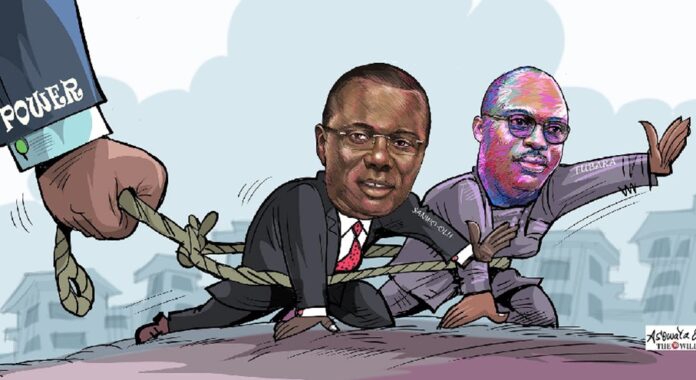
March 16, (THEWILL) – Governor Siminalayi Fubara of Rivers State and his counterpart in Lagos State, Babajide Sanwo-Olu, belong to two different political parties, the major opposition Peoples Democratic Party, PDP and the governing All Progressives Congress, APC, respectively, but they are facing similar challenges in the current political dispensation. While impeachment has been staring Fubara in the face from the outset of the supremacy battle with his benefactor, Nyesom Wike, Minister of the Federal Capital Territory, FCT, and majority of the Rivers State House of Assembly members, Sanwo-Olu has been literally walking on slippery ground as a fall-out of an ongoing leadership crisis in the Lagos State Assembly.
POWER PLAY IN LAGOS
How the dashing Governor of Lagos State survives the remaining two years of his tenure is entirely up to him, following developments over the leadership crisis in the State House of Assembly. THEWILL was first to report that President Bola Tinubu believes that Sanwo-Olu orchestrated the removal of Hon. Mudashiru Obasa as Speaker of the Lagos House of Assembly without his knowledge or consent.
The embarrassing drama that unfolded during the leadership tussle before the President directly intervened to restore order, showed that neither Sanwo-Olu, some influential members of the Governance Advisory Council (GAC) nor the majority of the elected members of the House of Assembly, who were not keen on Obasa’s return to the office of Speaker, could control what they had started.

A reliable government source who chose to be anonymous, said the President’s annoyance was with the process of Obasa’s removal, “which speaks volumes about their loyalty to the president.”
As reported by this newspaper, President Tinubu was miffed at being left in the dark about the impeachment. Yes, he had heard complaints about Obasa’s disrespect for the governor, party leaders and members of the assembly and roundly condemned it, but the source said they should have allowed the internal resolution mechanism of the party to fix the problem.
“The conspirators, as it turned out, waited till Tinubu departed for Abu Dhabi on an official assignment before carrying out their plan. That showed disloyalty and lack of trust which also goes with it.
“After the President’s meeting with the lawmakers, nothing was said about the fate of the governor, but from experience he should know that henceforth any act deemed unlawful or unconstitutional which may ordinarily be overlooked will receive the maximum political punishment akin to impeachment,” the source said. This is like saying that Sanwo-Olu’s political future henceforth is for him to determine.
Much earlier, President Tinubu was said to have recalled the embarrassing 2023 presidential election results in Lagos when he left the state in the governor and his team’s charge while campaigning all over the country and then had to suffer defeat in the hands of Peter Obi of the Labour Party.
Multiple sources say the reinstatement of Obasa is not designed to hurt Sanwo-Olu politically, since it is still within his power to avert it. But it is being used as an instrument to maintain cohesion within the governing structure in the state. “Even President Tinubu himself had always consulted widely within the party and other political structures before taking decisions on crucial matters because he knows that political order is very key to running systems at all levels,” one of the sources said.
THEWILL gathered that President Tinubu has not met face to face with Sanwo-Olu since Obasa’s initial removal though the governor has been sending emissaries to appease the president.
THEWILL also gathered authoritatively that the Economic and Financial Crimes Commission (EFCC) has expanded its investigation into the tenure of the embattled governor and has requested to interview more state officials close to the governor, as well as non-political associates, including a female socialite who threw a lavish birthday party abroad last year.
CASES IN THE PAST
There were decisive moments, under similar circumstances, in the past when the President had to intervene to maintain cohesion, avoid complacency and prevent political power from getting out of his control.
According to sources, one such occasion presented itself during the 2011 general election when the Independent National Electoral Commission, INEC, postponed the National Assembly Election scheduled for Saturday, April 2, 2011, to Saturday, April 9, 2011, even as voting had started in places like Lagos, Delta, Enugu, Kaduna, Kebbi and Zamfara States. It turned out to be a blessing for Tinubu because preliminary results from the field showed that the then ruling Action Congress of Nigeria, ACN, his party, had underperformed.
Dissent and power play between the state governors and party officials had polarised the party, such that he had to step in and wielded the big stick before the party could regain order.
Although ACN had INEC’s postponement of elections in that year to thank for saving it from its poor showing, it took the leadership and personal involvement of Tinubu, to marshal the required forces to triumph during the rescheduled polls.
Another example was when Akinwunmi Ambode was denied a second term as governor in 2019 allegedly for deviating from the dreams and vision of Lagos as conceived and agreed by the stakeholders in the state. Some party officials who initially sided with the governor and left the party to work against it had to retrace their steps after Tinubu stepped in to resolve matters.
The loss of the 2023 presidential poll and removal of Obasa were unacceptable for a man whose catch phrase on power is that “power is not served a la carte.” More so, when the politics of 2027 is buzzing in the corner with the goings on in the realignments within the opposition.
Tinubu’s meeting with the lawmakers after Obasa’s reinstatement is said to have stunned many politicians in Lagos. Only Hon. James Faleke, a member of the House of Representatives representing Ikeja Federal Constituency in Lagos, who simply told journalists that “the meeting went well,” agreed to field questions from reporters.
A Lagos State government official, who spoke with THEWILL on the condition of anonymity, said he was unaware of any form of punishment or threat to Governor Sanwo-Olu. He argued that the governor had never and will never do anything against the wish of President Tinubu, adding that whatever happened in the State Assembly was purely the work of the legislators.
“What we learnt and which I think is correct in that meeting between the President and the legislators ended in the peaceful resolution of the leadership crisis in the state assembly. The governor did allow them (the lawmakers) to run their show. Please respect the separation of powers here,” the source said.
Reminded that moves to reinstate Obasa and reconcile the aggrieved members of the Assembly was brokered in the Marina residence of the governor, he stated that Sanwo-Olu was duty bound to play a role he likened to that of a father mediating in the quarrels of his children.
However, a social cultural group for Lagos State indigenes, De Renaissance Patriots, which had been against the reinstatement of Obasa and supported the retention of Mojisola Meranda for purely identity reasons, disagreed with the manner the crisis in the Assembly was resolved.
Spokesperson of the group, Prince Bashir Adefaka, in a note sent to THEWILL at the weekend, said the Chairman, retired Major-General Tajudeen Olanrewaju, is full of pity for Governor Sanwo-Olu.
In the note, the retired general said: “I can tell Governor Babajide Sanwo-Olu to watch his back because he is more possibly going to be the victim of this whole scenario. Obasa has now been crowned as leader of the APC in Lagos State holding brief for the leader who is currently occupied with a national assignment in Abuja.”
Gen. Olanrewaju, who is a former Minister of Communications, further said, “There were litigations that were not concluded except mitigations unknown to the Constitution of the party. At the end of the day, a Lagos state indigene, Hon. Mojisola Lasbet Meranda, was a victim and lost her legitimate election. Full stop.”
He called on indigenes of the state to learn from these events and prepare to “choose their indigenes as governorship, deputy governorship, Speaker, Secretary to the Lagos State Government, Head of Service, Chief Judge candidates and Chairmen of Local Government Areas in the soon to be conducted LGA polls and the upcoming general elections in 2027.”
UNFOLDING BATTLE IN RIVERS
Similarly, Governor Fubara is facing the reality of a possible impeachment by the Rivers State’s House of Assembly where 27 aggrieved lawmakers who are in the majority are spoiling for war. The Martins Amaewhule-led Assembly on Friday adjourned its sittings indefinitely, a day after the governor notified the lawmakers of his plan to present the 2025 budget on Wednesday, March 19, for consideration and approval.
This decision, the governor said, was in compliance with the Supreme Court judgment and in response to the lawmakers’ request for him to re-present the budget.
Earlier, the lawmakers on Wednesday denied the governor’s access to the premises of the House of Assembly to represent the budget on the grounds that the 12-hour notice was too short and the communication for the meeting by the Secretary to the Government was conveyed through social media.
Despite the governor’s formal notice on Thursday, the Amaewhule-led assembly on Friday adjourned plenary indefinitely, escalating the political crisis in the State.
For the Amaewhule led -legislature which has been handed temporary control of the Assembly through the recent Supreme Court ruling before the pending adjudication on the substantive court case on their defection, the strategy is to get the governor to do their bidding under the threat of impeachment.
Sensing that the governor appeared to be buying time until the pending suit on defection is resolved, the lawmakers tried without success to remove the prop for the governor: they summoned the Chairman of the Rivers State Independent Electoral Commission, RSIEC, retired Justice Adolphus Enebeli and his team to appear before the Assembly.
Some RSIEC Commissioners answered the summons, but the Chairman declined and instead got his lawyers to write the Assembly leadership reminding them of the need to convey their language with civility as required in a democracy setting. Then, the lawmakers tried to get Commissioners appointed by Governor Fubara and cleared by the five-man Victor Oko-Jumbo led-Assembly to resign to no avail. Rather, the Commissioners, like the RSIEC Chairman, took the Assembly to court. Undaunted, the lawmakers tried to rattle the Chief Judge and force him to resign by sending a petition on alleged age falsification against him to the Director of State Service, DSS.
Unfazed, RSIEC chairman, retired Justice Enebeli, had scheduled the local government election for August 9 after securing the updated voters register from the Independent National Electoral Commission, INEC.
“There is no doubt that something is going on in the other camp to get at the governor,” said Jake Epelle, founder of Albino Foundation, who told THEWILL on Friday that he is on a mission to mediate between Governor Fubara and Wike for peace to reign in the state.
“I met the governor for seven minutes last week and I can tell you he is willing to embrace peace. But I have been unable to reach FCT Minister Nyesom Wike. One of his men, Chidi Lloyd had agreed with me to go together to see Wike, but somehow, he stopped answering my calls and my text messages. He has probably been told what to do. I think the governor has responded well to the issues after the Supreme Court ruling that the action taken by the five-man Assembly was illegal. They claim he responded through social media to their request to represent the budget. He went the extra mile by writing again because he wants the issue resolved. Now they have shut down the House of Assembly,” he added.
Epelle said the impeachment of Fubara cannot hold, vowing that relevant stakeholders would pull all the stops to prevent it from happening because it would further aggravate the tension in the state, which is desperately in search of peace to restore normalcy that has eluded it for several months now.
Senator George Sekibo, however, faulted some moves by Governor Fubara. Speaking at the weekend on national television, he said after the apex court ruling, they were invited for a meeting alongside the lawmakers. At that meeting, it was agreed that the lawmakers should write to the governor to come and represent the budget, he said, adding, “The governor did not go.”
He further said, “Budget presentation is a serious business. You cannot go to the Assembly unannounced. President Tinubu intervened at a point and the warring parties signed an agreement, Fubara made a U-turn on the resolutions. Besides, the Commissioners and RSIEC Chairman who failed to answer the summons by the Assembly, all went to court. These are the governors’ men.”
The ensuing stalemate has heightened tension in the state, especially in the face of intemperate language being used in interviews, comments and statements on the ongoing political impasse, Mr Epelle noted.
The public perception now is that the Amaewhule-led legislature is bent on impeaching the governor, a mission that first reared its head at the height of the supremacy battle between Fubara and Wike, leading to the bulldozing of the Assembly complex last year.
SUPREME COURT INTERVENES
Only recently, the Supreme Court pulled the state from the brink of the prolonged crisis through two rulings which the governor has complied with. A five-member panel led by Justice Emmanuel Akomaye had ruled against an appeal by Governor Fubara challenging the legitimacy of the House of Assembly under Speaker Amaewhule.
In another ruling, the apex court stopped the Central Bank of Nigeria, the Accountant General of the Federation and other financial bodies from releasing funds to the Rivers State Government. This ruling was handed down to the governor for disobeying previous rulings, which voided the local government election held on October 5, 2024.
The governor, in compliance with the rulings dissolved the local government councils and then proceeded to write a letter to the assembly for the representation of the 2025 budget.
PATH TO PEACE
Dialogue is the only way out of the crisis, Senator Sekibo said. He said the problem between the governor and Speaker is political and not personal and so both of them should be able to come to terms of agreement.
“Everybody involved in this matter should come to the negotiation table. Fubara and Wike should be locked in a room where they can fight each other and come out to tell the rest of us what they have decided,” Epelle told this newspaper.
PANDEF, which met with President Tinubu at the State House last week over the matter and was told to work towards peace on the basis of the apex court ruling, accused Wike of undermining the peace process in the state.
National Chairman, Ambassador Godknows Igali, the National Publicity Secretary, Olorogun Obiuwevbi Ominimini, other Executive members of PANDEF, Obong Attah lamented at the weekend that Wike’s unwillingness to meet with the committee is obstructing efforts to de-escalate tensions in the state.
The former governor of Akwa Ibom State, said that following a Special General Assembly in Port Harcourt in October 2024, the group set up a seven-member High-Level Peace and Reconciliation Committee.
“In a bid to prevent a full-blown crisis from developing, we constituted a team of eminent elders from across the South-South region. However, despite repeated attempts, we have been unable to secure a meeting with Chief Nyesom Wike, who has continued to rebuff our peace efforts.”
He said the success of any peace process hinged on Wike’s willingness to come to the table.
Rejecting insinuations that he was obstructing peaceful resolution of the crisis. Wike in a press briefing last Wednesday, faulted Fubara’s approach in writing “a useless letter,” to the Speaker as if they “are under his control.”
For peace to reign, the FCT Minister quipped, “What is peace? What is more important than letting the right thing be done? When the right thing is done, there will be peace. But if the right thing is not done, how can you talk about peace? Go present the budget; go submit the list of commissioners.”
RETIRED JUDGES FAULT SUPREME COURT RULING ON RIVERS
Meanwhile, an 11-man Independent Judicial Accountability panel comprising three retired judges as members at the weekend faulted the recent Supreme Court judgement on Rivers State. The panel, which is led by a retired judge of the Appeal Court, Justice Mojeed Owoade, said at its first meeting that the judgement created some gaps that can stretch interpretations to the point of calling into question the motive of the judges and lead to the erosion of public trust in judges.
“The judgement of the Supreme Court in the consolidated appeals leaves a gap as to whether the issue of the alleged defection of 27 members of the Rivers State House of Assembly is still alive or has been settled,” he said, adding, “This is because the court made comments on the issue of defection without actually addressing it.”
Arguing that judges had no case on the defection of 27 members before them at the time of their ruling, Owoade’s panel maintained that the Justices of the Supreme Court should have refrained from making comments on the issue since there was a pending litigation on the matter. He urged judicial officials to be, “mindful of their oaths of office at all times,” and “politicians to generally avoid undue influence on the judiciary and be more accommodating of each other in the interest of their people.”

Amos Esele is the Editor of THEWILL Newspaper. He has over two decades of experience on the job.
