
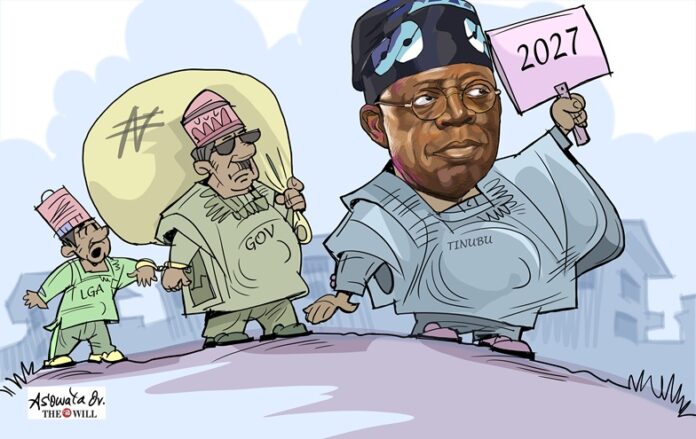
December 07, (THEWILL) — Friday’s Supreme Court judgement in a suit instituted by the Attorney-General of Osun State, Oluwole Jimi-Bada, against the Attorney-General of the Federation (AGF), Lateef Fagbemi (SAN), over the prolonged withholding of statutory allocations meant for the state’s 30 local government councils echoed its July 11, 2024, judgement on local government autonomy.
Although the court struck out the suit for want of a locus standi and restated that the Federal Government’s action in withholding local government funds amounted to a “grave breach,” of the 1999 Constitution and that the government had its “hand soiled,” in the unilateral decision, “to seize LGA allocations”, the split judgement of six to one delivered by Justice Mohammed Idris had ordered the authorities to ensure that “all funds are henceforth channelled directly to local government accounts in line with constitutional provisions.”
Ensuring that all funds are channelled directly to local government accounts has remained a theory rather than a practice for over a year when the Supreme Court, in a landmark judgment on July 11, 2024, granted full financial and administrative autonomy to all 774 local government areas (LGAs) in the country, while delivering judgement in a suit No. SC/CV/343/2024, initiated by the Attorney- General of the Federation against the 36 state governors.

“It has been motion without movement for the past one and a half years since the Supreme Court delivered that judgement last year. Nothing has changed,” president-general of the Nigeria Union of Local Government Employees, NULGE, Alhaji Aliyu Haruna Kankara told THEWILL in a brief interview at the weekend. According to him, for the Supreme Court to restate its position while delivering judgment on the Osun case shows that the matter has remained a judicial pronouncement with no political will by the authorities to implement the ruling.
“We still have challenges with implementation. A Committee was asked to fashion out modalities for the implementation of the judgement. We are part of the Committee,” he said.
According to him, the 10-member Inter-Ministerial Committee chaired by the Secretary to the Government of the Federation, George Akume, with Fagbemi and the Minister of Finance, Wale Edun as members, had clear cut directives to enforce the apex court’s ruling, end joint account abuse, ensure direct disbursement of funds from the Federation Account to local government councils and promote grassroots governance.
“The committee has since completed its work, but up till this time, nothing has been done. The government is still sitting on the report of the committee, so nothing has been done,” he added, wondering why the Federal Government embarked on the matter in the first place and then failed to push for the implementation of “its own victory,” at the apex court.
FAILED DREAM?
Implementing the court judgement has been challenging. “They are playing politics with the judgement, speaking from the information available to us. The governors are against autonomy. Over the years, it has always been the governors who are against local government autonomy,” Kankara told THEWILL.
President of the Nigerian Bar Association, Afam Osigwe, a Senior Advocate of Nigeria, SAN, in his reaction to the latest ruling of the Supreme Court, told THEWILL the judgement was legally binding on every Nigerian but would refrain from commenting further because there were still pending suits on the Osun case at the Oyo State High Court and the Federal High Court in Osogbo.
“The position of the law today as decided by the Supreme Court is that the LGA fund should be paid directly to local government councils. It is binding on all of us. That is not the NBA decision. So, I will not comment on today’s (Friday, December 4, 2025) Supreme Court ruling. Also, I would not comment on the Osun matter again because even though today’s case was struck out, there are other pending cases in Oyo State and Federal High Court, Osogbo. And It would be irresponsible for me to say more on this matter,” Osigwe said.
The NBA had on August 16, 2025 addressed a letter to Fagbemi, accusing the Federal Government of “violating the Constitution” and “abusing the rule of law” by allegedly withholding statutory allocations meant for local government councils in Osun State, because the government has, “no legal justification for the non-release of the allocations”.
Legally abusing the rule of law and violating the Constitution has been the major obstacle to full implementation of the judgement and leading to its exploitation for political ends, Alhaji Kankara said.
“The same Federal Government and its Attorney-General that went to court and succeeded in securing a judgement that this money should be paid to directly to the LG is failing to implement the law because, come to think of it, the allocation is being disbursed by the Federal Government. But they have refused to pay directly to local government councils? So, you can understand the irony on this matter. The situation is becoming so complex, that is why I say they are playing politics with it. It is unfortunate that the government would allow this to happen,” the head of NULGE said.
Apart from financial autonomy, the apex court judgement also had an administrative component as regards preventing governors from unilaterally dissolving democratically elected local government councils and establishing caretaker committees.
Currently, all the 36 states in the country have stopped replacing local government councils with caretaker committees and they have conducted local government polls in compliance with the judgement.
Whether the intent of the law operates, regarding the “involvement of more Nigerians in grassroots politics to ensure effective governance from the ground up,” as argued by Fagbemi, is another question. As has become the norm over the years, the governing parties always manipulate the polls to win, leaving nothing for any of the 16 or 17 political participating parties and affirming the control of the LGAs by governors.
Even where there appeared to be democracy in action during the conduct of the polls, it was often the outcome of a deep feud between the governor and some political bigwig. This is what happened in Abia and Rivers State where the respective governing Labour Party and the Peoples Democratic Party, respectively lost the polls. In Abia State, a proxy party of Governor Alex Otti, Zenith Labour Party won 15 out of the 17 seats, leaving two to the Young Progressive Party, YPP. There, Governor Alex Otti, who supports an LP faction led by Senator Nenadi Usman turned the tables against the National Vice-Chairman, Southeast, Comrade Ceekay Igara, who is loyal to factional National Chairman, Julius Abure, at a time the latter was recognised by the Appeal Court.
In River State where the PDP won three to the 20 for the All Progressives Congress, APC, out of the 23 seats in contention, the poll outcome was part of the peace deal between Governor Siminalayi Fubura and the FCT Minister, Nyesom Wike after a prolonged fight between them and a six-month emergency rule.
“So, it is mere rhetoric when governors say they are not interfering with LGA accounts and that they are obeying the Supreme Court judgement. It is not true, because the governors have a way of circumventing the law,” Kankara said, adding, “Apart from enacting new laws, now, they are always coming up with joint projects with the LGA and then they will take a percentage of the money and that amounts to interference.”
“Officials of local government councils went to the CBN branches in their states to try and open accounts with the apex bank, but they were told that there was yet to be any directive from the headquarters of the apex bank which would define the modalities and other guidelines to open an account. In fact, we reached out to the office of the Accountant-General, the office of the Minister of Finance, and the Central Bank of Nigeria, CBN. We asked the CBN to issue a circular directing local government councils to submit all their account numbers. But that has not been done by the CBN because they take directives from the Ministry of Finance.”
STATE PASS NEW LAWS ON LGAs
Interestingly, while the Supreme Court was delivering judgement on its case on Friday, the Osun State Assembly was passing a Local Government Accounts Administration Bill, 2025.
According to the Speaker, Rt. Hon. Adewale Egbedun, who announced that a clean copy of the bill will be transmitted to the Governor for assent, the bill, once signed into law, is expected to promote greater financial prudence, institutional integrity and improved service delivery across Osun State’s grassroots administrations.
But the obvious target of the bill is the Chairmen of local government councils because under the new framework, “signatory authority on all local government accounts will now rest solely with the Directors of Finance and the Directors of Administration and General Services of the local government areas. The bill expressly prohibits political office holders and their appointees from serving as signatories to these accounts.”
Similarly, the Anambra State House of Assembly had on October 8, 2024 passed the Local Government Administration Bill 2024. Section 13(1) of the bill states that the state shall maintain a State Joint Local Government Account, into which all federal allocations to LGAs must be deposited. Section 14(3) further mandates that each LG must, within two working days of receiving their allocations from the Federation Account, remit a state-determined percentage to the consolidated account. This requirement applies even if the allocations are received directly from the Federation Account. Section 14(4) outlines that if the state receives the LGA allocation on their behalf, it must deduct the specified percentage before disbursing the remaining funds to the LGA.
After appending his signature to the bill, Chukwuma Soludo, the state’s governor, warned that granting full autonomy to Nigeria’s 774 local government areas could lead to humongous chaos.
However, Nasarawa State has been singular in demonstrating that what is required to implement the judgement is political will.
Under the watchful eyes of Governor Abdullahi Sule, the Assembly, on October 14, 2024, passed a bill to restructure the local government system in the state to conform with the recent ruling of the Supreme Court granting financial autonomy to the third tier of government.
On November 4, 2024, Sule signed the bill into law.
“The amendment of the LG law will, among other things, abolish the existing joint accounts as well as abolish the state Ministry for Local Government and Chieftaincy Affairs,” the Chairman of the House Committee on Information, Jonah Ali, stated.
GOVT, NASS RESPONSE
The AGF is continuing to threaten state governors with contempt of court if they continue to bypass the Supreme Court judgment on local government autonomy.
On the other hand, the Minister of Finance and Coordinating Minister of the Economy, Wale Edun, has said the government has yet to start direct payment to local governments LGs because of “some practical impediments.”
The National Assembly has since pledged to amend Section 162, Subsection 6 of the 1999 Constitution, which created the State/Local Government Joint Account.
President of the Senate, Godswill Akpabio recently noted that the provision must be amended to allow for the full implementation of the Supreme Court judgment.
Perhaps in anticipation of the Friday apex court ruling on the one hand and the obstacles impeding the implementation of the court judgement, on the other, an Associate Professor in the Department of Local Government and Development Studies, Obafemi Awolowo University, Ile-Ife, Kazeem Oladele Lamidi, circulated an article titled; Local Govt Autonomy, Supreme Court Judgment and Emerging Challenges, on Thursday, December 4, 2025. In it, he argued extensively why local government autonomy in Nigeria remains partial and inconsistent, despite the judicial and political progress.
According to him, the Supreme Court’s verdict only addresses the financial aspect, while the administrative autonomy is still limited. He contended that many state governments will continue to interfere in local government affairs by controlling recruitment and staff deployment and determining which projects are implemented.
“Furthermore, the 1999 Constitution still gives States considerable control over LG structures and operations, creating a legal contradiction between guaranteed autonomy and state oversight. Addressing the challenges confronting the implementation of the 2024 Supreme Court judgment on LG autonomy in Nigeria requires a combination of institutional, administrative and political reforms.”
A reliable government source who confided in this newspaper said that no well meaning Nigerian can fault the government’s “good intention to strengthen democracy at the grassroots through the local government autonomy law. You may argue that it is yet to be pursued to the letter, but the spirit of the law is alive. That is what matters and with time it will be implemented,” the source said asking to me anonymous.
When reminded that the governing party now controls 25 states in the country and the government stands a better chance in applying pressure on the governors to follow the Nasarawa State example, the source quipped, “Journalists will be the first to say the government is contradicting federal principle and using undemocratic means to achieve its aims. The Nasarawa example shows that the spirit of the law has begun to take a foothold.
Nevertheless, THEWILL gathered that, in the face of clear constitutional and fiscal challenges to the full implementation of the judgement, the politics of 2027 has overshadowed the judgement as most governors are competing with one another to deliver the votes of their states to the President in the 2027 general elections.
“We will continue our advocacy work with CSOs, our international partners and the NLC to which we are an affiliate. The NLC has been up and appealing to the government to implement the judgement,” the NULGE President-General said.

Amos Esele is the Editor of THEWILL Newspaper. He has over two decades of experience on the job.
