
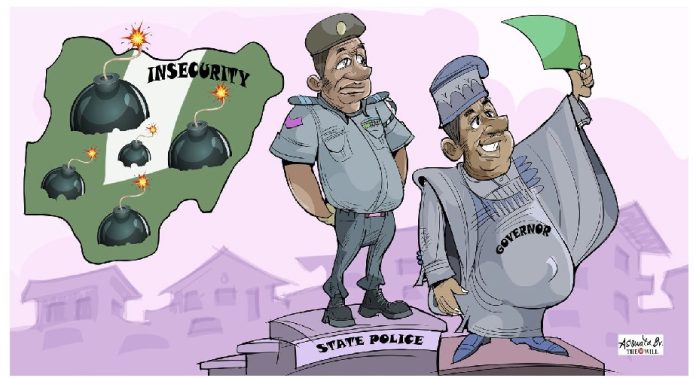
December 15, (THEWILL) – Governor Uba Sani of Kaduna State last Wednesday sounded upbeat about the strong support for state police among majority of his counterparts, but some key stakeholders, many of whom he said would be further engaged after the Secretariats’ panel report and deliberation by members of the National Economic Council, NEC, in January 2025, are very cautious.
He said, “Today, one of the discussions we had at the NEC meeting was the update on the creation of state police. As you are aware, there was a submission by states towards the establishment of state police.
Addressing State House Correspondents after the 147th meeting of the NEC at Aso Rock Villa, Abuja, the governor said, “Thirty-six states have submitted (their reports) minus the FCT. The FCT is not a state; they explained why they have not submitted it. But 36 states have all submitted their own positions on state police. From what is available, virtually most of the states are in agreement with the establishment of state police in Nigeria. I want to say here clearly that most of us are in agreement with the establishment of state police. Most of us agreed that the establishment of state police in Nigeria is the way forward towards addressing the problem of insecurity in our own country.”

Governor Sani further explained that state police is an idea whose time has come because of a severe shortage of security personnel. The security agencies are unable to cover all areas across the 36 states adequately.
“This talk about insecurity and overstretched security agencies as a reason for the establishment of state police is like taking the symptoms for the disease,” National Chairman of the Inter-Party Advisory Council of Nigeria, IPAC, Alhaji Yusuf Dantalle, told THEWILL on Friday. “As a student of sociology, I have come to realise that in Nigeria, we always like to address symptoms of a disease rather than the disease. And in the words of late Chief Obafemi Awolowo, as long as you do not solve the roots of the problems, they will continue to linger. Conventional crimes are symptomatic of social and political arrangement.
“If you follow Robert Merton’s theory of anomie on how people react to social situations, you will find that our challenges in Nigeria are about poverty, inequality and that the government is far away from the people they are supposed to be representing. Yesterday (Thursday) I was coming from Abuja and saw the number of policemen following one politician! Why does he need this level of protection for, against the people who voted him into power? What kind of democracy are we running.”
He contended the view that the army or police is overstretched and canvassed for better weaponry and welfare for security agencies to enhance their performance and professionalism.
“I do not believe the army is overstretched. If you say the military is overstretched, have you found out whether they have the wherewithal militarily? A lot has gone into equipping the military, but why are they not performing? So, there are so many questions to ask. I think the issue of insecurity in Nigeria is more political than policing can solve. Now, look at the State Independent Electoral Commissions and the Independent National Electoral Commission. The same governors that want state police would prevent people they do not want from becoming local government chairpersons. So, should we turn around and now leave state police in the hands of one person who has the local governments in his pocket? So, what happens at the end of the day? For me, state police are anachronistic; it is not an answer to insecurity. There are immediate and remote causes of problems. And there are long term and short term solutions to problems. The state police thing is a short -term solution to the problem. Who are the criminals, who are the bandits? Are they Nigerians? If they are, why do they keep increasing in numbers?”
The Executive Director of Rule of Law and Accountability Advocacy Centre, RULAAC, Okechukwu Nwanguma, speaking with THEWILL at the weekend, said that in as much as there is a need to decentralise the police and ensure the devolution of policing powers and resources to lower levels for enhanced effectiveness, “pushing for state police without addressing the root causes of insecurity, increasing crime and police inability to tackle them effectively would amount to replicating one problem 36 times over.”
“Experience has established that certain state governors will turn state police into their tools for repressing freedom of expression and political dissent. State police will turn some states into police states. But the question needs to be asked. What will be the process of appointments? How will the state be controlled to avoid turning them into playthings in the hands of oppressive governors? How will accountability to the law and the people, rather than the governor, be guaranteed.”
According to him, state police debate has since gone beyond the question as to whether to support it or not since the President, state governors, senior and junior lawmakers and former Presidents have all declared their support.
“The question the stakeholders should concern themselves with at this stage is what can be done to ensure that appropriate and adequate legal and institutional mechanisms are put in place to ensure effective democratic control and accountability, to ensure that state police are established in strict adherence to the principles of operational autonomy based on sound professional practices in appointment, operations and control,” he said, adding that, “I have always posited that centralised police structure is the bane of police effectiveness. But added to that is lack of adequate resourcing for the periodic recruitment to fill the manpower deficit, purchase modern equipment and ensure training and retraining to ensure professional effectiveness and improvement in welfare and working conditions.”
Speaking in an earlier interview with THEWILL on this matter, Managing Director of Beacon Security Intelligence, Dr Kabiru Adamu, said that although there is a general desire for a different security model in the country with state police as the most popular, Nigeria “as a country, still has not differentiated between policing and police.”
Policing, according to him, which deals with the processes that ensure maintenance of law and order, prevention of crime and prosecution of offenders is often confused with police which is all about structure.
Contributing to the debate, Prof Onwudiwe Ihekwoaba in a recent article, titled; “The Future of State Police In Nigeria: A Focus On The Southeast,” published in the African Journal of Criminology and Justice Studies: Vol. 14: Iss. 1, Article 1, 2024, stated that, given the current situation in the country, it is crucial to establish a state police system that empowers each region to address security concerns in collaboration with neighbouring regions.
He contended that by integrating community policing into local police forces and drawing inspiration from successful policing practices in other federal systems, Nigeria can significantly enhance its security framework.
Speaking on the high level of insecurity in the southeastern states of Anambra, Enugu, Imo, Ebonyi and Abia, where “wholesale terror and retail violence make it impossible for the citizens to conduct their daily peaceful activities,” he canvassed that each state ought to be allowed to develop its police under the leadership of its governors, who would appoint the chiefs of police, individual leaders who are knowledgeable about their culture, customs, language, theology, rules and principles, to serve the communities and their local security concerns.
He however advised: “State police mandate should emphasise providing intelligence on offenders, such as kidnappers and other forms of domestic violent actors to the Nigerian Police Force, the Nigeria Security and Civil Defence Corps (NSCDC) and other security agencies, including the State Security Service (SSS) without much fragmentation.”
LONG ROAD TO STATE POLICE
This problem of definition between state police and policing, according to Dr Adamu, appears to be the stumbling block to the implementation of state police in the country.
THEWILL recalls that official support for state police is almost a decade old. And the reasons for support have remained the same – insecurity and criminality space unmanned by security agencies.
During the constitutional amendment processes in 2011 and 2015, for example, state police was agreed upon by all stakeholders as the viable way to address the security challenges in the country. Former Governor Abdulaziz Yari of Zamfara state who was Chairman of the Nigeria Governors Forum in 2018 recounted this position during a two-day security conference organised by the Eighth Senate with state governors, service chiefs, civil society organisations, religious and traditional rulers in attendance.
“Today, we have reiterated the position of the Vice-President (Yemi Osinbajo, who had addressed the conference, saying that having, “state police is the way to go) and the position of the security summit that we held in August that there is a need for state police and we say it is the only answer.”
Then Senate Minority Leader, Godswill Akpabio and Leader of the Northern Senators Caucus, Adamu Aliero, agreed that, “Measures must be taken to stop further killings and the only way to do it is to have a synergy between the security agencies. Even the governors agreed that having state police is the way to go. It is quite consistent with what the Vice-President has suggested,”
Almost in a similar fashion, the House of Representatives organised a national dialogue on state police on April 23, 2024. At the talk, ex-President Goodluck Jonathan and a former military Head of State, Gen Abdulsalami Abubakar (Retd.) and some stakeholders, who supported state police, disagreed strongly with Inspector-General of Police, Kayode Egbetokun, who stiffly canvassed the idea that Nigeria is not matured for state police.
On May19, 2024, the Speakers of the 36 Houses of Assembly in Nigeria hailed processes by the National Assembly to amend the 1999 Constitution to allow for the establishment of state police. The Conference of Speakers of State Legislatures of Nigeria, in a communique signed by the Conference Chairman, Adebo Ogundoyin, said, “The conference strongly advocates state policing to check the negative trend of insecurity in our country. To achieve this, the conference appeals to the National Assembly, the Presidency and other relevant stakeholders to leverage the ongoing constitution review exercise.”
In January 2025, the 148 National Economic Council, NEC, will meet to formally deliberate on the reports of its panel and secretariat on the agreement reached by majority of governors for the creation of state police. According to Governor Sani, it would be one year since the idea was officially mooted under President Bola Tinubu’s administration. The president and governors opened talks on state police on February 15, 2023.
Two days before then, the House of Representatives had entertained a bill, titled, ‘A bill for an Act to alter the Constitution of the Federal Republic of Nigeria, 1999, to provide for the establishment of State Police and related matters.’
In April, the Nigeria Governors Forum joined the bandwagon and called on governors to submit reports to NEC, which subsequently warned delaying states to hurry up with their reports or face sanctions.
Nwanguma told THEWILL that interventions by civil society organisations for serious reform of the country’s current police structure for enhanced operational efficiency has regrettably failed. According to him, in 2006, the Network on Police Reform In Nigeria, NOPRIN, with support from some development partners, conducted extensive research on policing within Nigeria with a view to accomplishing five objectives: Ground law enforcement policy and police reform in the realities faced by the Nigerian populace; document the patterns and prevalence of police abuses of human rights; inform and design of police responses to public safety and security needs; build and inform constituency for effective and accountable policing and finally, enable victims of police abuse to seek redress through internal and external oversight mechanisms.
The research conducted in 14 states over nine months, using representative samples across the six geo-political zones in the country, he said, showed that “the actions and operations of the Nigeria Police Force often contradicted Nigerian laws and increasingly endangered the lives that the police are meant to protect.”
He said, “The Nigeria Police Act, signed into law in 2020 aimed to transition the police from a colonial and oppressive force into a democratic, community- centered entity. However, the recent End SARS protests illustrated the public frustration with persistent police violence and impunity. Despite the enactment of the Police Act, the subsidiary police regulations remain outdated and contradictory, stalling meaningful reform.
Efforts made to contact the Force Public Relations Officer, ACP Olumiyiwa Adejobi, failed he did not respond to calls or text messages. Nevertheless, the Inspector-General of Police, Egbetokun recently stated the Force’s position on state police. At the dialogue on state police organised earlier in the year by the House of Representatives, Egbetokun, had said, “On the issue of state police, it is the submission of the leadership of the Nigeria Police Force that Nigeria is not yet mature and ready for the establishment of state-controlled police.”
Egbetokun, who was represented at the talks by AIG Ben Okolo, suggested that the Federal Road Safety Corps and the Nigeria Security and Civil Defence Corps could be merged with the Police Force to enhance its operational efficiency.
In a swift rebuttal, Speaker of the Lagos State Assembly, whose views represents that of proponents of state police, replied the IGP, stating that Lagos State, which has operated the Security Trust Fund through which successive administrations, starting from that of Asiwaju Bola Tinubu, have provided enormous support to the police command in Lagos, “yet crime of different dimensions has continued.”
In the same vein, many states in Nigeria in what looks like a dress rehearsal for state police, have been providing some form of funding for the police, including provision of operational vehicles, stations, equipment and subventions, yet to no avail, thereby forcing some states like Ondo, Ogun, Oyo, Osun and Ekiti to form a local security outfit, Amotekun, just as others like Edo, Zamfara have formed vigilantes, in their bid to confront security challenges in their region and states.
WAY FORWARD
RULAAC’s Nwanguma noted that as it had been argued in the CSO Panel on Police Reform, “state police should only be established on a basis of strict adherence to the principles of operational autonomy and be based on sound professional practice in appointment, operations and control.”
He added that the principles of the Police Act 2020 should not only be understood by both the police and citizens but also integrated into daily policing practises, thereby promoting a culture of lawfulness and respect for human rights within the police.
IPAC National Chairman, Dantalle insists that the problem is largely one of leadership. “They are not accessible to the people. It is all about money, money, money. The children of an average politician in Nigeria do not attend schools in the country nor do they go to hospitals here. So, you now see how the leaders distance themselves from the people.
“I think what is important is to address the level of social and economic inequality pervasive in the country. These are the urgent things facing Nigerians. As much as I like the idea of having state police, I think what is of vital importance and of urgency is the social and economic lives of the people. All conventional crimes we have in Nigeria are reactions to the social and economic realities in the country. We are arresting and killing criminals, but they keep increasing in numbers.
“The problem of insecurity, if we must address it, we must look at the root of the problem. The high level of unemployment, the hopelessness of the average Nigerian, politically and economically, inaccessibility of Nigerians to good education and health, in short basic needs of life are the challenges facing the country and efforts should be made to resolve them or we would be going around in a circle.”
For Prof Onwudiwe, there must be a willingness by the stakeholders, those with political and economic power, to admit and change the police structure for the maximum happiness and welfare of the citizens. Regions in Nigeria, he said, are connected and have similar security threats and patterns, adding that what affects one region, regarding security threats, directly and indirectly affects other regions. “While decentralisation aims to empower state governments with greater autonomy in law enforcement, collaboration and coordination with federal security agencies remain crucial,” he said.
CLEEN Foundation, an NGO that promotes public safety, security and access to justice endorsed state police but advised that certain measures be followed logically to realise police devolution. These are amendments of relevant sections of the Constitution, ensuring appropriate checks and balances to “safeguard against abuse of power and maintain national unity and cohesion.” Others are capacity building, inter-agency collaboration, community engagement, resource allocation, accountability mechanisms, clear operational framework and public awareness campaign.
“The question the stakeholders should concern themselves with at this stage is what to do to ensure that appropriate and adequate legal and institutional mechanisms are put in place to ensure effective democratic control and accountability, to ensure that state police is established in strict adherence to the principles of operational autonomy, based on sound professional practices in appointment, operations and control,” Dr Adamu, told THEWILL.

Amos Esele is the Editor of THEWILL Newspaper. He has over two decades of experience on the job.
