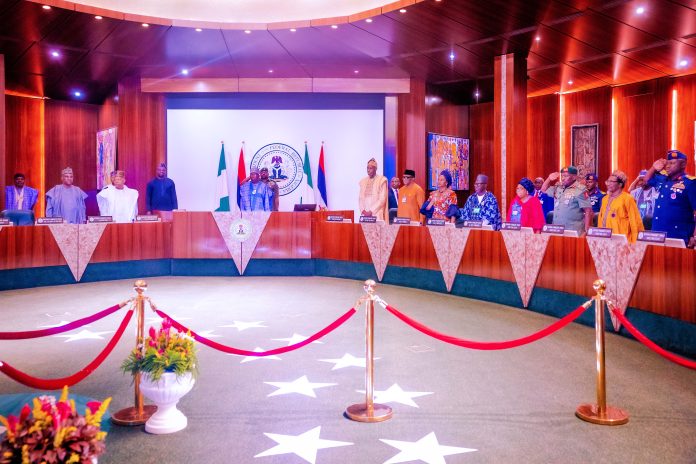
August 29, (THEWILL) — The National Economic Council (NEC) has endorsed preparations for Nigeria’s next Medium-Term National Development Plan (MTNDP) to cover the years 2026 to 2030.
The framework is expected to consolidate ongoing reforms and align Nigeria’s growth trajectory with its long-term targets.
Speaking after Thursday’s NEC meeting chaired by Vice President Kashim Shettima at the Presidential Villa in Abuja, the Minister of Budget and Economic Planning, Atiku Bagudu, explained that the current development plan will end in December 2025, necessitating a seamless transition.

Bagudu said the new national development plan will build on existing policies, deepen continuity, and align Nigeria’s growth trajectory with the long-term goals of Nigeria Agenda 2050.
“The 2026–2030 plan will consolidate current reforms while addressing Nigeria’s new socio-economic realities. It will give shape to efforts around job creation, infrastructure, food security, human capital, and social protection”, he noted.
Bagudu said the process would draw from wide consultations, involving the three tiers of government, political parties, private sector stakeholders, civil society, youth groups, labour unions, and traditional leaders. To guide the exercise, structures such as a National Steering Committee and technical sub-committees will be co-chaired by representatives from both the government and the private sector.
In his presentation at the Council, Accountant General of the Federation Shamseldeen Babatunde Ogunjimi, revealed that the Excess Crude Account (ECA) has dwindled to just $535,823.39. He added that the Stabilisation Account holds N78.45 billion, while the Natural Resources Account stands at N106.72 billion.
Despite the lean balances, NEC proceeded to approving the new five-year strategy, which will succeed the outgoing National Development Plan (2021-2025).
The vice president said the plan will not be developed solely from Abuja but through a participatory process involving state and local governments, the private sector, civil society, labour, youth, and traditional institutions.
Shettima said the new plan, which succeeds the National Development Plan 2021–2025, approved under the Muhammadu Buhari administration, represents a bridge between lessons learnt and Nigeria’s long-term economic ambitions.
“Another major consideration today is the expiration of the National Development Plan 2021–2025 and the preparation of its successor, the Renewed Hope Plan 2026–2030.
“This, to us, is no ordinary transition. It is the bridge between lessons learnt and ambitions pursued. The Renewed Hope Plan will consolidate ongoing reforms, deepen policy continuity, and align our medium-term strategies with the long-term horizon of Nigeria Agenda 2050. It’s a practical roadmap towards a $1 trillion economy by 2030.
“This, to us, is no ordinary transition. It is the bridge between lessons learnt and ambitions pursued. The Renewed Hope Plan will consolidate ongoing reforms, deepen policy continuity, and align our medium-term strategies with the long-term horizon of Nigeria Agenda 2050. It’s a practical roadmap towards a $1 trillion economy by 2030”, he said.
The NEC also reviewed progress on the fight against polio, with encouraging updates from Gombe State Governor, Mohammed Inuwa Yahaya, chair of the NEC Committee on Polio Eradication.
According to him, cases of the circulating variant type 2 polio virus have dropped sharply in 2025 compared to last year—78 cases in 2024 to 42 so far this year. Notably, Kano and Katsina states achieved reductions of over 80 percent, while Zamfara has recorded zero new infections. Sokoto, however, accounted for more than half of this year’s cases, with 13 out of 23 nationwide.
Governor Yahaya said vaccination coverage improved to 84 percent by June, with millions of children immunised in high-risk states. Campaigns also delivered other health services such as nutrition for pregnant women and malaria prevention.
NEC approved upcoming immunisation drives, including a September 11–14 campaign in high-risk states and a nationwide integrated vaccination campaign in October covering children under 14 against polio, measles, rubella, and malaria.
The Council directed deputy governors, as heads of state task forces, to convene meetings before each round of vaccinations, while local government chairmen will lead follow-up mop-up operations. Security agencies were also tasked with providing protection in vulnerable areas such as Sokoto, Zamfara, and Kebbi.
The National Primary Healthcare Development Agency reiterated the need for timely funding to sustain momentum, a call NEC backed by urging the Office of the Accountant-General to prioritise resources for vaccination and other primary healthcare programmes.
Felix Ifijeh is a journalist with years of professional reporting experience. Known for his keen news sense, compelling storytelling and commitment to accurate, impactful reporting, he has built a reputation for turning leads into clear, engaging, and well-structured reports that resonate with readers. His work reflects deep newsroom experience and a commitment to accurate, impactful journalism.