November 14, (THEWILL) – Director of Planning, Research, and Statistics at the Niger Delta Development Commission and prominent Niger Delta activist, Dr. Patterson Ogon, has called on the Nigerian government to move away from its heavy reliance on oil to establish a diversified and sustainable economy.
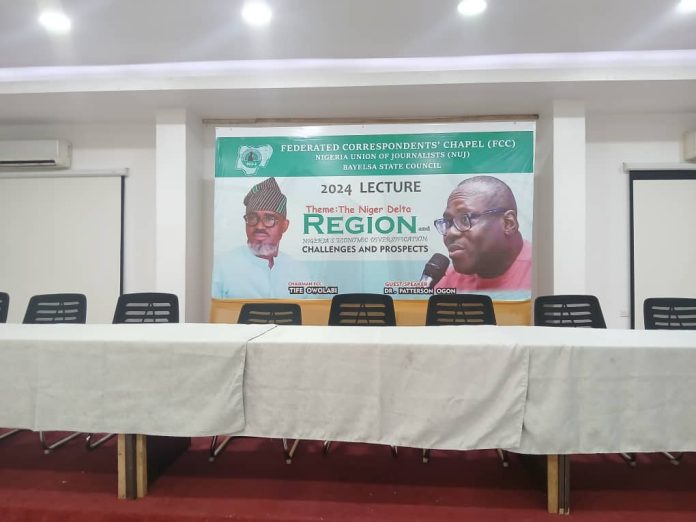
Ogon emphasised this need during the 13th Annual Lecture Series of the Federated Correspondents’ Chapel, Nigeria Union of Journalists, Bayelsa State.
Speaking on the theme, “Niger Delta Region and Nigeria’s Economic Diversification: Challenges and Prospects,” Ogon highlighted the transformative role agriculture once played in Nigeria’s economy before the oil boom.

“Agriculture accounted for 72% of Nigeria’s total national output in 1950,” he noted, listing crops such as palm oil, cocoa, groundnuts, and rubber, alongside fishing and animal rearing as key economic activities at the time.
He urged Nigerian leaders to accelerate the shift towards agriculture and manufacturing, citing these sectors as crucial for a resilient economy and a healthier ecosystem.
“Nigeria’s economic diversification faces multiple hurdles, including a historic dependency on oil revenues, mismanagement of oil proceeds, and the volatility of global oil prices,” he said.
Ogon described the “pains” that accompany oil wealth, stating, “The Niger Delta’s oil riches have brought a complex socio-economic crisis, further exposing the region to global economic instabilities caused by fluctuating oil prices.”
He pointed out that economic diversification is traditionally used to encourage sustainable growth, advocating for Nigeria to embrace similar approaches to move beyond oil.
While acknowledging that the federal government has shown interest in diversification, Ogon lamented that the discovery of oil led to a decline in Nigeria’s productive sectors.
He recalled that in the pre-petroleum era, Nigeria thrived on agriculture, mentioning the historic achievements of the palm oil industry, groundnut pyramids, and cocoa production.
“However, oil revenues caused these once-thriving sectors to lose prominence, and the Third National Development Plan (1975–1980) aimed at diversification had limited success,” he added.
Highlighting the challenges posed by oil dependency, Ogon referred to a 2003 Catholic Relief Services report which stated, “As economies grow more dependent on a depleting resource, oil exporters move from exhilarating booms to painful busts.”
He warned that Nigeria’s oil-driven mono-economy remains vulnerable to global price fluctuations, emphasising that agriculture and manufacturing need an enabling environment to thrive.
In his address, the Chairman of the Federated Correspondents’ Chapel, Mr. Tife Owolabi, underscored the Niger Delta’s pivotal role in Nigeria’s diversification.
“The Niger Delta, rich in natural resources, faces unique challenges that hinder its potential. From environmental degradation to infrastructure deficits, and from socio-economic disparities to security concerns, the region’s complexities demand thoughtful exploration,” he said.

Amos Okioma is a Correspondent at THEWILL