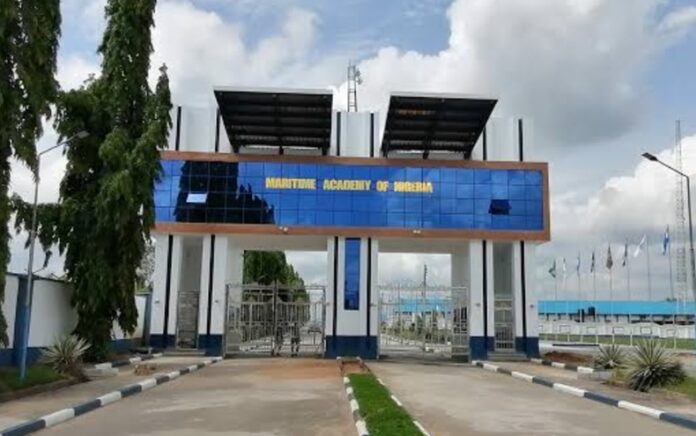
October 10, (THEWILL) — As Nigeria marks 65 years of independence, one institution that mirrors the nation’s own story of resilience, reform and renewal is the Maritime Academy of Nigeria, Oron. Established in 1979 as the Nautical College of Nigeria, barely two decades after independence, the Academy was envisioned to build indigenous manpower for the country’s growing maritime sector and reduce dependence on foreign training.
Over the years, the Academy has faced its share of turbulence; from infrastructure gaps to questions about global competitiveness. But today, it is steadily repositioning itself as a benchmark in maritime education and training in West Africa.
At a press briefing and citizens’ engagement held recently, the Acting Rector of the institution, Dr Kevin Okonna, presented a scorecard of the Academy’s progress over the last ten months of his administration.

Sited on a 100-hectare waterfront campus in Akwa Ibom State, the Academy now boasts some of the most advanced training facilities in sub-Saharan Africa. The installation of a Full Mission Bridge, Full Mission Engine Room and Ocular Vision Simulators has placed the institution in line with the International Maritime Organisation’s standards under the STCW Convention.
Okonna explained that the simulators, acquired in partnership with global manufacturer Applied Research International (ARI), support more than a dozen mandatory and specialised courses. “Most of our simulator-based courses are fully booked ahead of schedule”, he said, noting that cadets and industry professionals are already benefiting.
Beyond simulation, the Academy has strengthened its survival training facilities. The survival pool complex now houses Helicopter Underwater Escape Training (HUET) equipment and a free-fall lifeboat with a launching davit, expanding offshore drill options. These additions, according to the Rector, bring training closer to real-life conditions.
The Academy has also upgraded cadets’ welfare and learning environment. Hostels have been rehabilitated and fitted with solar backup systems, while the institution has reconnected to the national grid after eight years of disconnection — an initiative that has also enhanced public power supply to the host community.
In terms of faculty, the Academy has recruited seven new marine professionals since January, including expatriates with foreign certification. This closes manpower gaps and supports the Academy’s growing portfolio of seven regular cadetship programmes and 48 short courses. Smart classrooms, an expanded ICT centre and a new e-library now complement the modern learning environment.
Staff development has also been prioritised. Seventy-five staff members have undergone training in Quality Management Systems in line with ISO 9001:2015, preparing the Academy for international certification. For the first time since its establishment, a Conditions and Scheme of Service for staff has been developed and submitted to the Office of the Head of the Civil Service of the Federation.
On stakeholder engagement, the Academy has partnered with the National Inland Waterways Authority (NIWA) to host safety awareness sessions and distributed life jackets to local operators. It has also reached out to shipowners’ associations to secure onboard training placements for cadets — a persistent challenge in Nigeria’s maritime education sector.
As of August 2025, over 3,217 industry participants have passed through the Academy’s short courses, compared with 4,595 in 2024. Another 200 cadets are scheduled to graduate in November, all of them registered with international professional bodies such as the Nautical Institute and the Institute of Marine Engineering, Science and Technology, both in the United Kingdom.
Infrastructure expansion is also ongoing, with new facilities including a Marine Exhibition Hall, Medical Centre, Refectory, Guest Houses, Engineering workshops and laboratories. Procurement of additional simulators is underway to meet rising industry demand.
The Academy’s reforms have drawn commendations from the National Assembly. Chairman, Senate Committee on Marine Transport, Senator Wasiu Sanni Eshinlokun, described his committee’s oversight inspection as “nothing short of remarkable”, while Deputy Chairman, House of Representatives Committee on Maritime Safety, Education and Administration, Rt. Hon. Uduak Alphonsus, pledged to push the Academy’s concerns to a logical conclusion.
Minister of Marine and Blue Economy, Adegboyega Oyetola, in his keynote at the engagement, described the Academy as central to government’s manpower development strategy under the new national marine policy.
Despite its progress, the Acting Rector insists that onboard training opportunities remain the Academy’s greatest challenge. “We urgently require sea time placements for our cadets to complement classroom training”, he told stakeholders.
As Nigeria reflects on 65 years of nationhood, the Maritime Academy of Nigeria stands at a critical juncture. From its modest beginnings in 1979 to its current transformation, the Academy embodies the country’s broader struggle for self-reliance and global relevance.
For the graduating cadets set to leave Oron in November, that transformation is not just institutional; it is personal. Their success will ultimately measure the true impact of the Academy’s reforms.