
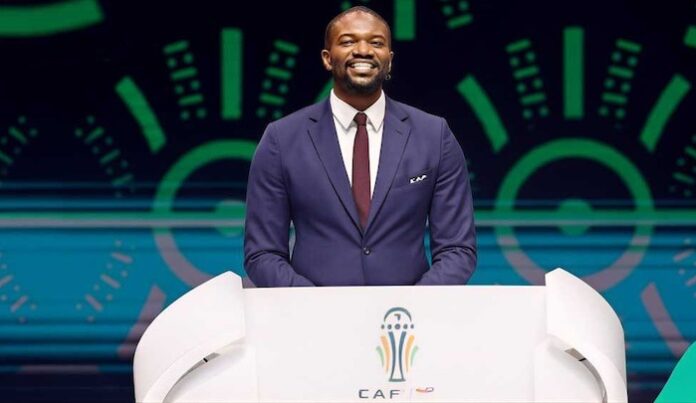
March 30, (THEWILL) — On March 29, 2026, at the Giza Palace Hotel in Cairo, a congress of the Confederation of African Football ratified an appointment that carried the weight of nearly seven decades of administrative exclusion. Samson Adamu, the organisation’s former director of tournaments and events, was confirmed as acting Secretary General, the first Nigerian to hold the position since CAF was founded in 1957. The occasion passed without ceremony befitting its historical significance, yet for those who track the slow redistribution of power within African football governance, the moment was anything but routine.
The immediate trigger was the resignation of Veron Mosengo-Omba, the Swiss-Congolese official who departed the same day, citing a desire to pursue personal projects and contribute to football development in the Democratic Republic of Congo. His exit, however, had a less tidy backdrop. Mosengo-Omba had faced sustained criticism following the 2025 Africa Cup of Nations final, during which Senegal’s title was stripped amid questions about refereeing impartiality and administrative conduct. The controversy had damaged confidence in the organisation’s institutional structures, and calls for reform had grown louder in the months that followed. His successor steps into a secretariat still navigating that fallout.
Adamu’s path to the role was built through operational rather than political channels. Having completed the FIFA Master programme in 2009, he spent years managing the logistical delivery of major continental competitions, including the Africa Cup of Nations and inter-club tournaments. His reputation within the organisation rests on methodical execution and procedural reliability, qualities that CAF’s president, Patrice Motsepe, appears to have weighed carefully. Motsepe confirmed that his vice presidents would oversee the search for a permanent Secretary General, while indicating that he would encourage Adamu to seek the full-time role himself. The interim designation functions, therefore, as both a holding measure and an audition.

The historical dimension of this appointment is not incidental. No Nigerian had occupied the Secretary General’s chair, whether temporarily or permanently, since CAF’s formation, a gap that stretches across 69 years of continental football administration. Nigeria has, of course, produced officials of regional and global standing. Amos Adamu, whose son Samson now holds this role, served on the FIFA executive committee, and Amaju Pinnick, now special adviser to the CAF president, accumulated considerable influence within both bodies. Those roles, significant as they were, did not place a Nigerian at the operational centre of the continental administration. The Secretary General manages daily functions across 54 member associations, overseeing legal affairs, competition scheduling, regulatory enforcement, and the implementation of executive decisions. Whoever holds that office shapes how policy moves from paper to practice across the continent.
The question of what this shift actually means requires careful handling. Symbolic weight and structural power are not the same thing. Voting authority at CAF remains with the congress of member associations, and political direction continues to be shaped by alliances across North, West, Central, East, and Southern Africa. Reports indicate that the appointment did not command universal support across all regional blocs, which points to factional dynamics that the incoming acting Secretary General will need to manage with considerable precision. Nigeria’s presence in the administrative core adjusts the country’s access to internal decision-making, but does not redraw the political arithmetic of the organisation.
What it does offer is proximity. The Secretary General serves as the primary channel of communication between CAF and FIFA’s headquarters in Zurich. That relationship involves the management of international sports law, financial arrangements, and the delicate question of African football’s autonomy within a global governance structure where continental bodies have historically operated under significant pressure from the world body. Having a Nigerian citizen coordinate that dialogue represents a form of access that the country has lacked for the better part of a century of organised football.
The domestic context adds a further layer of complexity. The Nigeria Football Federation held an extraordinary general assembly in Yenagoa just days before the Cairo congress, at which delegates approved revisions to the federation’s statutes, electoral code, and standing orders. The next elective congress has been set for September 26 in Lafia, Nasarawa State. These moves suggest an attempt to regularise governance processes ahead of leadership elections, though the NFF has a well-documented history of disputes over electoral procedure and institutional legitimacy that statutory revisions alone cannot immediately resolve. The contrast between a Nigerian occupying a central continental role and the persistent turbulence of domestic football administration is not lost.
Yet the connection is not without meaning. The Secretary General holds responsibility for CAF’s engagement with member associations, including standards compliance and operational coordination. That engagement creates a pathway through which governance expectations can be reinforced, even if direct intervention in national federation affairs lies outside the remit of the role. The informal influence of a credible Nigerian administrator in Cairo, at a time when domestic reform is actively under discussion, represents an alignment of circumstances that may prove consequential if handled with appropriate restraint.
Adamu also inherits an organisation with an ambitious forward agenda. Plans presented at the Cairo meeting include expanding the Africa Cup of Nations to 28 teams, and the integration of video assistant referee technology into more stages of club competition is continuing. These developments reflect CAF’s attempt to close the commercial and technical gap between African football and football in other global confederations.
His background in tournament delivery positions him to manage that programme with operational confidence, though the broader challenges of financial transparency and institutional trust within CAF extend well beyond competition logistics.
In the end, this appointment will be measured not by historical symbolism but by the condition of the secretariat when the transition period concludes. If competitions are delivered cleanly, if communication between CAF and its member associations improves, and if the organisation makes credible progress on the governance questions that Mosengo-Omba’s departure has brought to the surface, then Adamu’s claim to the permanent role will be difficult to resist. If the acting period is marked by political friction or administrative missteps, the opportunity will pass. Nigeria has waited 69 years for this kind of foothold in African football’s engine room. What the country does with it now is the more consequential story.
Jude Obafemi is a versatile senior Correspondent at THEWILL Newspapers, excelling in sourcing, researching, and delivering sports news stories for both print and digital publications.
