
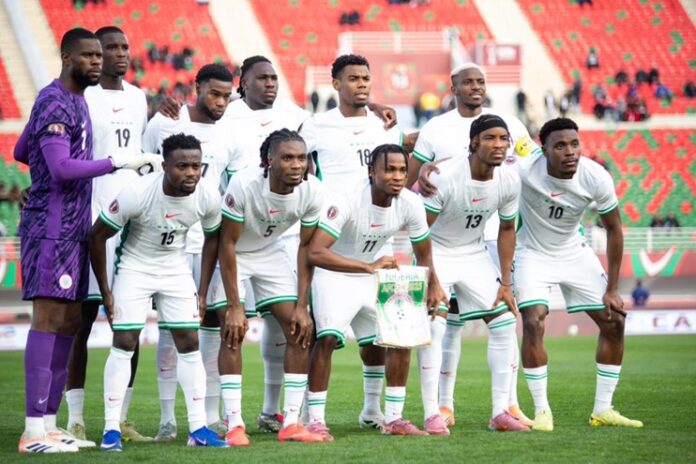
February 22, (THEWILL) — Three months after a penalty shootout in Rabat ended Nigeria’s direct route to the 2026 World Cup, the match result remains the only thing anyone can be certain about. Everything else, from who was eligible to play, to whether the documentation submitted to football’s governing body was accurate, and whether the Super Eagles might yet be reinstated, hangs on a verdict that FIFA has so far declined to deliver.
The Nigeria Football Federation filed a formal petition with FIFA in December 2025, challenging the eligibility of players who featured for the Democratic Republic of Congo in the African qualifying playoff final on November 26. The match, played in Rabat, finished 1-all after 90 minutes before DR Congo won the penalty shootout 4-3, earning their place in the intercontinental playoffs scheduled for Mexico in March 2026. Nigeria, absent from the 2022 World Cup in Qatar, had seen the tournament as an opportunity for redemption. Their petition became an attempt to find a way back in through the rulebook rather than through goals.
The legal argument the federation has constructed is specific and, its officials insist, grounded in evidence rather than grievance. The NFF contends that between six and nine players who appeared for DR Congo did not meet eligibility criteria because they held foreign passports, from the United Kingdom, France and Belgium, while simultaneously appearing under Congolese nationality. The complicating factor is that the DRC’s own constitution prohibits dual citizenship for adults. If those players had not formally renounced their other nationalities, their Congolese passports would, on the NFF’s reading, be legally invalid under Congolese domestic law.

Among those named in reports are Aaron Wan-Bissaka, the West Ham United defender, and Axel Tuanzebe, who plays for Burnley. Both previously represented England at youth level before committing to DR Congo’s senior team. FIFA’s own regulations permit such switches provided a player has not appeared in a competitive senior international for their original association and can demonstrate a legitimate national connection. The NFF’s argument, however, goes a step further: it maintains that FIFA was provided with incomplete or misleading documentation during the clearance process, and that the passports used to obtain that clearance may not have been valid under the laws of the very country issuing them.
Mohammed Sanusi, the NFF’s general secretary, framed the case carefully in December. The responsibility of the international body, he argued, is to clear players on the basis of documents presented by a national association, but if those documents were obtained through a process that contravened Congolese law, the clearances themselves become questionable. This is the distinction on which the entire petition pivots: not whether FIFA followed its own procedures, but whether the information fed into those procedures was accurate.
FIFA acknowledged receipt of the complaint and confirmed that its disciplinary committee had begun a review. Beyond that, the organisation has said nothing. A date of February 16 circulated widely in Nigerian media as the expected day for a ruling, yet it passed without a statement. As of 20 February, neither federation had received official communication from Zurich. Ademola Olajire, the NFF’s director of communications, has repeatedly denied reports claiming that a verdict had been quietly reached, and Shehu Dikko, chairman of Nigeria’s National Sports Commission, confirmed publicly that the matter remained with FIFA’s independent judicial bodies and that no outcome had been disclosed.
FIFA’s 2025 annual arbitration report, published in February 2026, contained no reference to the Nigeria-DR Congo case. That absence has been interpreted in some quarters as a sign the investigation remains ongoing rather than concluded, though the organisation does not disclose details of active proceedings. Experts in sports law have noted that such processes can take weeks or months, and that precedent generally favours the status quo unless a clear violation is established.
The Congolese Football Federation has dismissed the petition as an attempt to claim in a boardroom what was not achieved on the pitch. Their position is that all players were cleared through FIFA’s official channels before the match and that prior approval should settle the matter. They argue, with some justification, that FIFA’s eligibility framework prioritises its own statutes over the domestic laws of member associations, and that if a valid passport was produced, the threshold was met.
That argument has its supporters beyond Kinshasa. Critics within the Nigerian sporting community have pointed out that similar diaspora player switches have gone unchallenged elsewhere across African football, and that holding DR Congo to a standard not applied uniformly elsewhere could look selective. Others have been blunter still, suggesting that the NFF’s energy might be better spent on coaching stability, youth development and the structural issues that contributed to missing 2022 altogether.
The stakes for both nations are far from abstract. Nigeria has the commercial reach, the fan base and the historical weight to regard World Cup qualification as something close to an obligation. For DR Congo, whose last World Cup appearance was in 1974, the March playoffs represent a chance to return to the global stage after more than five decades. A ruling in Nigeria’s favour would, according to the NFF’s understanding of the regulations, see them awarded a three-nil forfeit win and sent to Mexico in DR Congo’s place, where the Leopards are currently scheduled to face either Jamaica or New Caledonia.
The broader implications of whichever way FIFA rules are significant enough to explain the delay. Should the petition succeed, it would establish a precedent requiring FIFA to assess the validity of national passports under domestic law, a principle that could expose any diaspora-reliant squad in countries with restrictive citizenship rules to future challenge. Should it fail, it would confirm that FIFA’s own clearance process is the definitive standard, regardless of what a member state’s constitution might say about the documents used to obtain it.
The 2026 World Cup, expanded to 48 teams and staged across Canada, Mexico and the United States, was always going to produce its share of qualifying controversies. Few, though, have placed football governance under quite this much scrutiny. The silence from Zurich grows louder with each passing week, but when the letter does arrive, it will say far more about the architecture of the sport than about one penalty shootout in Rabat.

Jude Obafemi is a versatile senior Correspondent at THEWILL Newspapers, excelling in sourcing, researching, and delivering sports news stories for both print and digital publications.
